
Introduction
The agile method is an iterative and incremental approach to agile project management and an agile development methodology used by software development teams. It is carried out in a collaborative spirit with just the right amount of formalism and helps deliver high-quality products while adapting to changing client needs.
It is a nice definition, but what does it mean?
Agility is a flexible and adaptable method of project management and a broader agile management approach, not one rigid process. It turns traditional product management methods upside down, where everything is planned from A to Z before anything is produced. For project managers, software developers, and organizations looking to improve product delivery, this makes Agile especially useful when requirements change and customer needs become clearer during the development process.
To put it simply, in agile we cut the large initial project into smaller sub-projects; each sub-project adds value to the product and is useable, creating an iterative development process and an iterative approach to delivery. Then the team works iteratively and incrementally. It means that it focuses on one sub-goal at a time and repeats it cycle after cycle until the end goal is achieved. In the sections that follow, you’ll see the principles behind Agile, the Agile Manifesto, how Agile compares with traditional methods like Waterfall, why Scrum is the best-known framework, and how agile methodologies improve project outcomes.
Let’s understand with an example –
Imagine that you have to develop a mobile fitness application. After clarifying the customer needs with the client and the priorities, split the project into the following –
- Login Page and user profile creation.
- Steps counter, calorie counter, cardio program, weight loss program, body building program, stretching, yoga, guided meditation, and personal coaching.
So, this list represents all the features of the fitness application.
Classic project management approach – We plan the entire project from start to finish, ensuring that each phase is clearly defined and structured. Development proceeds in a systematic manner, with continuous validation at every stage to ensure quality, accuracy, and alignment with the specified requirements. Upon completion, all components are thoroughly tested and finalized. The fully developed and validated project is then delivered to the client as a complete and ready-to-use product. In this process, there is no room for change and a risk of delivering the final product that doesn’t meet the client’s expectations.
Agile Approach – In this approach, agile teams typically work in sprints lasting one to four weeks. The process begins with the initial sub-project, and by the end of the first cycle, the team delivers a functional login page along with user profile creation features. This allows the client to review the progress and provide feedback. Based on the client’s input, adjustments are incorporated in the next iteration. For example, if the client requests a change to the application logo to better reflect the company’s values, the team implements this update while continuing development. In the second cycle, the team also develops an additional feature such as a step counter, alongside the requested revisions. The client is satisfied with the results. He decides to release the first application version to some of his subscribers for testing.
During the third iteration, a calorie counter is added to the application. The client tests the mobile application and, in the meantime, collects information from subscribers, most of whom are stressed and would like priority access to online yoga classes and guided meditation. The client requests the development team to change priority settings. At the end of each cycle, the team plans, analyzes, codes, validates, and delivers the entire sub-project. During the fourth iteration, the online yoga class functionality is added and in the fifth iteration, guided meditation is added. The client then informs the team that they no longer want cardio, weight loss, and strength program features, as the demand is too low for these services. The project team adapts accordingly.
For the last iteration, the client informs the team that they no longer need the personalized coaching functionality and that they would like to add the feature of share on social media networks, to increase the application’s visibility instead. The team plans to follow up in accordance with the client’s request. As the product is divided into several sub-projects, the team can respond much more easily to unforeseen events and client requests, without endangering the whole project.
One important thing to remember is that the product is not delivered at once at the end of the project, but gradually through the sub-projects.
We notice that the final product delivered by the classic approach and the agile method is completely different, despite having the same requirements at the beginning.
As we see in this example, in the agile method, the client is very involved in the project; being almost a part of the team. This creates real customer collaboration between the client and the team, with frequent feedback that helps the team respond in real time, align the product with customer needs, and improve customer satisfaction. Also, the product can be launched in the market with minimum useable features. Agile enables teams to adapt quickly during software development projects.
Why and how was the agile method born?
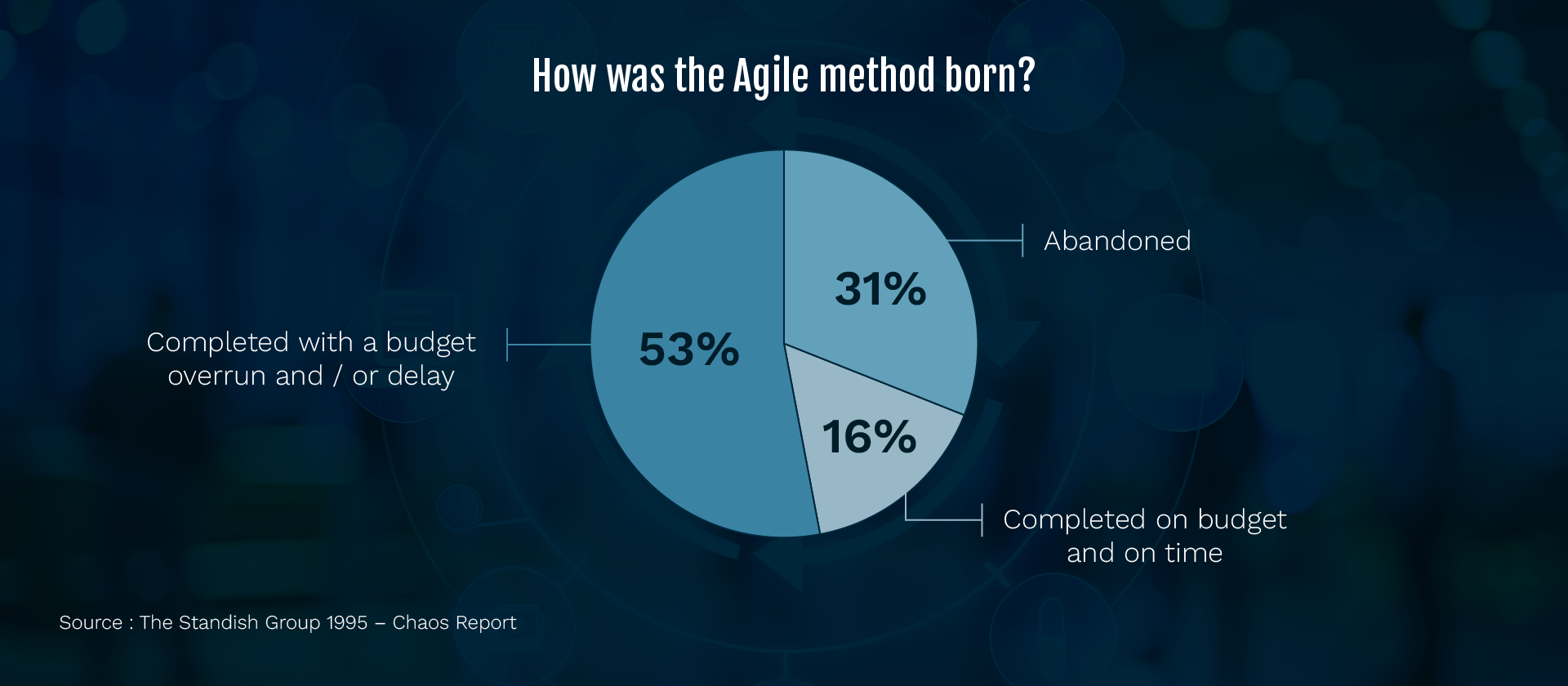
In the 90’s, IT projects often failed. A study published in 1995 showed that only 16% of projects were completed on time within budget,31% projects were abundant, and 53% were completed with a budget overrun and or a delay. There was clearly something that could be done in project management to increase the success rate.
In February 2001, 17 computer developers met in the US to find a new way to develop software. This is where agile approach was born. They pulled their respective methods and created the agile manifesto.
Agile Manifesto
The four core principles of the agile methodology are outlined in the manifesto.
Here is what it says –
“We are uncovering better ways of developing software by doing it and helping others do it. Through this work we have come to value:”
Individuals and interactions over processes and tools
Working software over comprehensive documentation
customer collaboration over contract negotiation
Responding to change over following the plan
This underscores collaboration over contract negotiation as a core Agile value.
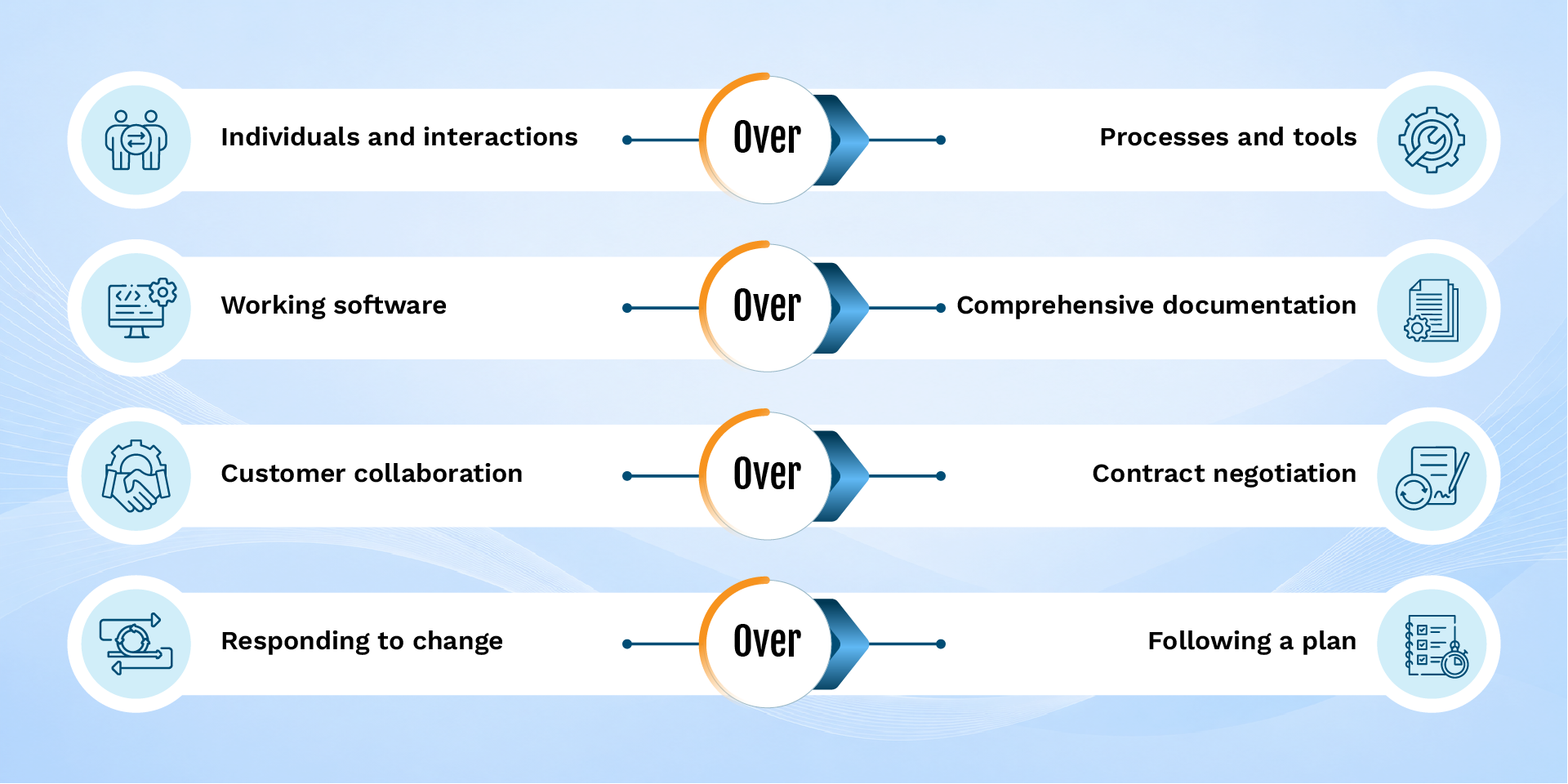
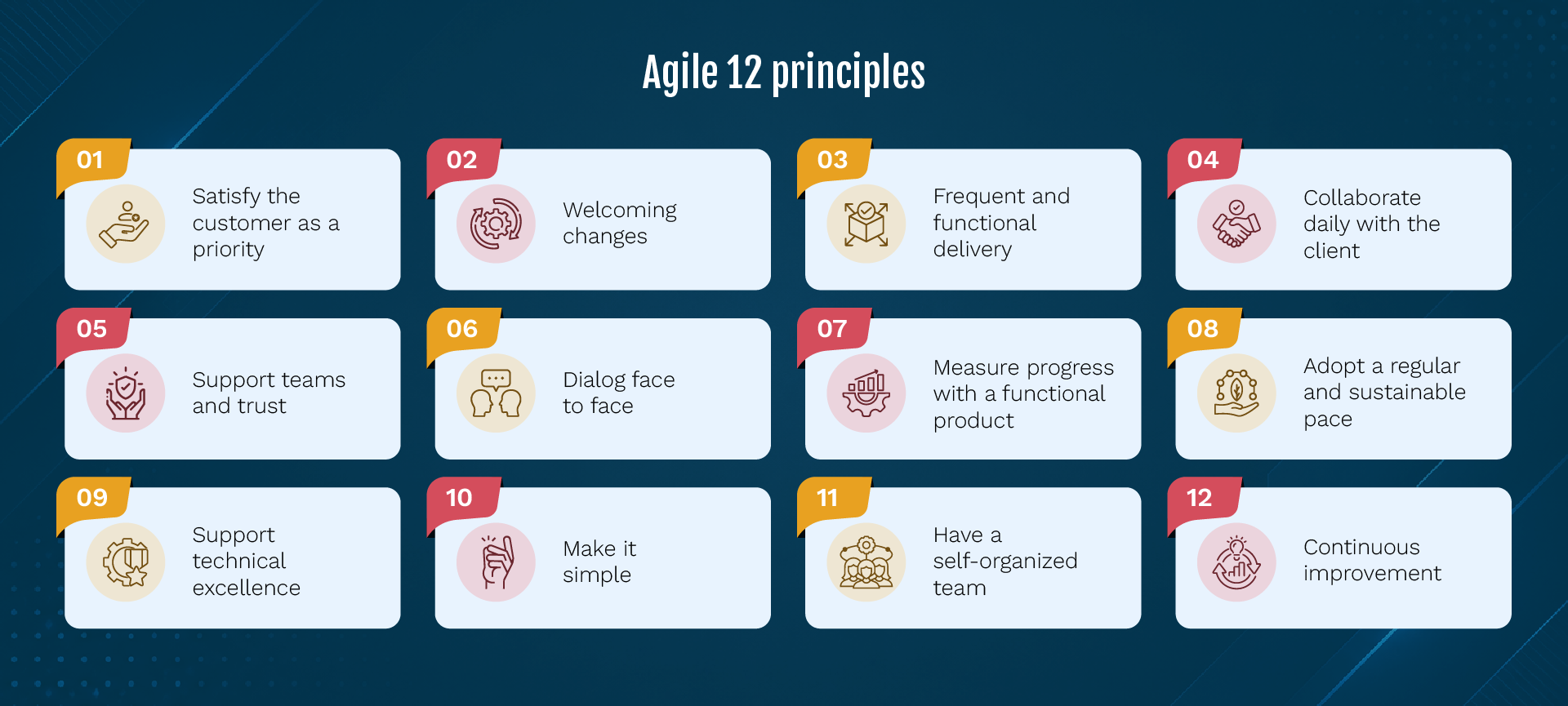
Agile doesn’t ask us to throw out processes, tools, documentation, contracts, or planning, and these priorities are central to the broader agile movement. A common misunderstanding is that agile eliminates these things. Not at all each element is important, but in agile, our greater value lies with those on the left. From these four core values, 12 general principles arise.
Agile vs Waterfall
Now that we have an overview of the agile method, let’s discuss its benefits and why to choose agility? What are the major differences between agility and the old ways.
As mentioned earlier, the agile method is opposed to the so-called traditional methods such as the waterfall method, unlike agile development and the agile process. The waterfall method bears this name because the method follows the logic of a waterfall. The project follows linear and sequential phases. That means they are done in a specific order one after the other. Each phase is dedicated to a specific task that depends on the previous phase. A phase must be fully completed before the next can begin. So, it leaves little room for changes.
Agile allows you to adapt to changes, and this flexibility is one of the key benefits of agile. But what is the main difference between the waterfall method and the agile approach that allows this adaptation?
To understand the difference, we need to understand the Iron triangle. It is a model that represents the three constraints of project management –
- Scope
- Cost
- Time
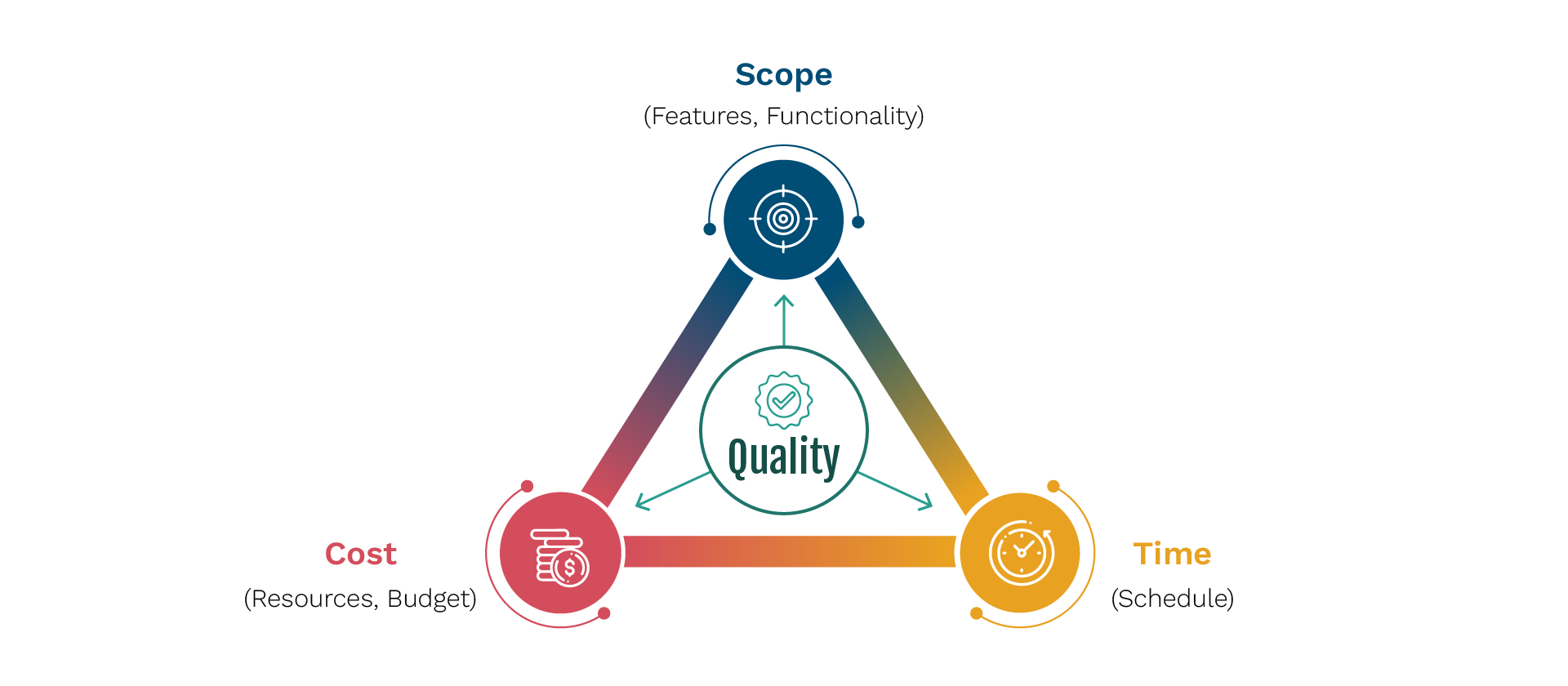
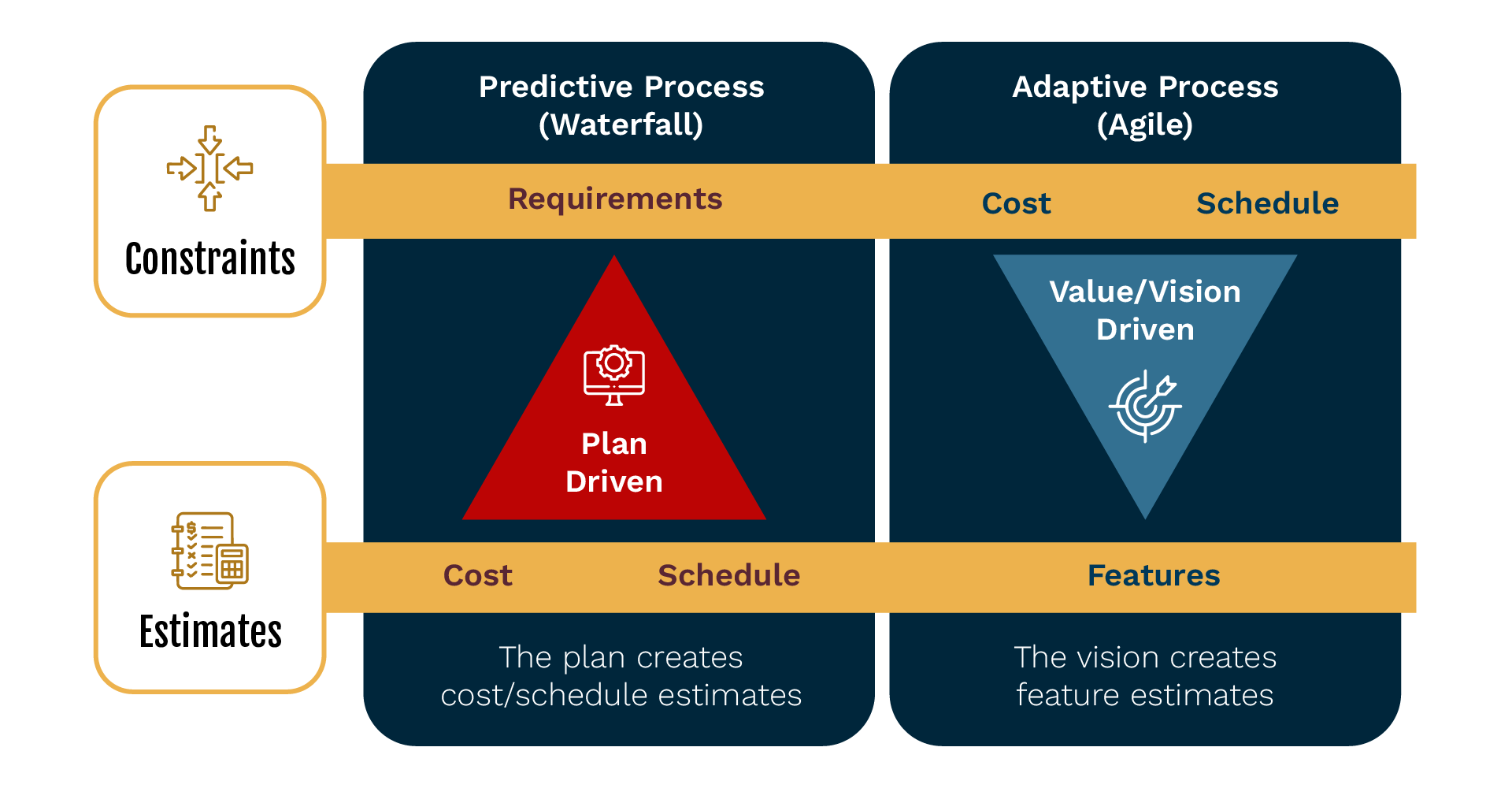
In traditional project management methods, the scope is fixed; the cost and delivery time are estimated. Unlike the waterfall method, agile projects have a fixed schedule and resources while the scope varies. The scope of the project completely depends on the client’s needs.
In agile, the iron triangle is completely overturned.
Waterfall Iron Triangle
- Fixed: Scope (detailed requirements defined upfront).
- Variable: Time and cost (budget and schedule are adjusted to meet the scope).
- Approach: Linear and sequential, with little room for changes after the planning phase.
- Goal: Deliver the exact predetermined scope.
Agile Iron Triangle
- Fixed: Time and cost (fixed-length sprints/iterations and consistent team resources).
- Variable: Scope (prioritized based on value, allowing for flexibility and changes).
- Approach: Iterative and incremental, with frequent client feedback.
- Goal: Deliver the highest value, quality product within the constraints.
Advantages of using the Agile method –
The advantage is that through continuous delivery, the product can be tested by the end user quickly in usable increments rather than waiting until the end. If the user does not like the product or there is no demand for the product, then we can change direction or pivot.
Another advantage is that the client has more visibility on the project progress and costs as he is updated about the budget at the end of each step.He can therefore make informed decisions to stop or continue the project. Agile also adopts a continuous improvement approach so that its productivity increases cycle by cycle, while improving visibility and learning throughout the software development process.
Agile Methodologies in agile project management
Agile or agile method, refers to the concept of agility. Agile methodologies designate the frameworks and practices for implementing the concept of agility. There are many methodologies that allow management of agile projects. Agile software development includes multiple frameworks you can implement to increase the efficiency of your processes.
Agile frameworks –
- Scrum
- Kanban
- eXtreme Programming
- LEAN
- Crystal Clear
- Feature Driven Development (FDD)
The most popular is scrum, to the point that people sometimes mistake it for agile itself.
Scrum in project management
Scrum is a framework that was defined in 1995 by Ken Schwarber and Jeff Sutherland in the scrum guide. It is one of the most common agile project management frameworks used by agile teams, especially software teams. They do not explain how to specify, develop or test a product, but provide a framework with –
- Specific roles
- Events
- Artifacts
- Rules
The core principle of scrum is adaptability – allowing teams to adjust project direction as work evolves, which helps support complex projects. Scrum is based on breaking down projects into iterations called sprints. They are events of fixed duration of one month or less, during which the team focuses on a goal that adds value to the product.
Let’s understand how to work in scrum –
1. Scrum Team – The scrum team has two important characteristics; it is built as cross functional teams and self organizing teams. Scrum teams are made up of three different roles –
- Product Owner: The Product Owner (PO) is the voice of the client. Their role is to maximize the value the scrum team brings to the product with each sprint, and agile teams rely on empowered team members with clear responsibilities.
- Scrum Master: They act as a coach who helps the scrum team and the organization to understand the scrum theory and to put it into practice.
- Developers: They work on product development in an incremental way, and Scrum is widely used by software development teams working on software systems and software development projects.
2. Stakeholder – Individuals who care about the team’s work and the product development. They interact with the scrum team but are not part of it.
3. Product Backlog: A prioritized list of project needs, comprising different user stories, representing the objectives to be achieved by the team. The PO oversees creating, prioritizing, and updating the product backlog.
3. User Story: This is a functional request from key users of the product. It describes in a very simple way a feature that adds value to the product.
4. Sprint / Iteration: It is a cycle, lasting a month or less, which repeats itself. Each sprint is a full scrum event and contains four other scrum events, supporting iterative development and continuous learning.
- Sprint Planning: This is a sprint planning meeting. It consists of selecting elements of the product backlog to be carried out during the following sprint.
- Daily Scrum / Daily Stand-Up: Daily meeting of less than 15 minutes allowing developers to discuss the sprint’s progress, identify blocking points, synchronize, and share progress with team members.
- Sprint Review: This is a working meeting where the team presents the work done during the sprint to stakeholders and especially to the client. This is the opportunity to collect feedback and discuss the next steps of the project.
- Sprint Retrospective: This is the opportunity for the team to discuss the work process. The goal is to inspect the progress of the current sprint and to think of ways to improve the quality and the efficiency.
Backlog refinement – It is not part of the official scrum events, but the scrum team uses it a lot. The purpose of the backlog refinement is to clarify the elements of the product backlog so that they are ready to go into the next sprint.
Story Point: This is a unit of measurement that is used to estimate the overall effort to fully implement a user story.
Planning Poker: The technique to estimate the tasks to be performed. Each item in the product backlog is estimated collectively. This method gives a playful aspect to the estimation process.
Agile is more than a method or a practice. Agile is, above all, a philosophy. Project teams must change their mindsets and get rid of old reflexes to be agile. Where agile is effective, is when the project team and management change the way they work, collaborate, and communicate, while allowing teams enough autonomy to adapt.
Know More: Devops Services
Frequently Asked Questions
Q. 1 What is the main difference between Agile and waterfall methodologies?
The waterfall methodology adopts a linear, sequential process, where all requirements are specified at the start, making changes challenging. Agile uses an iterative, incremental method, enabling teams to adapt to evolving requirements through ongoing feedback, collaboration, and agile techniques.
Q.2 What are the most popular agile frameworks?
Some widely used agile frameworks include –
Scrum is a framework that divides work into fixed-length sprints with regular reviews. Kanban visualises work on a board, and limits work in progress to manage flow. Extreme Programming (XP) emphasises customer involvement, frequent releases, and strong technical practices. Lean streamlines processes by eliminating waste and enhancing value. Crystal Clear focuses on small teams, frequent delivery, and improving team communication. Feature-Driven Development (FDD) organises development by designing and building features in short, iterative cycles.
These frameworks and methods apply to projects outside of software development. SCRUM is the most widely implemented framework among software teams.
Q.3 Why is Scrum the most commonly adopted framework in software development, and how does it relate to agile?
Scrum ranks among the most widely used agile frameworks for project management and delivery. It organises work into defined iterations called Sprints and assigns specific roles, such as Product Owner, Scrum Master, and Developer, to maximise team efficiency and promote ongoing improvement.
Q.4 Why do organisations prefer agile methodologies?
Organisations prefer agile methodologies because they –
- Accelerates product delivery.
- Encourages customer collaboration.
- Enable teams to adapt easily to changing requirements.
- Increases transparency and project visibility.
- Supports continuous delivery, which can improve customer satisfaction.
Q.5 What is test-driven development in Agile?
Test-driven development is an agile quality practice within Extreme Programming that uses tests first to guide development and validate each increment.
Q.6 What is Adaptive Software Development?
Adaptive software development is an agile approach centred on continuous learning and adaptation as requirements and solutions evolve.