An Overview
Cybersecurity is no longer optional, it is a strategic necessity. When the gaps are found, picking the best fit from an array of available solutions is the only way to move ahead. Engineering teams are advancing faster than ever, yet the cybersecurity threats keep catching up, targeting the exact layers that product companies rely on the most: APIs, pipelines, dependencies, and Cloud infrastructure. The market is crowded, the promises appear identical, picking the wrong provider is costly. Getting it right transforms how confidently the team can build and deploy. This guide is designed to help with exactly that aspect.
Security Gaps a Product‑focused Provider Should Solve
Most cybersecurity providers aim at protecting infrastructure, networks, endpoints, and servers. This is useful, but for product engineering teams, infrastructure coverage is only part of the risk because product security focuses on what is being built and how it is being built. The real issues reside within what is being built and how it is being built.
Security is built in, not added at the end- The costliest vulnerability isn’t the one attackers discover, it’s the one introduced during a sprint and overlooked until it reaches production. The right provider integrates security into the development process, includes automated checks in the pipeline, and considers threat modelling during design, not just a scan the week before release. It should also reinforce secure coding practices and broader coding practices with automated security testing and ongoing security testing in ci cd, so development teams get support without slowing delivery. By 2026, 60% of organizations will require product teams to adopt secure-by-design practices to avoid falling behind competitors and losing customer trust.
Visibility into all the product dependencies- Modern codebases are built from open-source libraries, third-party SDKs, and external APIs, dependencies the team does not fully control. If one of the software libraries becomes vulnerable, this is something to be aware of before the next product update goes live.
API and Cloud security that matches the actual build- APIs are the most exploited and least protected surface. Cloud environments change every time someone pushes a commit. Common challenges here include the pressure to deliver secure-by-design products without slowing innovation and the complexity of attack surfaces across cloud, IoT, APIs, and embedded systems. An incorrectly configured access role can create serious security risks very quickly, and weekly security checks may not detect it in time.
Vulnerability prioritization engineers can act on- Not five hundred findings with no context; just clear guidance on what to fix in one particular sprint, why it matters, and exactly where to find it. Good vulnerability management should catch security vulnerabilities early and give engineers actionable context.
Security fits inside the workflow- The right provider embeds security practices inside GitHub, GitLab, and Jira so development teams can work in their usual tools, not outside the process waiting for things to pass through. A general-purpose provider defends the perimeter. A product-focused one safeguards everything from the first line of code to the customer’s screen.
Secure boot and firmware integrity- The device should only run firmware that has been signed and authenticated. If someone can flash unsigned code onto the hardware, all the security measures become pointless.
Regulatory Compliance to Assess Before the Search Starts
Most provider searches begin with a shortlist. They should start with an honest assessment of where the product engineering environment actually stands before asking anyone else to fix it, ideally using a structured framework such as the NIST Cybersecurity Framework to guide that review.
Taking 20 minutes to answer these questions will save one from choosing a provider built for someone else’s problems:
| What to Assess? | Why It Matters Before the Search? |
| What are you actually protecting? | APIs, pipelines, dependencies, staging environments, not just servers. Try to list them out. |
| How is security currently included in the development process? | Knowing the current maturity determines whether you need basic hygiene or advanced SDLC integration |
| What’s your specific threat reality? | Every business has unique security risks, so security solutions should be tailored to those specific threats and informed by threat intelligence to keep pace with evolving threats |
| What security debt are you carrying? | Understand the current security gaps, including compliance gaps, before a cybersecurity provider starts working on the system |
| What does your team own vs. the provider? | Set clear security responsibilities early to avoid friction later |
| What does success look like for the year? | Set clear security goals early so you know what you want to achieve |
| Secure boot, hardware-based key storage, and disabled debug ports | Many providers focus only on software and may lack IoT hardware security expertise. |
The clearer the goals, the better the decision in the end. A provider who bases their proposal on an incomplete view of the environment will underestimate, underdeliver, and nothing will change.
Key Selection Criteria for a Cloud Security Product‑based Security Provider
Most vendor evaluation checklists are similar. Features, certifications, pricing, references, yet organizations still end up with products that don’t quite fit. The problem isn’t the checklist. It is what is missing from it.
When assessing a product-based security provider, focus on how well they understand the product environment, not security in general. A provider who can speak the stack across multi-cloud environments, including how cloud security providers secure cloud services, APIs, and DevOps pipelines, will provide the right recommendations.
Assess security maturity within SDLC. Can they assist with threat modelling, secure design reviews, and integrate into the existing pipeline? The top providers embed security into the engineering workflow, not as a disruption at the end.
Scalability is important too, but not just in terms of volume. CSPs help manage data, applications, and infrastructure safely across growing cloud environments without sacrificing performance or maintaining compliance. As a product develops across cloud or regulated environments, the security provider should also evolve with it, without always having to specify that it is a new engagement. That includes continuous visibility, compliance monitoring, threat detection, and threat protection, supported by real time threat intelligence, as practical selection criteria as complexity grows and multi-cloud adoption increases; buyers may even compare platforms from Palo Alto Networks or Palo Alto at a high level.
Finally, assess their mindset. Are they a vendor identifying problems, or a partner assisting in solving them? The difference becomes evident in every interaction. The right provider doesn’t slow a product down; they make it harder to break. They should also be able to detect threats in complex cloud infrastructure and support ongoing monitoring and continuous monitoring as risks evolve.
If a product includes physical devices, a provider who only understands Cloud and application security will overlook where the real risk lies. The need is then for someone with real experience in firmware security assessments, secure boot implementation, hardware penetration testing, and OTA update protection.
Common Mistakes Teams Make When Choosing a Provider
- Engineering teams are great at evaluating technology. Evaluating vendors is a different skill and the gaps often show up at the worst possible time.
- Treating security as an IT problem, not a product problem. Many teams choose providers that focus on network monitoring or SOC services without verifying their understanding of APIs, SDLC, or Cloud-native environments, creating poor fit that can raise exposure to cyber threats and data breaches as business outcomes. The result is security that feels entirely disconnected from how the product is actually built.
- Getting impressed by the demo, not the delivery. Every provider looks sharp in a controlled demo. What matters is what happens after the contract is signed, the point of contact, their speed of response, and whether they can deliver rapid response times and the right security services in practice.
- Features over fit. A long feature list means nothing if the tool doesn’t integrate into the pipeline, workflows, or issue-tracking system, and many teams overbuy disconnected tools even as the market shifts toward platformization. Adoption gaps can quietly become security gaps.
- Allowing procurement to lead the decision-making. When cost is the main criteria, technical suitability gets overlooked, so teams should also check sector experience, industry certifications, and a proven reputation instead of relying on generic vendor claims. The cheapest provider, who misses critical vulnerabilities, will cost far more than the budget gap.
- Confusing compliance with security maturity. Helping one pass an audit is not the same as helping to build secure products. Compliance is a minimum, not an end point and good providers recognize the difference, especially when choosing a partner with relevant market experience rather than broad claims alone.
- Bringing in security too late. Waiting for an incident or an upcoming audit to engage a provider means missing the most cost-effective window, threat modeling, secure design reviews, early-cycle testing.
- Ignoring hardware and firmware security. Teams building IoT, embedded, or medical devices often do not invest enough in HW/FW protections, assuming that Cloud-side security is enough. A strong provider helps treat the device, firmware, and Cloud as a single security plane, and not as three separate worlds.
Best Practices Selection Checklist
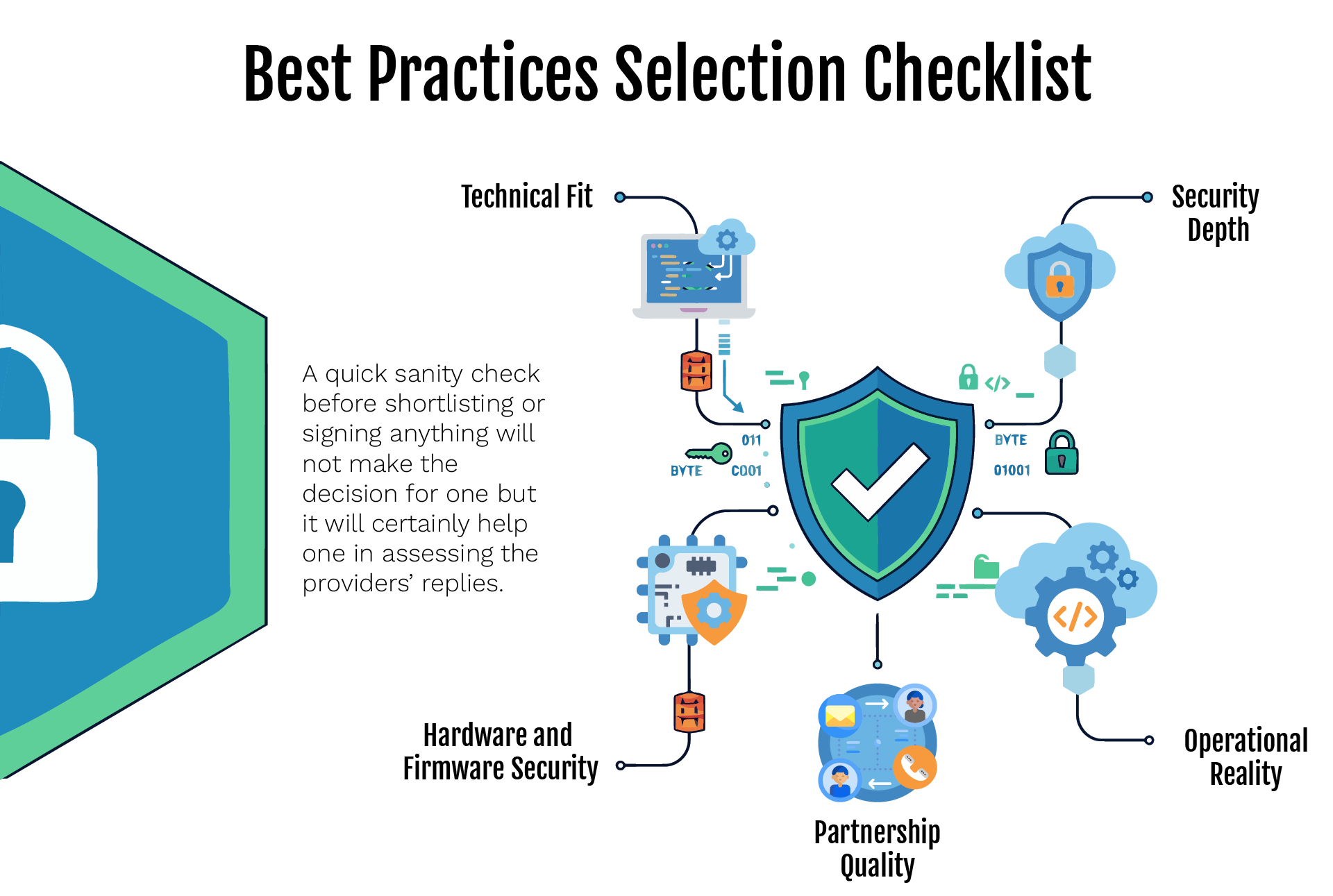
A quick sanity check before shortlisting or signing anything will not make the decision for one but it will certainly help one in assessing the providers’ replies.
Technical Fit
- Do they understand the architecture, such as Cloud-native, APIs, IoT, or embedded systems?
- Can they integrate with the Git, and DevOps tool chain seamlessly without creating a parallel workflow?
- Have they previously worked with products at the current stage and complexity?
Security Depth
- Do they support threat modelling and secure design reviews, not just end-of-cycle testing?
- Can they run SAST/DAST/SCA within the existing pipeline?
- Do they prioritize vulnerabilities based on business impact, not just severity scores?
Operational Reality
- What does onboarding actually involve, in terms of the timeline, setup, and internal effort on their part?
- Do they have defined SLAs for incident response and critical vulnerability disclosure?
Partnership Quality
- Do they communicate in developer-friendly language or stick to generic risk terminology?
- Will they work within the release schedule or treat security as a hurdle?
- Can the provider improve security without slowing down product development?
Hardware and Firmware Security
Check if your team has:
- Verified that the provider has conducted firmware security assessments for similar products
- Asked for examples of secure boot, OTA update security, and hardware root of trust implementations they’ve reviewed
- Confirmed that they can perform hardware penetration testing debug port exploitation, side-channel analysis, firmware extraction
- Ensured that they understand the security implications of the specific hardware platform and chipsets
Conclusion
Selecting the right cybersecurity provider is not something to be rushed. The cost of a bad decision is not just financial; it is the downtime and stress. Everything in this guide comes down to one simple idea: knowing what is needed before one starts looking, asking the questions that are genuinely hard to fake answers to. Taking the time to choose, using the checklist to cross-check, and choosing someone who can actually help when things go wrong. Remember, the choice is not just of a vendor but of a long-term partner.