

Introduction
With the rapid advancement of technology, many of the digital walls we rely on for protection are no longer effective. Hackers have become more intelligent, systems have grown increasingly complex, and the challenge of defending against attacks is expected to surpass the combined capabilities of technology and government alone. The European Union Cyber Resilience Act (CRA) has been designed to mitigate these gaps and to safeguard digital products. The European Commission introduced the CRA as part of broader EU legislation to address cybersecurity challenges across the internal market.
The CRA legislation introduces wide-ranging changes to how businesses develop and market their digital products. It aims to harmonize cybersecurity standards and protect digital products across the EU, placing a strong emphasis on resilience and continued improvement, from initial development through the product’s end-of-life and disposal.
What the Cyber Resilience Act Actually Does?
The CRA is a regulation designed to take control of products with digital elements, including both hardware and software, before they reach retailers and to protect them during their entire life cycle and beyond. This means that manufacturers are responsible for the security of their products, and developing secure digital products is no longer just a recommendation – it is now a requirement. The secure cyber resilience mindset shifts how we view the development process; security must be built into new products at the time of development as opposed to being added later.
The CRA outlines different risk categories related to hardware and software; thus, firms that manufacture products with digital elements are required to comply with its cybersecurity requirements. Digital elements refer to both hardware and software components that are connectable and can be vulnerable to cyber threats. The CRA introduces horizontal cybersecurity requirements, which are broad standards applying across different product categories to ensure a unified approach to cybersecurity compliance.
The CRA requires digital products—and the firewalls, servers, and systems that host or manage them—to remain secure against cyberattacks for as long as they are sold to end users. Additionally, the CRA establishes common cybersecurity standards for digital products to ensure security throughout their lifecycle.
The CRA mandates that all digital products (i.e., IoT and others) have adequate built-in defenses and protections against current and future threats that are likely to arise as new computer security techniques are developed by those who intend to breach security of digital networks. By harmonizing cybersecurity across the EU market and internal market, the CRA ensures consistent protection and compliance for all stakeholders.
Key Provisions of the CRA: A Technical Deep Dive
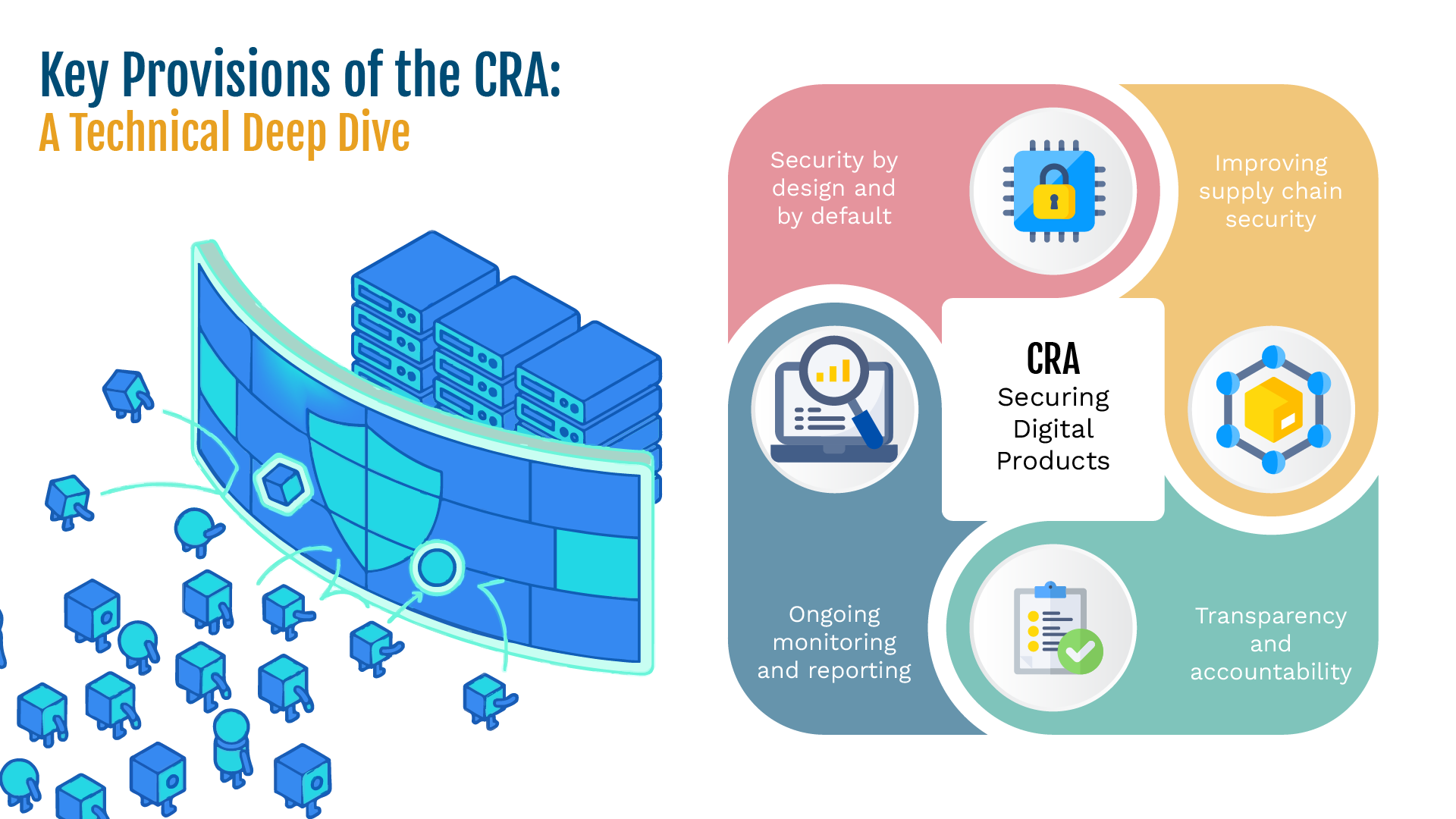
1. Security by Design and Default
Forget the old way, where security gets added at the last minute. The CRA demands that security is baked in from day one. Software developers play a crucial role in ensuring security by design for programs and digital components, making sure that both hardware and software are protected from the outset. That means things like strong passwords, encryption, and safe software are not just nice extras; they are standard. The goal is to catch weaknesses early and tackle risks before they become disasters.
Take hardware, for example. The law mandates devices to have built-in features like secure boot and Trusted Platform Modules (TPMs). These ensure only approved software runs, blocking malware and ransomware right out of the gate. Security updates are required throughout the product’s lifecycle to address vulnerabilities as they arise, ensuring ongoing compliance and protection.
2. Securing the Supply Chain
Today, risks do not just come from your own product. They come from everywhere, including your suppliers. The CRA seeks to rebalance responsibility among manufacturers, importers, and distributors in the supply chain, forcing every supplier who deals with hardware or software to meet strict security rules. This is huge for IoT, where a single device might have parts from a dozen different companies, each bringing its own possible vulnerabilities.
So, manufacturers need to check every link in their supply chain, run risk assessments, and audit vendors for cybersecurity compliance. Effective risk management and maintaining proper accounts are essential for supply chain security. The CRA addresses vulnerabilities that can arise from interconnected supply chains, ensuring a more secure and transparent process.
3. Nonstop Monitoring and Fast Reporting
Companies cannot just hope things go smoothly. The CRA requires continuous 24/7 monitoring of cyber threats and sets strict reporting obligations for manufacturers to notify authorities of incidents within specified timeframes, typically major incidents must be reported within 24 hours. That means setting up advanced monitoring systems, such as SOCs and SIEMs, to catch problems fast.
Manufacturers must maintain security logs and conduct regular audits, making sure they are always ready to prove that they are following the rules. Enforcement mechanisms, such as market surveillance and penalties for non-compliance, ensure that authorities can verify adherence to these requirements and take action if reporting obligations or other standards are not met.
4. Transparency and Responsibility
The law does not let companies hide behind vague promises. They must be upfront about what security features their products have, what bugs or vulnerabilities exist, and how updates affect the product. Consumers must have access to clear information about product security features and known vulnerabilities, enabling them to make informed decisions. Every patch, every fix; they all need to be clearly explained, including any risks.
This pushes companies to create better documentation and be more open about their cybersecurity. Some companies may even provide certificates or risk reports for each product, giving customers a clear view of both what they are getting and the potential risks involved.
The Broader Impact: Why the CRA Matters
The CRA has a broader impact than just affecting how individual companies are required to build secure products and how a company must design those products (shift from a reactive approach toward cybersecurity to a proactive approach). By doing so, all organizations working within the cybersecurity industry can participate in creating products that are fundamentally more secure and resilient to cyberattacks. Cyberattacks on digital products can cause severe disruption to economic and social activities, and in some cases, even be life threatening, especially when vulnerabilities in connected devices impact critical functions.
Additionally, the CRA provides the technology sector worldwide with a model for how other regions might develop their own cybersecurity frameworks in the future, for instance, using the EU’s approach as a basis for creating standards as cyberattacks grow more sophisticated. The CRA’s approach can serve as a model for securing such products globally, including sensors, meters, PCs, smartphones, and IoT devices.
Another way the CRA responds is by highlighting that security is now a primary focus rather than an afterthought, while also addressing growing consumer demand for safe digital devices. The threats posed by the increased security vulnerability through data breaches and identity theft have made the public aware of how insecure devices are and the requirement to have more secure devices. Social activities and community engagement play a crucial role in promoting cybersecurity awareness and fostering a culture of security. The CRA is expected to help businesses rebuild customer trust.
Challenges and Opportunities Ahead
There is a long road ahead for both the industry and the government –
Organizations must implement new requirements introduced by the CRA, which can be challenging on a large scale. While the introduction of the CRA creates a significant opportunity for progress, it is not an easy path. The Act requires organizations to completely rethink how they build their products. Every manufacturer must take the additional required steps of developing new security measures and incorporating them into their current offerings. Additionally, all manufacturers must invest their resources upfront to ensure that they have a built-in level of security. However, the return on this investment is much greater than simply ticking off a checklist. The substantial expense of implementing an ineffective measure is accompanied by significant losses to your organization in the form of reputational damage and financial loss associated with product recalls, cyberattacks, and other related issues.
As the emphasis on security increases, organizations are required to hire qualified individuals to fulfil the growing expertise demand. Education and ongoing training in cybersecurity are crucial for both individuals and organizations to meet CRA compliance. Engaging with and supporting communities, especially within the open-source ecosystem, can also help organizations navigate new requirements and share best practices. Expect the demand for product security experts, supply chain risk experts, and incident management experts to continue to rise.
Future Scope of the CRA
In the future, the CRA is expected to change not only the way we define compliance, but the entire digital environment, much like the impact GDPR had on the privacy landscape. The final version of the CRA will enter into force after it is published in the official journal of the EU, marking the start of its binding regulatory obligations. Globally, governments are expected to follow the path set by the EU in implementing the CRA, and before long, “CRA-compliant” or “CRA-certified” is set to be commonplace as a quick way to indicate that a device is designed with your security in mind. Moreover, the “tightening” of supply chains is going to be a byproduct of organizations having to provide assurance of their security capabilities before being trusted by buyers.
The adoption and implementation of the CRA relies on political agreement among EU institutions and active participation from member states, which are responsible for enforcing the regulation and harmonizing cybersecurity standards across the internal market.
The CRA also addresses open source software by introducing specific provisions and exemptions for open source communities, recognizing their unique role and the challenges they face under the new regulatory framework.
Final Thoughts: A Rallying Cry for the Digital Economy
Opportunities are increasing for people to focus on the digital economy, giving the Cyber Resilience Act a platform and room to grow. The CRA is not just a governing law; it is a unifying call to action for the digital economy. Businesses should take time to re-examine their methods of doing business with a cybersecurity-first focus on designing and developing products, rather than product life cycle. The CRA not only gives businesses an opportunity but also places a responsibility on them to lead in creating and delivering secure, trusted products, while safeguarding retailers and the critical assets of their industry.
As we move toward a more interconnected tomorrow, the Cyber Resilience Act lays out the groundwork for a safe and resilient digital world in which cybersecurity is embedded in the DNA of product development and throughout the product life cycle.
The Cyber Resilience Act (CRA) guidance continues to evolve, based upon regulatory requirements, product classification, and the ongoing urgency to remain current; therefore, it is mandatory for manufacturers and their appropriate support/development teams to periodically review the CRA.