
Introduction
Artificial Intelligence (AI) is an integral part of product engineering and development these days, making AI governance non-negotiable to operate with AI in the development of products. Pressure on engineering teams continues to grow as they work to meet regulatory requirements, ensure data integrity and security, demonstrate AI explainability, and still deliver innovative products at speed. Recent research shows that 77% of companies are actively working on creating AI governance programs and that number is close to 90% for companies that use AI. This demonstrates how AI governance went from being an afterthought to being strategic, as companies are creating governance frameworks even if they have not yet started to implement AI. [1]
While companies are creating governance programs, the product engineering ecosystem today at large is still without governance. This blog discusses operational governance practices that product engineering teams can adopt today to embed governance by design without slowing delivery.
AI Governance Must be Part of Development Lifecycle – More than Afterthought to Compliance:
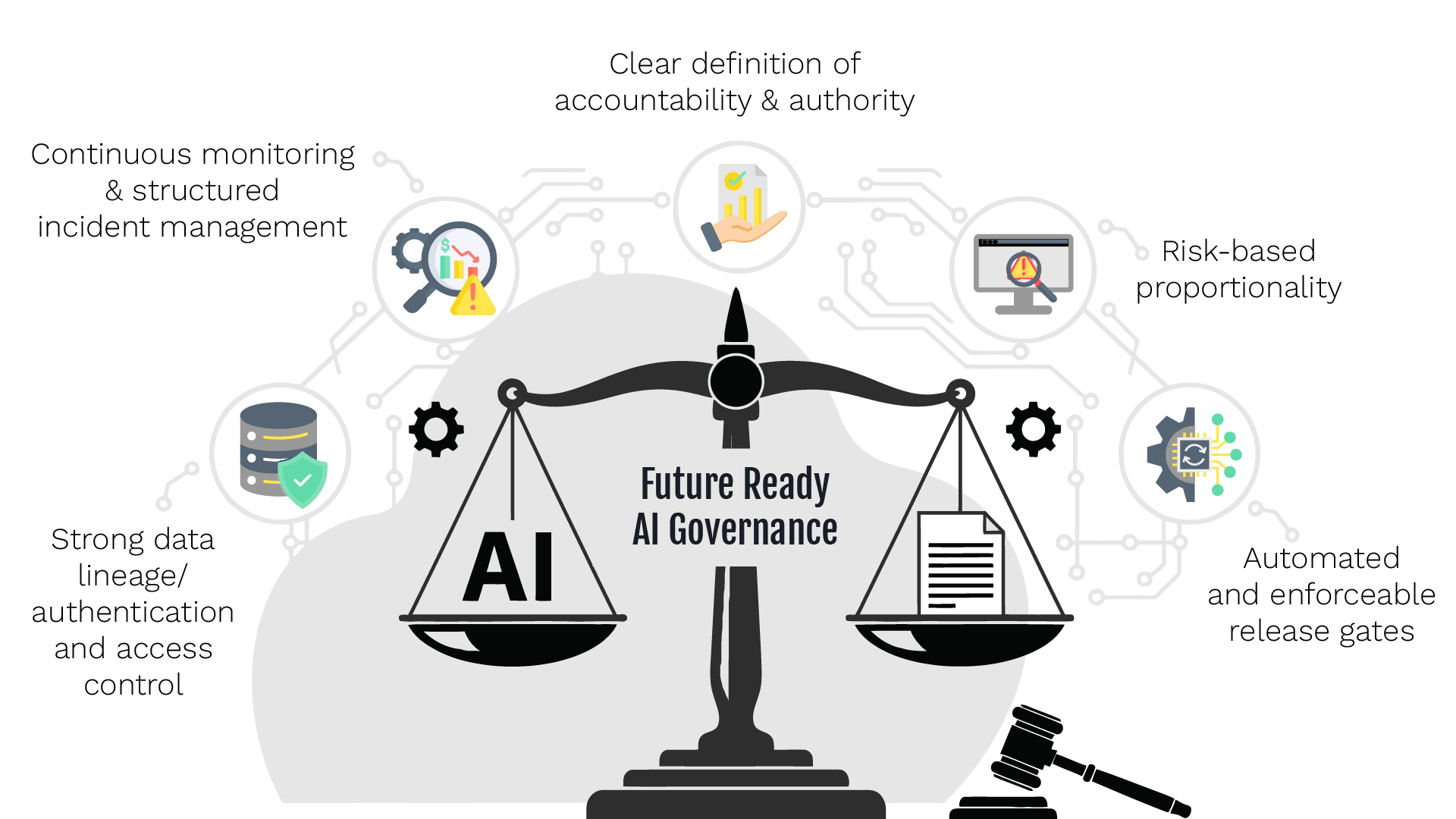
Effective AI governance must be woven directly into the development lifecycle rather than treated as a post-hoc audit, because today’s systems not only carry traditional software risks but also AI-specific challenges like drift, hallucinations, data leakage, bias, and adversarial manipulation. The goal isn’t to eliminate risk but to define, measure, and control it so teams can deliver AI features quickly and safely through clear ownership, policies, risk controls, and continuous monitoring. This requires practical, early-stage integration, classifying risks before training or integration, documenting datasets rigorously, attaching evaluation artifacts to every model or code change, enforcing CI/CD release gates backed by monitoring and rollback plans, and automating these steps to prevent governance decay under delivery pressure.
Hence, it’s paramount to bring structure to this model. The key lies in embedding governance, observability, standardized artifacts, telemetry, and review gates directly into MLOps/LLMOps workflows, focusing on repeatability and traceability and making it easier for organizations to scale AI use cases on consistent, well governed foundations.
AI Risk Management and Tiering to Drive Proportional Oversight:
A tiered approach to AI risk helps ensure that risk assessment scales with impact rather than applying uniform, inefficient controls.
- Low-risk models: Internal assistive tools; summarize, draft, automate low impact tasks
- Medium-risk models: Customer-facing or operational recommenders that influence workflows
- High-risk models: Eligibility, pricing, security posture, regulatory exposure
This kind of tiering is one of the core AI governance processes for evaluating AI projects by impact, with tighter constraints applied to high-stakes tools such as hiring or lending algorithms.
In this regard, developing structured playbooks for mapping proposals to tier-specific requirements and supporting the formation of review mechanisms can give governance real authority within delivery processes. By defining these tiers upfront and allowing each to automatically trigger the appropriate obligations, organizations can reduce ambiguity, establish consistent, non-negotiable governance, and make those rules part of an AI governance framework that helps prevent unintended consequences in high-stakes use cases such as hiring or lending.
Strengthening Data Control
AI failures often stem from underlying data problems ranging from labeling errors and bias to unclear consent, leakage, gaps in lineage, and poor data quality. These make disciplined data governance more critical than reactive compliance checks. Effective practice centers on:
- Maintaining consistent dataset‑to‑model versioning for reproducibility
- Embedding automatic metadata throughout pipelines
- Keeping transformation steps transparent so teams can trace privacy impacts and protect sensitive data
- Enforcing role‑based access with audits and robust security standards to reduce unauthorized access and support data protection
- Aligning retention or deletion with privacy and regulatory expectations
Data stewards enable trusted access for the right stakeholders while enforcing those controls.
Enterprises are increasingly looking to automatically capture metadata and link data, models, and evaluations into a coherent lineage, aligning with frameworks such as the National Institute of Standards and Technology’s (NIST) AI Risk Management Framework and ISO/IEC 42001. This enables their teams to build structured evidence, handle privacy tradeoffs when systems can infer details from innocuous data, improve AI outcomes, and support responsible AI governance.
Moving on From Accuracy-led Evaluation Metrics to Multidimensional Reliability
Rigorous AI evaluation and governance require far more than a headline accuracy metric, demanding scrutiny of how systems behave across tasks, subpopulations, and edge cases, alongside exposure to adversarial and stress conditions, distribution shifts, transparency and explainability, and the level of explainability needed for effective human oversight. Generative AI is adding further expectations around measuring hallucinations, toxicity, susceptibility to prompt based attacks, and broader ethical concerns, while confirming that AI systems operate reliably under stress and shifting conditions.
Data scientists should lead the testing and validation of AI models for bias, robustness, and performance, helping identify and mitigate discriminatory outcomes across demographic groups.
Models should move to release only when evidence demonstrating these criteria is attached directly to the artifact and pull request. Enterprises need to adopt this type of multi‑metric, repeatable evaluation, aligning technical rigor with structured governance approaches, ethical guidelines, and ethical considerations.
Engineering Human Oversight with Explicit Roles and Triggers
Effective oversight in AI systems needs intentional design and AI oversight as a collective responsibility rather than ad‑hoc intervention, with clear thresholds, defined accountabilities, and accountable AI governance that assigns explicit ownership for the actions and errors of AI systems, plus feedback mechanisms that route low‑confidence outputs to human review, enforce approval steps for high‑impact automated decisions, and log all overrides for future retraining or recalibration. Sustained governance also depends on periodic sampling of real‑world outcomes to surface drift or emerging harms. Legal and compliance officers should be part of review and escalation decisions to verify requirements are met and reduce violation risk.
To bring these practices to life, enterprises should look to incorporate established human‑in‑the‑loop workflow patterns into both CI/CD and runtime environments, supported by dashboards, alerting, and SLA‑bound queues. Cross functional AI boards should review new high-impact AI use cases with legal, cybersecurity, data science, and operational leadership involved. These oversight patterns support the responsible use of AI and help ensure that AI decisions can be reviewed, overridden, or halted when necessary, so supervisory processes become part of the system’s routine functioning rather than an afterthought.
Integrated Continuous Monitoring, Incident Response, and Documentation
Since AI systems keep evolving after deployment, they require ongoing monitoring across the post-deployment period, rapid rollback mechanisms, and an investigation discipline. This means detecting distribution shifts in real time, triggering automated anomaly alerts, and applying Bias & Performance Monitoring with fairness metrics and drift detection to catch inaccuracies before they affect end users, while relying on feature flags or kill switches for quick reversions and using severity levels to drive structured on call and response workflows. Assessments should systematically feed insights back into controls, playbooks, and datasets, while automated documentation within pipelines supports standardized documentation, model testing, and validation to help prevent financial losses from rogue automated actions or corrupted data pipelines and keep evidence current for audits, sales, and internal decisions. Regular audits and continuous monitoring of deployed systems are vital for maintaining accountability, ensuring compliance with ethical guidelines and regulatory standards, and strengthening AI operations after release. These practices also provide core AI governance metrics for reporting on compliance, reliability, and incident trends.
Drawing from this perspective, enterprises are now actively driving edge-to-enterprise AI adoption, and employing foundations like telemetry, alerting, rollback patterns, and automated documentation across edge and cloud environments. This supports the operational consistency needed when models span devices and cloud services, and aligning with guidance that encourages centralized governance to scale diverse AI use cases effectively.
Adopting Responsible AI Governance Structures with Real Authority and Adaptability
Frameworks are likely to fail in situations where review bodies lack real authority or when teams are rewarded only for speed. Shared ownership across legal, product, engineering, and operations is paramount for strong governance integrating into daily engineering. With evolving AI regulations and governance practices, preparing for advances in the regulatory and marketplace space is just as important.
Enterprises should act toward building features with the ability to adapt to regulations, bringing together advisory and engineering disciplines. Going beyond aligning portfolios with frameworks and regulatory expectations, enterprises should integrate policy, pipeline, and automat ed evidence needed to keep compliance sustainable as requirements evolve.
Conclusion
To conclude, AI governance is increasingly being viewed as an engineering discipline that encompasses all aspects related to product design, data management, risk management/control, and operational excellence. Enterprises that are best at implementing governance processes have fewer issues, quicker delivery of new products, and build the required trust for enterprise adoption.
To support this breadth of oversight, eInfochips is powering edge‑to‑enterprise AI adoption for the global enterprises, leveraging NomAIzo™ and policy‑driven workflows that enable organizations to govern both their own models and the third‑party AI capabilities embedded throughout their ecosystem.