

As cars become more digital, chips like Qualcomm’s RIDE 8775P are leading the way. The 8775P is built to handle innumerable functions in one powerful system. Specifically designed for automotive applications such as advanced driver assistance systems (ADAS) and infotainment, the 8775P is tailored to meet the demanding requirements of modern vehicles. Designed for highly scalable, central compute architectures, the 8775P merges ADAS, infotainment, audio, and zonal control into a single, flexible platform. Automotive infotainment is a critical component in connected vehicles, enabling advanced user experiences and seamless integration of digital services. The 8775P is an automotive infotainment SoC designed to meet stringent safety and performance standards, ensuring reliability and compliance with industry requirements. The 8775P is developed with safety assurance in mind, aligning with Automotive Safety Integrity Level (ASIL) D requirements. This SoC targets ASIL D, the highest safety standard for automotive systems, and is engineered with SEooC (Safety Element Out of Context) principles to support safety-critical applications.
By enabling advanced safety features and supporting innovative automotive architectures, the Qualcomm RIDE 8775P and its collaborations are engineering human progress—advancing automotive safety, innovation, and mobility for a better driving experience worldwide.
In this blog, we will dive deep into the specifications and use cases of Qualcomm RIDE and how it makes it possible to deliver high-quality audio for cars.
Introduction to Automotive Compute
The automotive industry is experiencing a profound transformation, driven by the rapid adoption of advanced driver assistance systems (ADAS) and the emergence of automated driving technologies. As vehicles become more connected and intelligent, the demand for high-performance, reliable, and safe computing platforms has never been greater. At the heart of this evolution is Qualcomm Technologies, Inc., a global leader in intelligent computing solutions for the automotive sector.
Qualcomm Technologies is empowering global automakers to deliver intelligent computing and functional safety through its innovative Snapdragon Ride platform. This comprehensive ride platform is designed to support a wide range of automotive applications, from driver assistance systems (ADAS) to fully automated driving, ensuring that vehicles can process vast amounts of data in real time while maintaining the highest standards of safety and reliability.
The Snapdragon Ride platform stands out in the automotive industry by offering a scalable, car-to-cloud infrastructure that seamlessly integrates advanced driver assistance, automated driving, and functional safety features. By leveraging cutting-edge technologies such as machine learning, computer vision, and high-performance processing, Qualcomm Technologies enables automakers to create vehicles that are not only smarter but also safer and more efficient.
As the automotive landscape continues to evolve, the role of intelligent computing becomes increasingly critical. With the Snapdragon Ride platform, Qualcomm Technologies Inc. is at the forefront of this revolution, helping the world’s leading automakers deliver next-generation vehicles equipped with advanced driver assistance systems and automated driving capabilities. This commitment to innovation and safety is shaping the future of mobility, making cars more capable, connected, and secure than ever before.
An Overview of the Qualcomm Ride Platform (8775p)
- Qualcomm has provided a Ride platform based on the Snapdragon Chassis framework.
- It features:
- 4 high-performance cores ARM Cortex
- 4 efficiency cores ARM Cortex A55
- Onboard Qualcomm Adreno GPU
- Qualcomm AI Engine
- Hexagon DSPs for offloaded solutions
- Functional Safety (ISO 26262 ASIL-D support)
- Multi-Gig Ethernet
Implementation of Multi-zone Architecture
The multi-zone concept refers to logically and physically isolated computing domains (zones) that independently handle various vehicle workloads from cluster rendering and infotainment to driver monitoring and zone ECUs (e.g., for doors, lighting, climate control). This architecture supports a range of development functions necessary for implementing and managing complex vehicle workloads, enabling efficient software integration, system validation, and scalability for advanced driver-assistance systems (ADAS) and automated driving solutions.
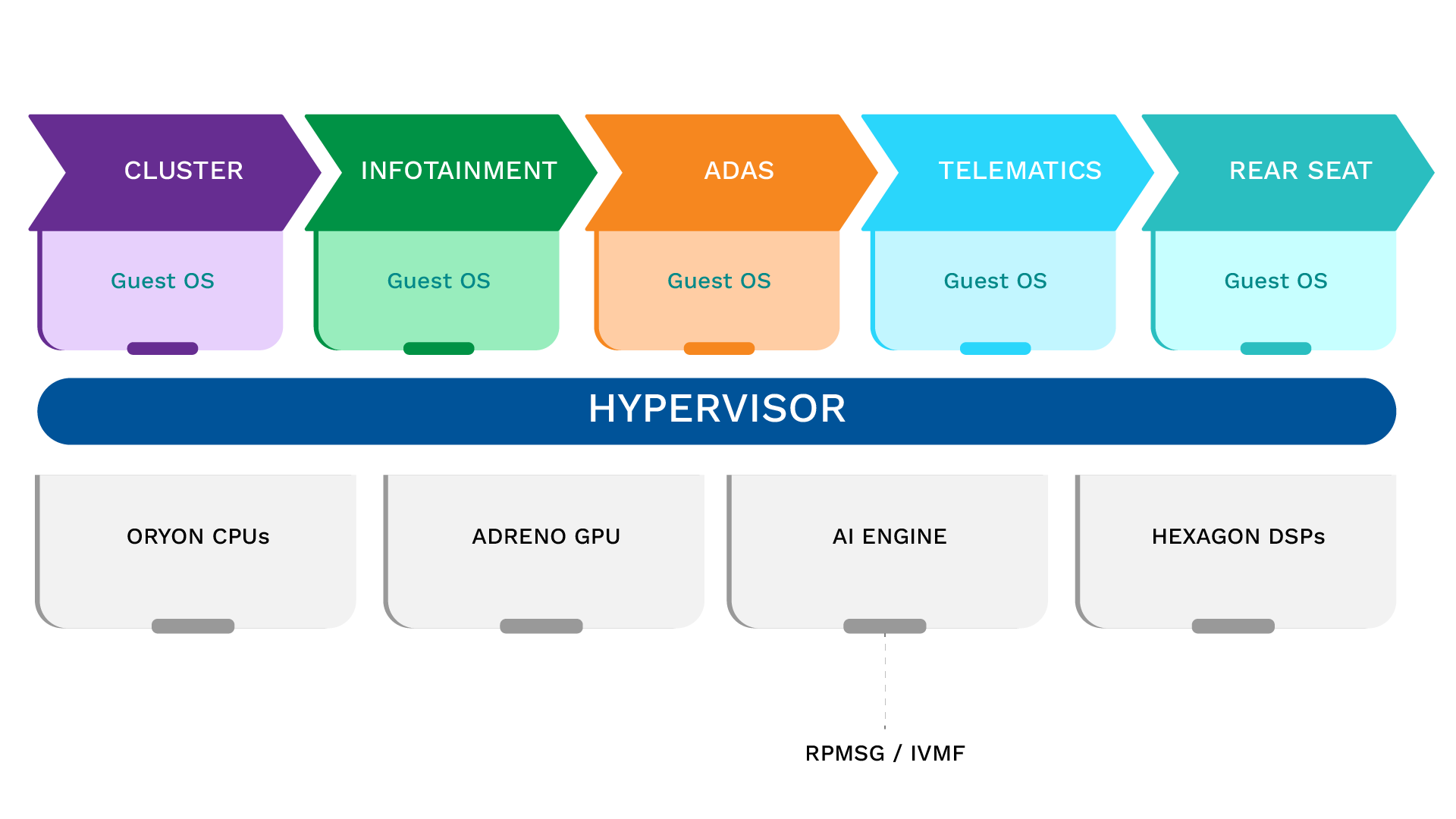
Multi-zone Architecture
What are the Different Types of Architecture Layers?
RIDE 8775P implements multi-zone computing through a three-tier abstraction:
1. Hypervisor Layer (Type-1 Real-time Hypervisor)
- Qualcomm uses a certified real-time hypervisor (e.g., QNX Hypervisor or AGL KVM with Jailhouse extensions) to enforce:
- Hardware-assisted memory and I/O isolation
- Virtual Device Interfaces (VDIs) for sharing peripherals like GPUs or Ethernet controllers
- Guest scheduling with deterministic latency for critical RT domains
2. Zone VMs / Partitions
- Each zone runs as an isolated VM or containerized partition, typically including:
- Infotainment Zone: Android Automotive OS / Linux with high GPU priority
- ADAS Zone: RTOS or Linux with preempt-RT and access to AI Engine and ISP
- Telematics Zone: Linux with modem stack, GPS, V2X communication
- Instrument Cluster Zone: Qt-based HMI or Crank GUI, with a high frame sync
- Rear Seat Zone(s): Android Container for media apps
Each zone is given dedicated CPU cores (via CPU pinning), separate DRAM regions (using IOMMU mappings), and optionally virtual PCIe interfaces.
3. Interzone Communication
- Shared Memory
- VirtIO , RPMsg , CAN-over-IP interfaces
- Custom Inter-VM Message Framework
Audio Overview of the Qualcomm Ride platform
Audio processing on the RIDE platform is achieved amazingly using a central DSP driven pipeline.
It also has capabilities of multi-zone audio (driver, navigation, music), immersive audio, etc.
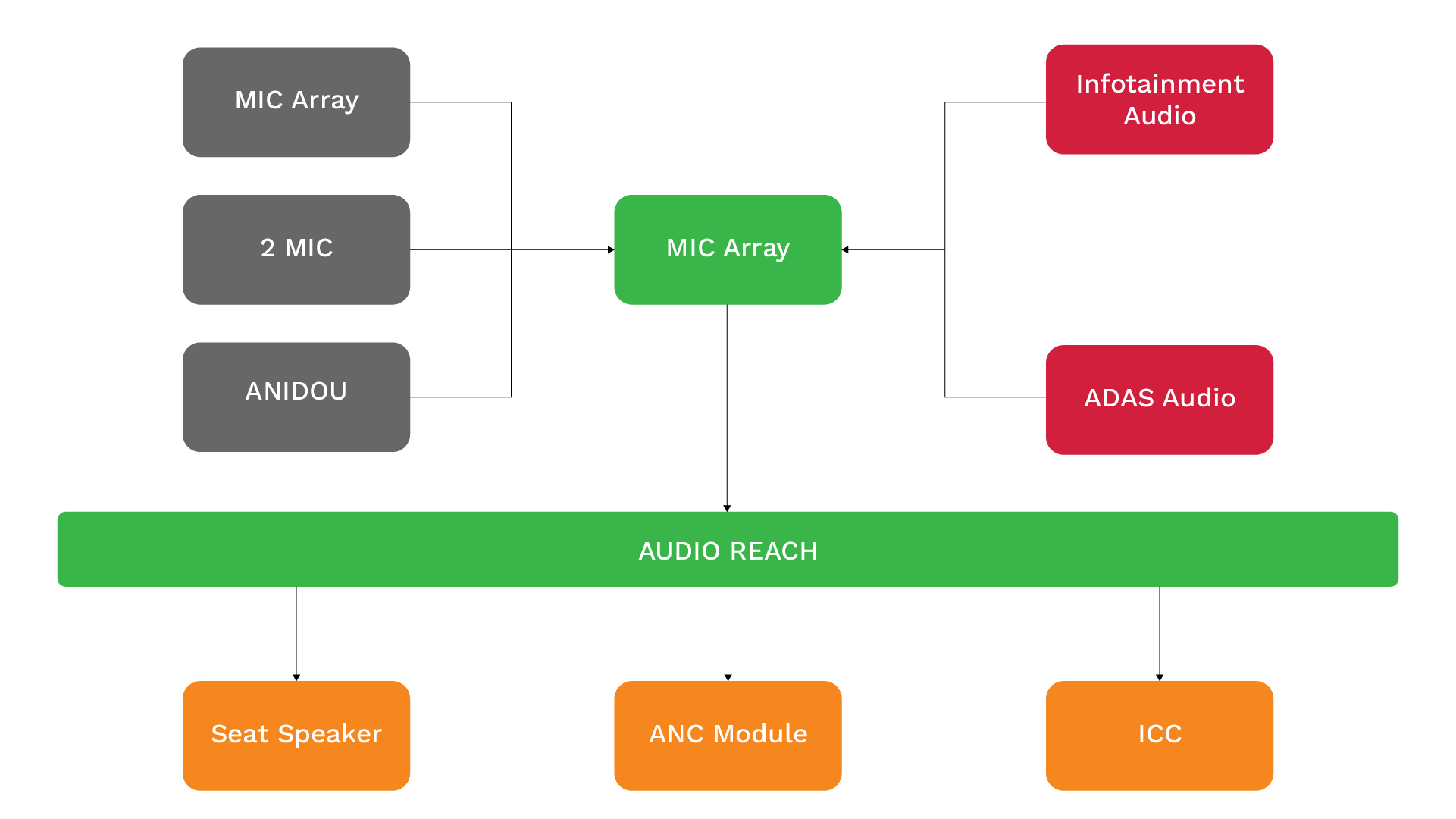
1. Audio DSP Subsystem
Qualcomm RIDE 8775p integrates:
- 2 Hexagon HVX DSP
- LPASS (Low Power Audio Subsystem)
- VoiceUI and wake-up work engines for NLP (Natural Language processing which uses its AI cores
- Multiple codec support is provided.
2. Multi-domain Audio Routing
Audio streams are managed via a central Audio HAL, split across zones using Qualcomm’s AudioReach architecture:
- Virtual Audio Devices (VADs) per zone isolates streams
- Zonal mixing matrix: Every zone can mix multiple sources and route them to speakers via:
- Internal AFE paths
- External audio processors (e.g., DSP amplifiers over I2C/SPI)
- USB or BLE endpoints for wireless headsets
3. Advanced Features
- In-car Communication (ICC): Real-time mic-to-speaker routing with echo cancellation (for driver-rear passenger interaction)
- Engine Sound Enhancement (ESE): Adds synthetic engine sounds using real-time data from CAN sensors
- ANC (Active Noise Cancellation): Uses cabin mics and adaptive FIR filters implemented on Hexagon DSP
- Zonal Sound Profiles: Each seat/zone gets custom EQ, volume levels, and virtual surround (via Dirac or DTS AutoStage SDKs)
Software Framework and SDKs
Qualcomm provides the Automotive Software Development Kit (ASDK), which integrates:
- Hypervisor BSPs for QNX, AGL, and Android Automotive OS
- Qualcomm Multimedia Framework (QMMF) for unified audio/video
- Diagnostics SDKs (e.g., Sentry, Snapshot)
- AudioReach Graph Designer: GUI for audio pipeline design with drag-and-drop DSP module chaining
These software frameworks and SDKs are designed to provide scalable solutions for diverse automotive infotainment and ADAS requirements. These are part of Qualcomm’s broader products and services businesses, supporting automakers with comprehensive development and integration solutions.
Integration in Centralized Zonal Architectures
The 8775P plays a central compute node in emerging Zonal E/E Architectures:
- Zonal ECUs (e.g., 6155P-based) handle sensor aggregation per vehicle quadrant
- 8775P aggregates zonal data, performs global decisions (e.g., path planning, infotainment rendering), and coordinates vehicle actuation
- Over Gigabit Ethernet with TSN, data is deterministically passed to the RIDE 8775P in real time
This architecture reduces wire harness complexity, lowers BOM, and enables continuous feature delivery via OTA updates.
Real-world Deployment Use Cases
- Digital Cockpit Fusion: Multiple zones, each handling a display (cluster, central, rear-seat), all rendered via the 8775P GPU pipeline
- Zonal Audio Separation: Rear-seat passengers watch different media, while in the front the screen displays navigation, all processed in parallel without crosstalk
- Personalized Sound Bubble: Based on the seat occupancy (sensor-driven), sound is directed and spatialized using beamforming on the DSP
- Fail-operational Safety Zones: Even if the infotainment OS crashes, cluster/ADAS zones continue uninterrupted due to hypervisor isolation
Qualcomm products such as Snapdragon Ride SoCs and the Snapdragon Ride Flex platform, are central to enabling automakers to deploy advanced ADAS and automated driving solutions. The integration of the Snapdragon Ride System and Snapdragon Digital Chassis supports a unified, software-defined vehicle architecture, allowing for scalable and flexible automotive solutions.
The Qualcomm RIDE 8775P shows what a modern, safe, and high-tech car computer should be like. It uses advanced features like multizone virtualization, real-time audio processing, and built-in AI to create a smooth, secure, and flexible system.
As carmakers move towards combining different systems into one and using zonal designs, chips like the 8775P provide the base needed to build the next generation of smart, software-based vehicles.
eInfochips (An Arrow Company) plays a key role in helping bring the RIDE platform to life faster. eInfochips has a highly skilled team of enthusiastic engineers who leverage experience in the automotive field and the Qualcomm Drive platform, making eInfochips a reliable partner. From getting the system up and running to setting up zones and handling advanced audio, eInfochips offers complete support throughout the development process.