DDR PHY VREF Characterization Solution

High-speed DDR and LPDDR interfaces operate under increasingly stringent timing and voltage constraints. Process variation, voltage fluctuation, temperature, jitter, noise, and channel effects can all degrade memory reliability and introduce significant complexity into PHY validation workflows.
The DDR PHY VREF Characterization Solution addresses these challenges by automating receiver characterization through controlled VREF and sampling-delay sweeps. It enables engineering teams to generate DDR read-eye diagrams, quantify available margins, identify underperforming bits, and determine the optimal PHY operating point. Purpose-built for modern DDR and LPDDR interfaces, the solution delivers actionable margin intelligence across channels, ranks, byte lanes, and individual DQ bits, empowering teams to enhance reliability, reduce debug time, and optimize read performance.
Automated Read-Eye Analysis, Margin Extraction and DDR PHY Validation

Key Capabilities

Automated VREF and Delay Sweeps

Performs coordinated receiver VREF and sampling-delay sweeps across the DDR read window to characterize operating margins with precision and consistency.

DDR Read-Eye Generation

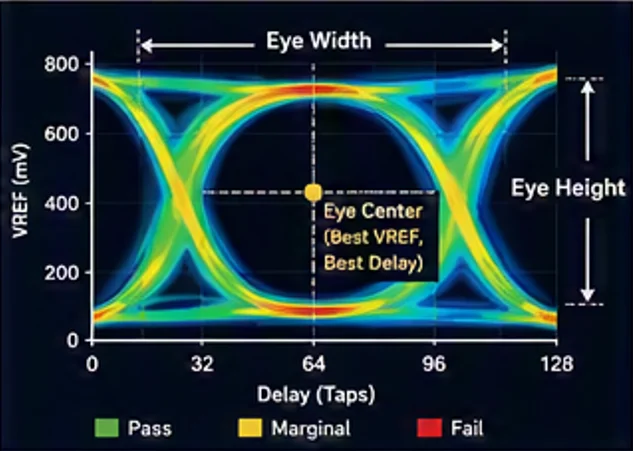
Produces two-dimensional read-eye diagrams that clearly distinguish passing, marginal, and failing operating regions for thorough signal integrity assessment.

Timing and Voltage Margin Analysis

Quantifies available eye width and eye height to provide a rigorous evaluation of timing and voltage tolerance under operational conditions.

DDR

3

Optimal Operating-point Identification

Determines appropriate VREF and delay settings by identifying the largest stable read-eye region, ensuring reliable and well-centered operating conditions.

Per-bit and Multi-level Visibility

Delivers comprehensive performance analysis across the full PHY hierarchy, encompassing channels, ranks, byte lanes, DQS groups, and individual DQ bits.

BER and Reliability Analysis

Assesses pass/fail behavior and bit-error trends to detect marginal operating conditions and highlight potential reliability concerns before they impact system performance.

Automated Reporting

Generates engineering-ready reports, interactive dashboards, and exportable characterization data to support validation workflows and facilitate thorough technical review.

Supported DDR and LPDDR Technologies

The solution supports:
Characterization can be performed across multiple channels, ranks, byte lanes, DQS groups, DQ bits and operating frequencies.

DDR4

DDR5

LPDDR4

LPDDR4X

LPDDR5

LPDDR5X

How it Works

The solution initializes and configures the DDR PHY before conducting coordinated VREF and sampling-delay sweeps across the read window. At each test point, it executes read transactions, captures pass/fail and error data, and translates the results into eye diagrams, margin metrics, optimal operating settings, and engineering reports.
The solution initializes

Key Benefits

Applications

The solution supports DDR PHY development, silicon bring-up, PVT characterization, product qualification, manufacturing screening and failure analysis.

1. Silicon Bring-Up: Identifies timing, voltage, and receiver-margin issues during first-silicon validation.

2. DDR PHY Development: Supports receiver tuning, read-training evaluation, and PHY performance optimization.

3. PVT Characterization: Evaluates DDR read behavior across process, voltage, and temperature conditions.

4. Product Qualification: Generates repeatable characterization evidence for design-level and system-level validation.

5. Manufacturing and Screening: Assesses production margins and identify devices or configurations operating in proximity to defined limits.

6. Failure Analysis: Investigates weak bits, jitter sensitivity, signal-integrity concerns, and margin degradation.

Deliverables

Depending on the engagement and target platform, deliverables may include:

  • DDR read-eye visualizations
  • Margin and operating-point summaries
  • Per-bit and byte-lane analysis
  • Pass/fail and reliability views
  • Configuration and execution logs
  • Consolidated characterization reports
  • Exportable engineering data


Detailed supported outputs, metrics, test-pattern options and characterization parameters are available in the solution datasheet.

Improve DDR PHY Margin Visibility and Reduce Characterization Effort

Transform raw read-test data into clear eye, margin and receiver-performance insights with an automated
DDR PHY characterization approach.

Frequently Asked Questions

What is DDR PHY VREF characterization?

DDR PHY VREF characterization measures receiver performance by sweeping voltage-reference and sampling-delay settings across the DDR read window. It helps determine eye width, eye height, timing margin, voltage margin and the optimal receiver operating point.

Why is DDR read-eye characterization important?

A DDR interface may pass basic functional tests while still operating with limited timing or voltage margin. Read-eye characterization shows how much operating margin is available and helps identify weak or marginal conditions before production.

Which DDR technologies are supported?

The solution supports DDR4, DDR5, LPDDR4, LPDDR4X, LPDDR5, LPDDR5X and custom DDR PHY implementations.

What does the solution measure?

The solution measures parameters such as eye width, eye height, eye center, timing margin, voltage margin, best VREF, best delay, eye area, BER behaviour and per-bit margin.

Can the solution identify weak DQ bits?

Yes. Characterization can be performed at PHY, channel, rank, byte-lane, DQS-group and individual DQ-bit levels, helping engineers isolate weak or marginal areas.

Does the solution support PVT characterization?

Yes. It can be used to evaluate DDR PHY behaviour across process, voltage and temperature conditions.

Can it be used during silicon bring-up?

Yes. The solution helps identify timing, voltage, calibration and margin issues during first-silicon validation.

Is automated reporting supported?

Yes. The solution can generate consolidated engineering output and export data in formats such as CSV, Excel, PDF and HTML.

Can the solution be customized for a proprietary DDR PHY?

Yes. The characterization framework can be adapted for custom PHY architectures, register interfaces, test flows and reporting requirements.

How does the solution reduce validation effort?

It automates key steps such as PHY configuration, VREF and delay sweeps, read execution, data capture, error analysis, eye generation, metric extraction and reporting.

Discuss DDR PHY VREF Characterization Solution

Transform raw read-test data into clear eye, margin and receiver-performance insights with an automated DDR PHY characterization approach.

DDR PHY VREF Characterization Solution

Download Report

Download Sample Report

Download Brochure

Start a conversation today

Schedule a 30-minute consultation with our Automotive Solution Experts

Start a conversation today

Schedule a 30-minute consultation with our Battery Management Solutions Expert

Start a conversation today

Schedule a 30-minute consultation with our Industrial & Energy Solutions Experts

Start a conversation today

Schedule a 30-minute consultation with our Automotive Industry Experts

Start a conversation today

Schedule a 30-minute consultation with our experts
Please Fill Below Details and Get Sample Report

Reference Designs

Our Work

Innovate

Transform.

Scale

Partnerships

Device Partnerships
Digital Partnerships
Quality Partnerships
Silicon Partnerships

Company

Products & IPs

Privacy Policy

Our website places cookies on your device to improve your experience and to improve our site. Read more about the cookies we use and how to disable them. Cookies and tracking technologies may be used for marketing purposes.

By clicking “Accept”, you are consenting to placement of cookies on your device and to our use of tracking technologies. Click “Read More” below for more information and instructions on how to disable cookies and tracking technologies. While acceptance of cookies and tracking technologies is voluntary, disabling them may result in the website not working properly, and certain advertisements may be less relevant to you.
We respect your privacy. Read our privacy policy.

Strictly Necessary Cookies

Strictly Necessary Cookie should be enabled at all times so that we can save your preferences for cookie settings.