
Introduction
The traction inverter is the heart of an Electric Vehicle (EV) drivetrain system. It converts DC battery power into three-phase AC power to drive the electric motor. However, traditional inverters are not efficient compared to modern inverters.
McKinsey & Company’s report explains that the main reasons for consumers to avoid EVs are charging concerns, higher costs, and low range. Two of these challenges are due to the poor performance of traction inverters. As per the US Department of Energy, the electric drive system is responsible for about 18% of losses in an EV.
The modern inverters are efficient, and an average Battery Electric Vehicle (BEV) range has increased from 135 km in 2014 to 455 km in 2024. This is due to advancements in inverter efficiency and battery technology. Improvements in traction inverter technology and power electronics not only enhance efficiency and range but also positively impact battery life by reducing stress and energy losses.
Traction Inverter Overview
The traction inverter stands as a critical component in the architecture of electric vehicles (EVs) and hybrid electric vehicles (HEVs). Its primary function is to convert direct current (DC) battery power into alternating current (AC) power, which is essential for driving the electric motor. This conversion process enables precise control over the motor’s speed and torque, directly influencing the vehicle’s performance, efficiency, and driving range.
Advancements in traction inverter technology have been pivotal in the evolution of modern EVs. Innovations in power electronics, high voltage systems, and the adoption of silicon carbide (SiC) materials have led to significant improvements in power density, efficiency, and reliability. These developments allow for more compact and lightweight inverters that can handle higher power levels, supporting the automotive industry’s push toward electrification.
As EVs become more prevalent, the demand for high-performance traction inverters continues to grow. These inverters not only maximize efficiency and extend driving range but also play a vital role in reducing emissions and enhancing overall EV performance. The integration of advanced materials and high voltage architectures ensures that today’s inverters meet the rigorous demands of both consumers and automotive manufacturers, making them a cornerstone of next-generation electric mobility.
How Traction Inverters Address Current EV Challenges
The Electric vehicles industry faces many challenges such as limits on range, heat, and charging speed. Traction inverters play a direct role in managing these constraints.
- Silicon Carbide (SiC) semiconductors improve efficiency and reduce heat. They also enable smaller and higher-power inverter designs.
- High-efficiency power electronics reduce energy losses during operation. This helps improve both range and performance.
- Advancements in traction inverter technology contribute to a smoother, more responsive driving experience by enhancing vehicle performance and handling.
- Integrated thermal management monitors temperature in real-time. It prevents overheating and reduces long-term maintenance risk.
Key Use Cases and Applications
Traction inverters serve diverse applications:
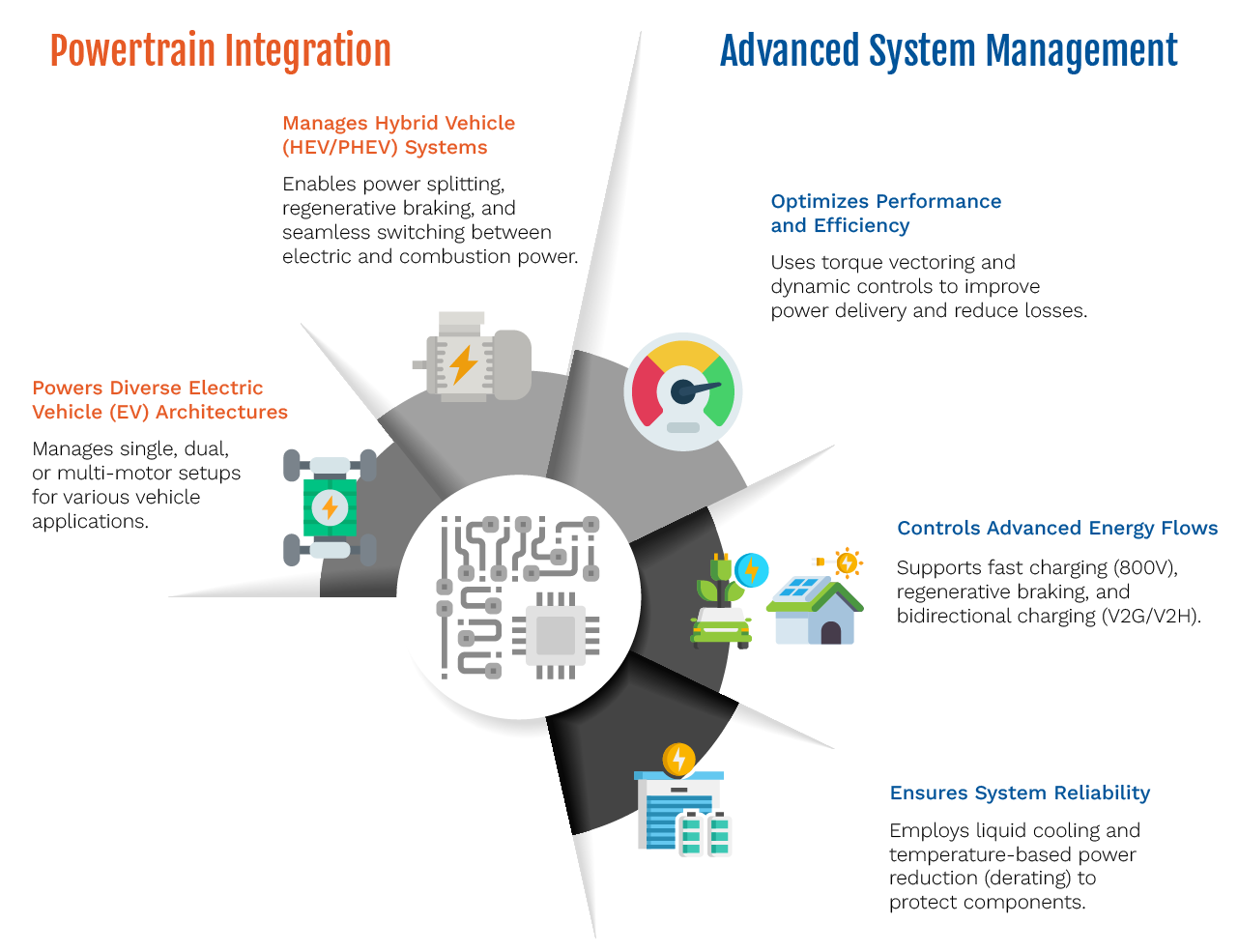
- Battery Electric Vehicles (BEVs) typically use 400 V or 800 V architectures. Single motors are common in compact vehicles. Dual motors support performance and AWD. Multi-motor setups are used in commercial applications.
- Hybrid Vehicles (HEVs and PHEVs) rely on integrated motor-generator units. These support power splitting and regenerative braking. Electric-only driving is possible. Transitions between electric and combustion power are managed at the inverter level.
- Performance optimization systems focus on torque vectoring and motor coordination. Power is distributed dynamically across motors. Efficiency maps adapt to driving conditions. Control methods such as SVPWM and dynamic gate control improve power delivery and reduce losses.
- Energy management covers bidirectional charging like V2G and V2H. Regenerative braking feeds some energy back to the battery, but it cannot bring the vehicle to a full stop on its own. Fast charging is enabled through 800 V architectures. The on-board charger converts AC power from external sources to DC for charging the high-voltage battery, working alongside the traction inverter as part of the vehicle’s overall power management system.
- Thermal and reliability management uses liquid cooling for high-power inverters. Temperature-based derating protects components. Thermal cycling data supports predictive maintenance. Cooling is actively controlled based on load.
Advanced Traction Inverter Technologies
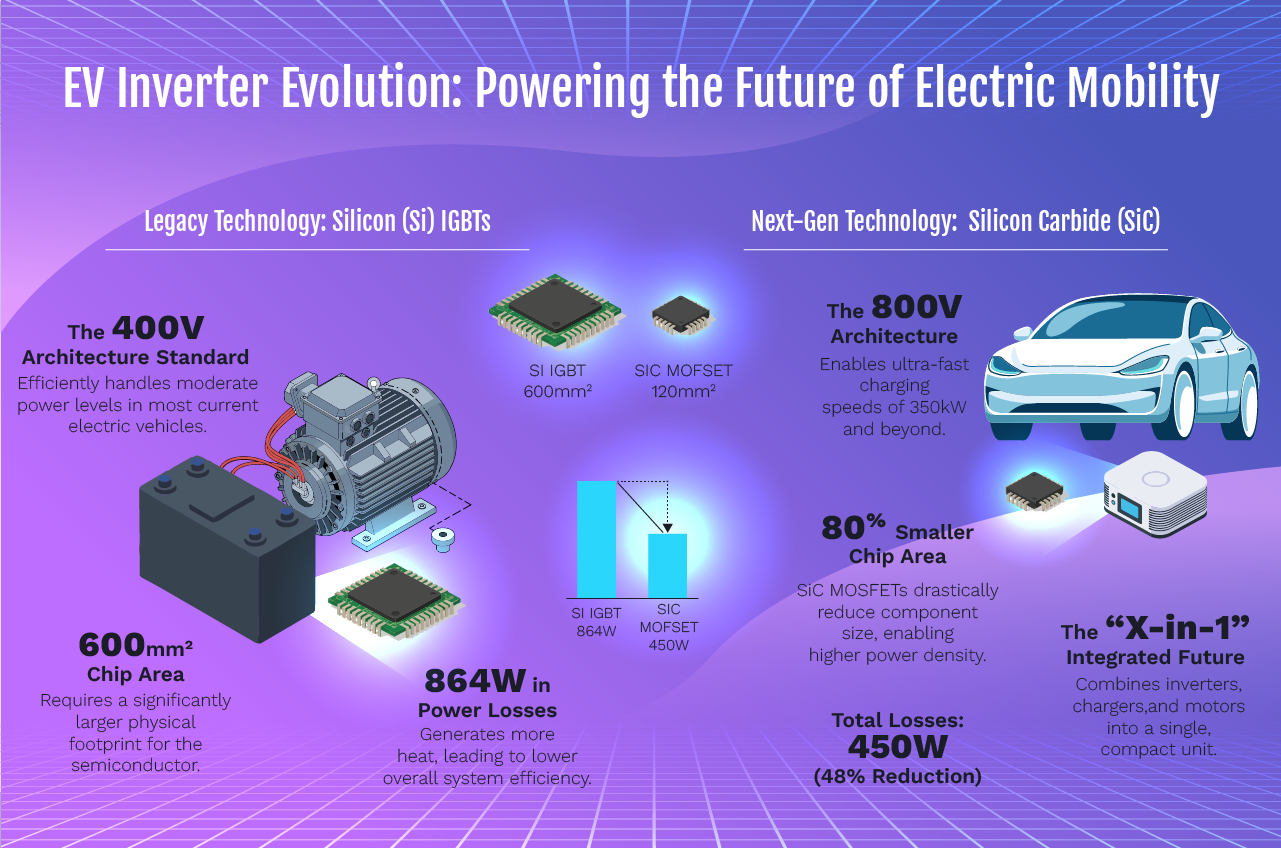
Modern inverter technology is improving. The evolution from silicon IGBTs to wide-bandgap semiconductors is shaping the next era of electric mobility. There are many other areas that contribute to such advancements. The image below represents the depiction of Legacy Technology vs Next-Gen Technology in a traction inverter:
Let us look at the individual components and understand how traction inverter is evolving: Recent innovations in traction inverter designs have significantly improved efficiency, scalability, and support for emerging vehicle architectures, enabling better performance and easier integration with new technologies.
400V to 800V Architecture Evolution
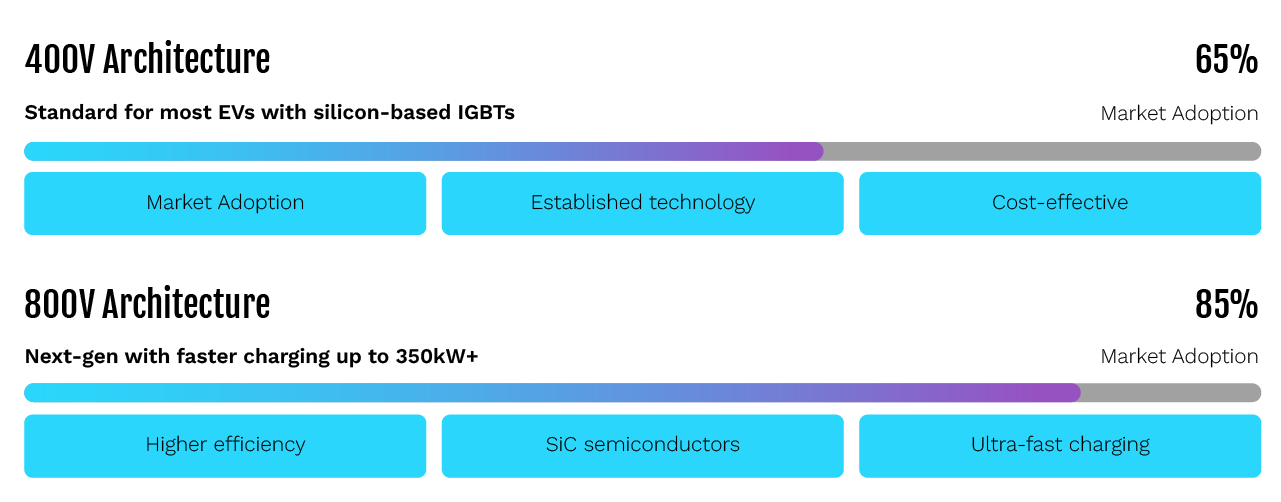
The 400V architecture remains standard for most EVs, with silicon-based IGBTs handling moderate power levels efficiently. Whereas the 800V architecture enables faster charging (up to 350kW and beyond) and higher efficiency. This is possible because SiC semiconductors are becoming essential at this voltage level for managing higher switching frequencies.
Wide-Bandgap Semiconductors
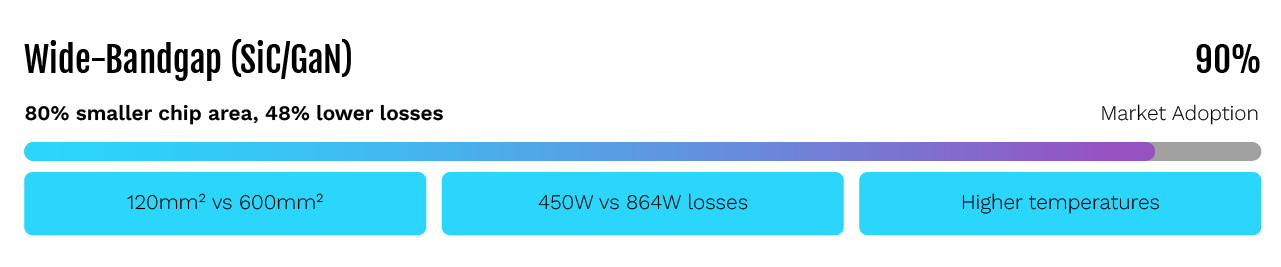
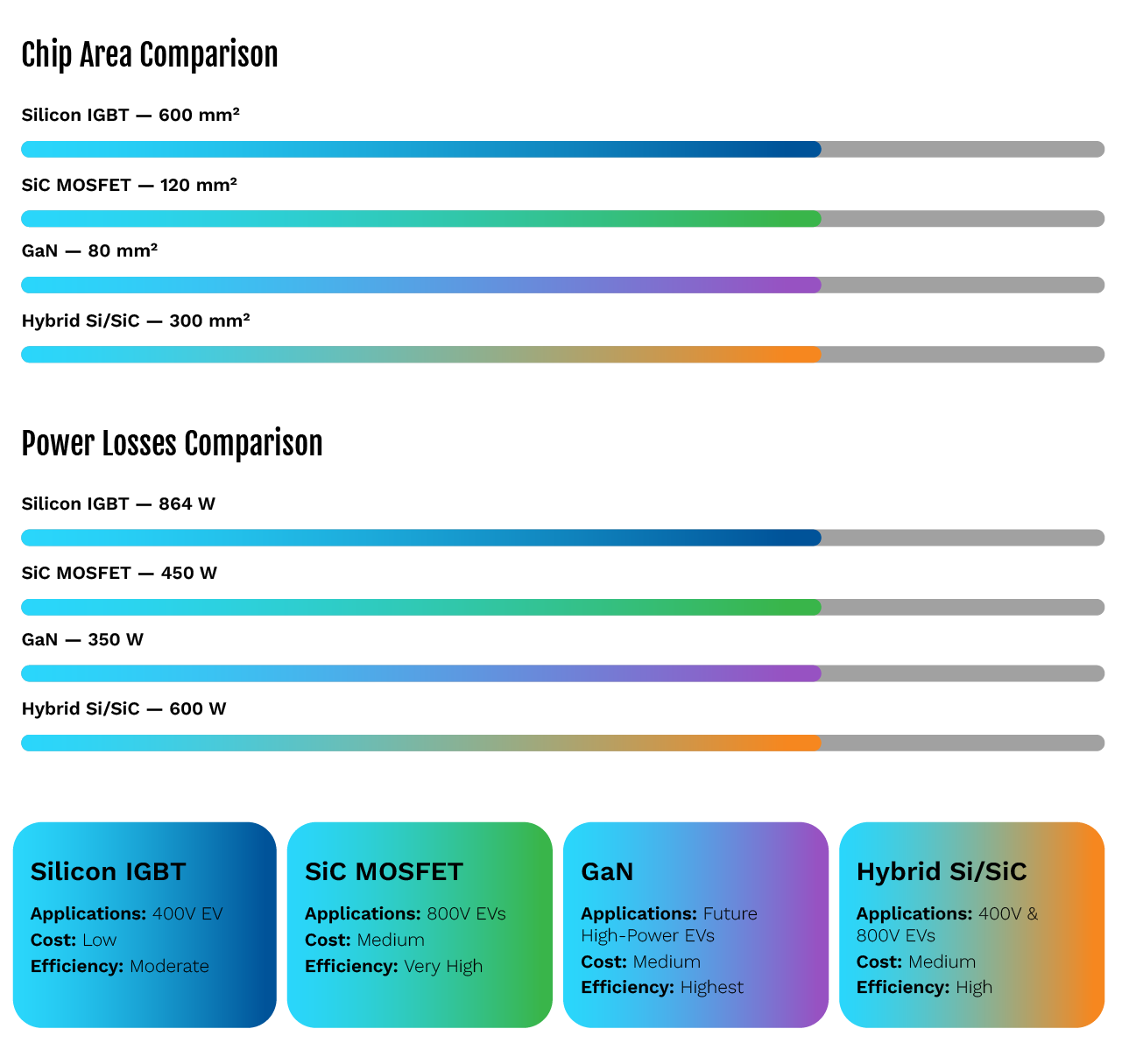
SiC and GaN technologies transform inverter performance. Silicon carbide MOSFETs require only 120 mm² chip area compared to 600 mm² for Si IGBTs, representing an 80% reduction. Total losses in SiC MOSFETs are around 450 W as compared to 864 W in Si IGBTs, a 48% reduction. This lower loss allows operations at higher temperatures and switching frequencies, resulting in a more compact inverter, improved thermal behavior, and better vehicle range.
Integrated Powertrain Systems
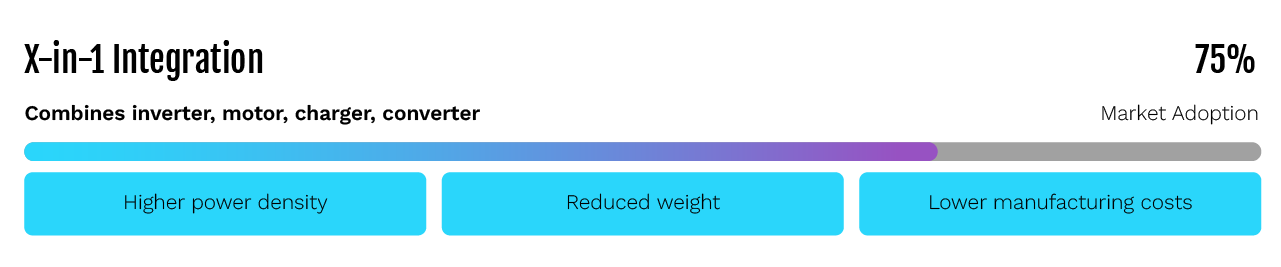
The shift toward “X-in-1” systems integrate the inverter with the motor, transmission, charger, and converter into a single, consolidated platform. This increases power density and improves packaging, resulting in weight reduction and improvement in thermal management. Manufacturing costs are also reduced.
Modular and Scalable Designs
Modern inverter architectures support different motor setups. They scale from single-motor economy vehicles to quad-motor performance EVs. Software-defined features allow OTA updates and make customization possible.
Key Design Challenges of EV Traction Inverter
The traction inverter is a complex device. There are various factors that can affect its performance. Engineers must consider the following items to design an efficient traction inverter:
- Voltage Isolation – Various electronic components operate at a few volts, while others operate at a very high voltage. Therefore, it is important to have strong voltage isolation. High voltage gate drivers are essential in this context, as they safely control and monitor power switches (such as IGBTs, SiC, and GaN) and ensure reliable operation in high-voltage environments.
- Thermal Management – The components in an inverter run continuously at a high voltage of around 30kW and peak load up to 200kW. This generates a significant heat in the system, and it should be managed well for effective operations.
- EMI Interference – The traction inverter must quickly convert DC from battery to AC for motor. This fast switching improves efficiency but also increases electromagnetic interference.
- Motor Control – Various algorithms must run continuously to avoid any delay in motor torque.
- Functional Safety – The traction inverter is a safety critical device. Engineers must do the hardware monitoring, continuous software check for its efficient performance.
- Environmental Conditions – Traction inverters should be a rugged device. It must go through rigorous vibration, thermal, and EMI testing for efficient performance.
Impact on EV Manufacturing
Traction inverters now influence EV manufacturing strategy in a very direct way. They impact powertrain integration, assembly complexity, and quality control.
- Automated testing and validation check inverter performance in real-time. Thermal behavior and power conversion are tested on advanced benches. Issues are caught before the inverter goes into the vehicle.
- Predictive quality control runs continuously on the production line. AI looks at electrical data, thermal patterns, and process variation. Quality risks are identified early.
- Production line integration focuses on how the inverter is assembled. Workflows are optimized to improve throughput. Assembly time comes down without adding complexity.
- Supply chain and component sourcing plans demand critical parts such as SiC modules. This helps avoid shortages, improve visibility, and reduce sourcing risk.
OEMs combine Industry 4.0 practices with advanced power electronics. Tesla has developed in-house silicon carbide inverters to improve efficiency. BYD uses vertically integrated inverter manufacturing to reduce costs and gain better supply chain control.
Semiconductor Technologies in Traction Inverters
In a traction inverter, different semiconductors are being used based on power level and efficiency targets, such as:
- Silicon IGBT is a mature and cost-effective option. It is widely used in 400 V systems and mid-range EVs.
- Silicon carbide (SiC) MOSFET supports higher efficiency and higher operating temperatures. It is commonly used in 800 V systems, premium EVs, and ultra-fast charging applications.
- Gallium nitride (GaN) enables very high switching frequencies. It supports compact designs for future high-performance applications.
- Hybrid Si/SiC modules balance cost and efficiency. They are suited for platforms transitioning from 400 V to 800 V.
Let us look at the semiconductor comparison in various aspects:
The Technology Stack
Advanced inverter technology requires sophisticated hardware software integration. They run in real time. The image below shows how the software layer acts as a brain, and the hardware layer acts as a brawn of the inverter system:
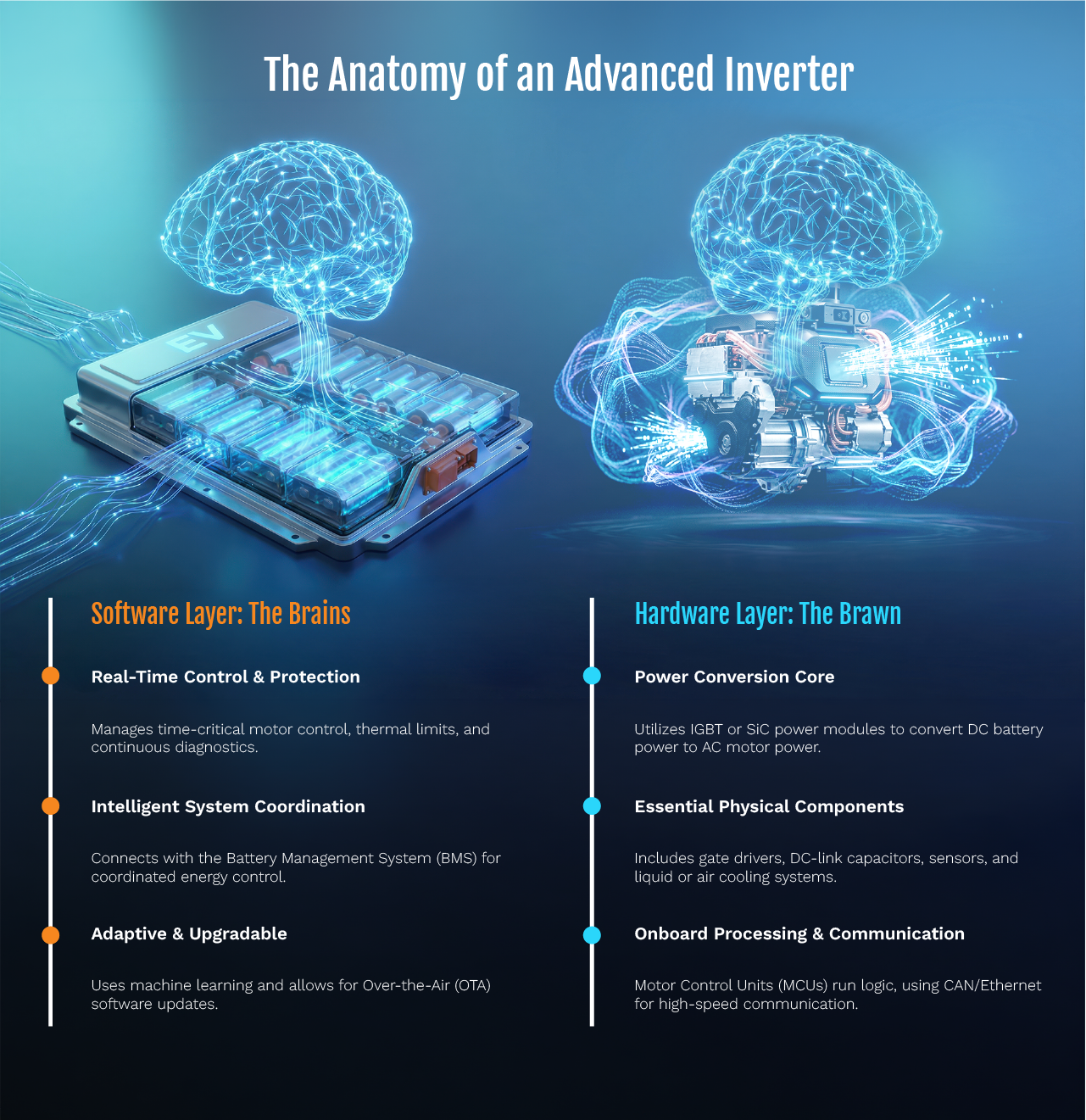
The software stack handles control. An RTOS runs time-critical tasks. Motor control and Field-oriented control (FOC) manage torque and speed. Thermal logic watches temperatures. The inverter talks to the Battery Management System (BMS). Diagnostics run all the time. Predictive maintenance builds over time. OTA updates keep the system current.
Hardware layers comprise power modules with SiC or IGBT semiconductors. Gate drivers control switching and protecting the devices. DC-link capacitors stabilize voltage. Cooling removes heat. It can be liquid or air. Sensors measure current and voltage. MCUs or motor controllers run the logic. CAN and Ethernet handle communication.
A traction inverter includes several core subsystems. Power modules handle DC-to-AC conversion and carry the main power flow. Gate drivers ensure accurate and safe switching. Control units run real-time algorithms and coordinate with other vehicle systems. New designs also use predictive control and machine learning to improve efficiency and adapt to driving conditions.
How eInfochips is Driving Innovation in EV Traction Inverters
eInfochips works across the full stack of power electronics and embedded control for automotive applications. We work closely with OEMs and Tier-1 suppliers on custom inverter designs, motor control tuning, and thermal management. Our team supports the entire development cycle, from hardware design through real-time control software.
NXP Semiconductors has signed a multi-year agreement with eInfochips to provide software packages and tools for NXP’s S32K family of automotive processors used in inverter control. We also work with partners such as NVIDIA, Qualcomm, Infineon, Analog Devices, and STMicroelectronics on advanced power electronics programs.
eInfochips can deliver complete inverter solutions. We have strong capabilities in hardware design, embedded software, power electronics, and automotive safety standards such as ISO 26262. These solutions are built to meet automotive performance, efficiency, and long-term reliability requirements.