
Introduction
Artificial Intelligence (AI) is reshaping the automotive industry. It is becoming a key differentiator, especially for the passenger vehicle segment. Buyers are now willing to switch to brands with better AI and digital features. A McKinsey survey found that in the year 2024, 38% of premium car owners in Germany would consider switching car brands if the alternative offered a better digital experience.
Automotive industry artificial intelligence is being integrated across vehicle design, manufacturing, autonomous driving, and customer experience, revolutionizing how the industry operates and delivers value to consumers.
To deliver advanced AI features, the automotive OEMs (Original Equipment Manufacturers) and Tier-1 suppliers must balance privacy, latency, and most importantly, the cost. For manufacturers and suppliers, the rush to seize the opportunities presented by advanced AI technologies raises important questions about the selection of appropriate hardware, software, and use-case deployment types.
According to an industry research, the global Automotive Artificial Intelligence Market size was valued at USD 4.29 billion in 2023. It is predicted to reach USD 25.78 billion by 2030, with a CAGR of 29.2% from 2024 to 2030. AI’s impact is revolutionizing traditional automotive processes and driving innovation throughout the industry.
Introduction to Artificial Intelligence
Artificial intelligence (AI) is revolutionizing the automotive industry by enabling computer systems to perform tasks that once required human intelligence, such as visual perception, speech recognition, and complex decision-making. In the automotive context, AI technologies are being integrated into every stage of vehicle development—from initial vehicle design to manufacturing and on-road performance. Machine learning and deep learning models are at the heart of these advancements, allowing vehicles to learn from vast amounts of data and adapt to new situations. This not only enhances vehicle safety and efficiency but also elevates customer satisfaction by delivering smarter, more intuitive driving experiences. As AI continues to evolve, it is setting new standards for innovation and excellence in the automotive industry.
Importance of AI in the Automotive Industry
AI plays a crucial role in enhancing vehicle performance, especially in the electric vehicles segment. There are intelligent algorithms that optimize battery health, thermal management, and power usage. AI also supports manufacturing by automating quality control and predictive maintenance.
Additionally, AI can enhance consumer experiences through natural language voice assistants, adaptive infotainment systems, and so on. By leveraging AI to personalize interactions, provide tailored marketing, and offer support via chatbots and virtual assistants, the automotive industry is significantly improving the customer experience throughout the sales and service process. On top of that, OEMs can get benefits from AI-driven analytics for better service planning, vehicle insights, and continuous software improvements via Over-the-Air updates.
Overall, AI is transforming the automotive industry from a hardware-focused industry into an intelligent, interconnected ecosystem.
Automotive Industry Trends
The automotive industry is experiencing a period of rapid transformation, fueled by breakthroughs in AI, the rise of electric vehicles, and the development of autonomous driving technology. One of the most significant trends is the widespread adoption of advanced driver assistance systems (ADAS), which leverage AI and machine learning to enhance vehicle safety and operational efficiency. Automotive companies are also placing a greater emphasis on supply chain management, using AI-powered solutions to optimize inventory, streamline logistics, and reduce costs. As the industry shifts toward electric vehicles and self-driving cars, the integration of AI and machine learning is becoming essential for staying competitive and meeting evolving consumer expectations. These trends are not only improving vehicle safety and performance but are also reshaping the entire automotive value chain.
How AI is solving current challenges in the Automotive Industry
There are many challenges in the automotive industry such as increasing vehicle complexity, higher development costs, and the growing demand for efficient EV performance. There are many ways in which AI can overcome these challenges:
- Intelligent algorithms can optimize battery usage, thermal management, and powertrain efficiency, solving key Electric Vehicle (EV) limitations
- Reducing accidents and driver errors by deploying AI-based driver behavior analytics that help minimize human error in driving and vehicle operation
- AI-driven predictive maintenance to predict failures and lower lifecycle and maintenance costs
Automotive Sector Transformation
AI is fundamentally transforming the automotive sector by introducing intelligent solutions across a range of applications. Predictive maintenance powered by AI tools enables automotive companies to analyze vehicle data in real time, anticipate potential issues, and minimize unplanned downtime. Quality control processes are also being enhanced through AI-driven computer vision systems that detect defects with greater accuracy and speed. In the realm of autonomous driving, AI models process sensor data to make split-second decisions, improving both safety and reliability. Additionally, AI-powered chatbots and digital assistants are elevating customer satisfaction by providing instant support and personalized experiences. These innovations are driving efficiency, reducing costs, and setting new benchmarks for excellence in the automotive sector.
Different Use Cases of AI in Automotive
Applications for AI are emerging in various domains such as Advanced Driver Assistance Systems/Autonomous Driving, infotainment, connectivity, powertrain, and many other applications where AI shows a strong impact. These applications or solutions are primarily deployed either on Edge, Cloud, or both (Hybrid). Let’s look at the various use cases and their deployments:
1. ADAS/AD – Most of the solutions here run on Edge
- End to end model for vehicle control, motion planning, and perception
- In-cabin safety like driver or passenger monitoring
- ADAS relies on real time data from sensors and cameras to enable immediate decision-making and hazard detection.
- Machine learning models are used for perception, navigation, and decision-making in autonomous vehicle systems.
- Gen AI is increasingly used to create personalized in-car experiences and enhance driver engagement.
- Autonomous vehicle technology leverages AI for safety, real-time decision-making, and advanced driver-assistance systems.
- AI powered vehicles use real-time data and advanced algorithms for autonomous driving, navigation, and communication with other vehicles to improve safety and traffic flow.
2. Infotainment and Comfort – Here the solution relies on Cloud or Hybrid deployments
- Voice assistance
- Personalized user profiles
- Augmented Reality (AR) based heads-up display
- Gesture detection
- Gen AI supports human-like interactions and personalized infotainment, transforming the in-car digital experience.
- Connected car features enabled by AI provide seamless device integration, real-time data exchange, and a curated in-vehicle environment.
3. Connectivity and Gateway – These systems primarily run on Edge
- In-Vehicle connectivity and network analysis
- Intrusion detection for malicious activity and cyberattacks
4. Powertrain and EV Systems –
- Range estimation
- Energy management
- Predictive maintenance
Most energy and range models deploy at the Edge, while predictive maintenance may use hybrid approaches.
1. Body and Chassis – These safety-critical applications also depend on Edge computing for low-latency control.
- Adaptive suspension systems based on terrain and weather
- Braking and traction optimization
- Body-level predictive maintenance
- Active noise cancellation
- Automatic emergency braking is a key AI-powered safety feature that helps prevent collisions by automatically applying brakes in emergency situations.
Among these use cases, ADAS is the most safety-critical and complex use case. ADAS has many applications such as vehicle control and driver monitoring that need a sophisticated AI model. Let’s look at some of the ADAS use cases in detail and see how AI is shaping them:
ADAS
AI in ADAS is improving decision making, sensor fusion, and real-time adaptability. For AI engineers, researchers, and Tier-1 suppliers, knowing inside out of the intersection of smart automation and autonomous vehicle safety is important for the next era of mobility.
Sensor fusion is very important in ADAS, as it relies on complex AI algorithms for data coming from various sensors such as radar, lidar, and cameras. And because of this, ADAS creates a precise image of the vehicle’s surroundings.
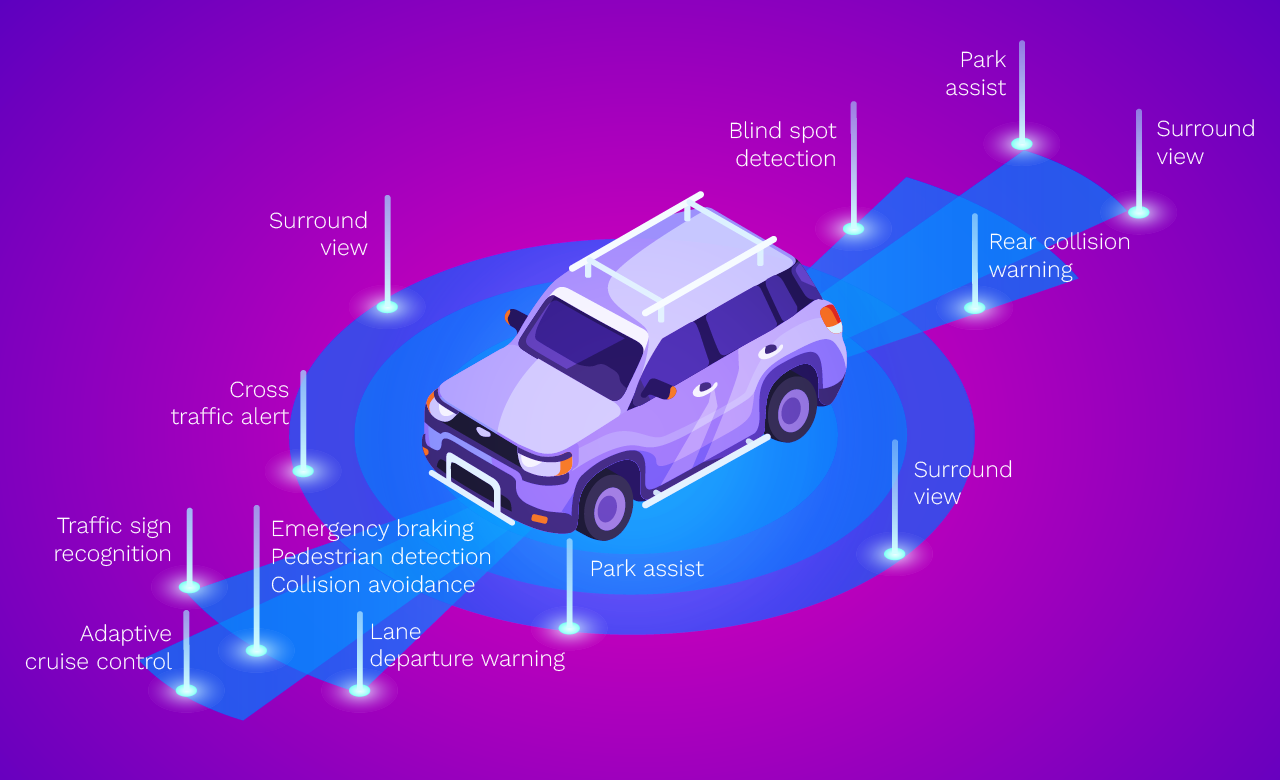
As we know, ADAS has six levels of automation from Level 0 to Level 5. Level 0 being the no-automation stage, and Level 5 is the fully autonomous stage. Let’s look at the involvement of AI in each level of ADAS:
Level 0: No Automation
This is a no automation level. The driver handles all driving tasks, and there is no active control of the system by AI.
Level 1: Driver Assistance
This level has very basic assistance. Here AI can control features like adaptive cruise control or lane assistance, but the driver needs to stay alert and control the vehicle.
Level 2: Partial Automation
At this level, the AI can control steering and acceleration simultaneously. The car can follow lanes or maintain distance from other vehicles. However, the driver must monitor the road constantly.
Level 3: Conditional Automation
Here, AI can handle perception and decision-making during certain conditions. The car may drive itself in traffic or on highways. But drivers need to take control when the system requests it.
Level 4: High Automation
The vehicle can drive on its own without human input in geofenced areas. We do not need manual intervention within these zones. Autonomous vehicle technology at this level relies on AI for safe and efficient navigation.
Level 5: Full Automation
This is the complete autonomy stage. The vehicle can operate in any environment without human involvement. No steering wheels or pedals are required. AI handles every driving task in all conditions. AI powered vehicles at this level demonstrate advanced autonomous driving, real-time decision-making, and vehicle-to-vehicle communication.
The below image represents the high-level architecture of AD/ADAS system:
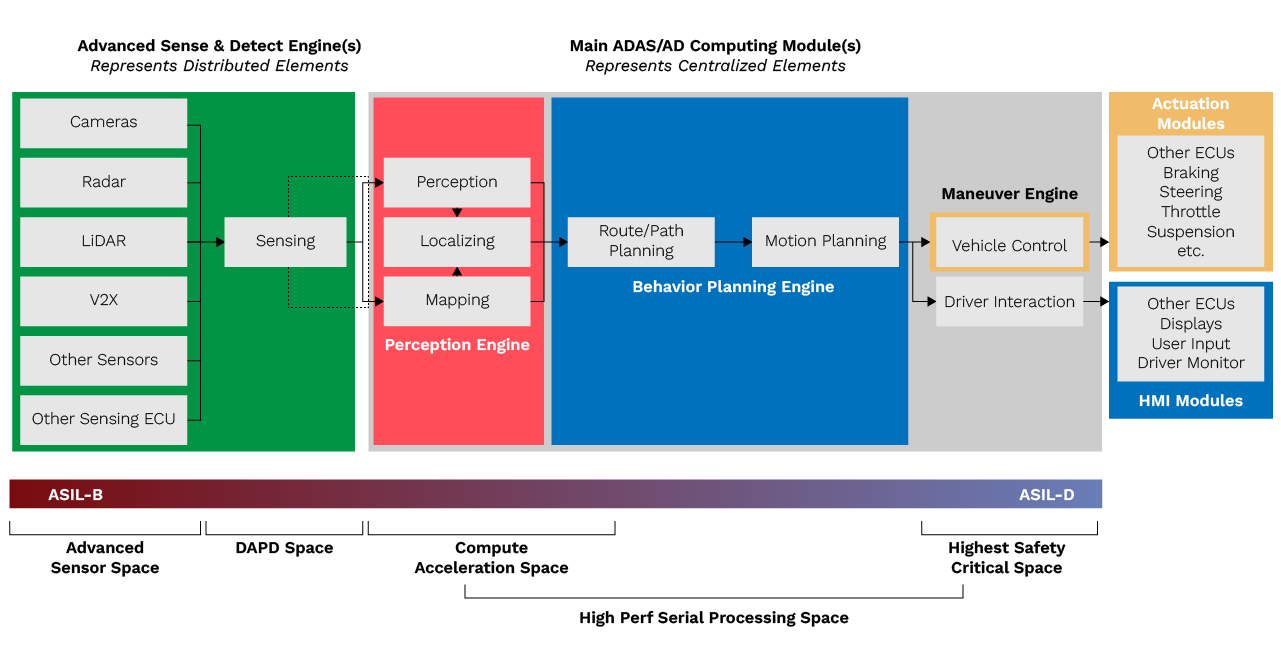
As the automotive industry evolves, there is a significant shift towards software defined vehicles, where AI enables centralized control, over-the-air updates, and enhanced vehicle functionality.
Importance of AI in the Automotive Manufacturing
AI plays an important part in everyday operations in automotive manufacturing. There are various areas in manufacturing where AI can support such as effectiveness in production, boosting productivity, R&D, maintenance, and many others. With automation and predictive analytics, AI is driving manufacturing efficiency by streamlining operations, reducing errors, and improving production speeds.
With the help of AI, the process is becoming increasingly effective and productive. Let’s look at some areas where AI is making an impact:
- Computer Vision–Based Quality Inspection
Here AI can oversee welding, painting, and assembly in real-time. It can also identify defects with high accuracy.
- Predictive Maintenance
AI can monitor machines continuously. It can read and understand vibration, temperature, and load patterns, and based on that, it can predict failures.
- Production Line Optimization
AI analyzes factory workflows and can improve overall throughput. It enhances production processes by identifying bottlenecks, improving scheduling, and ensuring quality at every stage.
- Robotics and Automation
AI powers smart robots on the shop floor. Robots can handle assembly and material movement with precision and adapt quickly to new tasks, optimizing manufacturing processes for greater efficiency and cost savings.
- Supply Chain & Inventory Optimization
AI can help with the inventory forecast demand. It prevents shortages and overstocking, helping automotive manufacturers optimize inventory levels. This improves visibility, enables supply chain optimization, and lowers the supply chain-related risks.
AI is transforming supply chain management in the automotive industry by improving demand forecasting, production planning, and overall efficiency, leading to more seamless and cost-effective operations.
- Digital Twins and Simulation
AI creates virtual models of factories and can simulate layout, flow, and process changes. AI driven IoT sensors are used for real-time tracking and quality control, further enhancing simulation accuracy and operational oversight.
- Energy & Resource Efficiency
The monitoring of energy usage across machines and utilities can be done through AI. It improves overall resource efficiency and maintains sustainability and operating costs.
In many ways automotive OEMs are also taking benefit of Industry 4.0 combined with AI and Machine Learning (ML) algorithms. For example, the Volkswagen Chattanooga plant is using AI-based quality control systems. In another instance, BMW is also utilizing AI applications to enable high-resolution 3D layouts of factories and buildings.
Different AI Models deployed on Cloud/Edge
AI and ML researchers have developed various models that can either be implemented at Edge or Cloud. The ongoing process of AI development is crucial for creating and deploying advanced models tailored for automotive use cases, enabling innovation in areas such as predictive maintenance, ADAS technology, and compliance with industry regulations. These models vary depending on the use case of the application. Let’s look at the list of models based on use cases:
| Use Case | Example Models |
| Text-to-text | GPT-x, Grok, Claude, Mistral 7B, DeepSeek, Llama, BERT |
| Text-to-image | Stable Diffusion, DALL-E, Midjourney, DeepSeek, Grok |
| Text-to-video | Sora, Runway Gen-3 |
| Text-to-code | GPT-x, Grok, Claude, Codex, AlphaCode |
| Text-to-speech | Whisper, DeepSpeech, Wav2Vec2 |
| Mathematical reasoning | GPT-x, Grok, Claude, DeepSeek |
| Image understanding | GPT-x, Grok, Claude, DeepSeek |
| Video understanding | VideoBERT, UniVL |
In-Vehicle Hardware-Software Technology Stack
Increased AI adoption in various automotive applications needs an advanced vehicle technology stack. The below image provides a simplified representation of main components of the hardware and software stack.
The software layer includes:
- An RTOS (real-time operating system) for time critical tasks such as ADAS/AD
- Non-RTOS supports infotainment and other supporting functions
- AI frameworks and runtimes
- AI models
- Model life cycle management tools
- AI applications like predictive maintenance AI assistant
AI systems integrate these software components to process data from sensors, drivers, and external sources, enhancing vehicle functionality and safety through informed decision-making.
Hardware layers include:
- Flash memory for storage
- High-bandwidth Memory (HBM) and Dynamic RAM and to support computing
- Different types of processing elements like Central Processing Unit (CPU), Graphic Processing Unit (GPU), Neural Processing Unit (NPU), Digital Signal Processor (DSP)
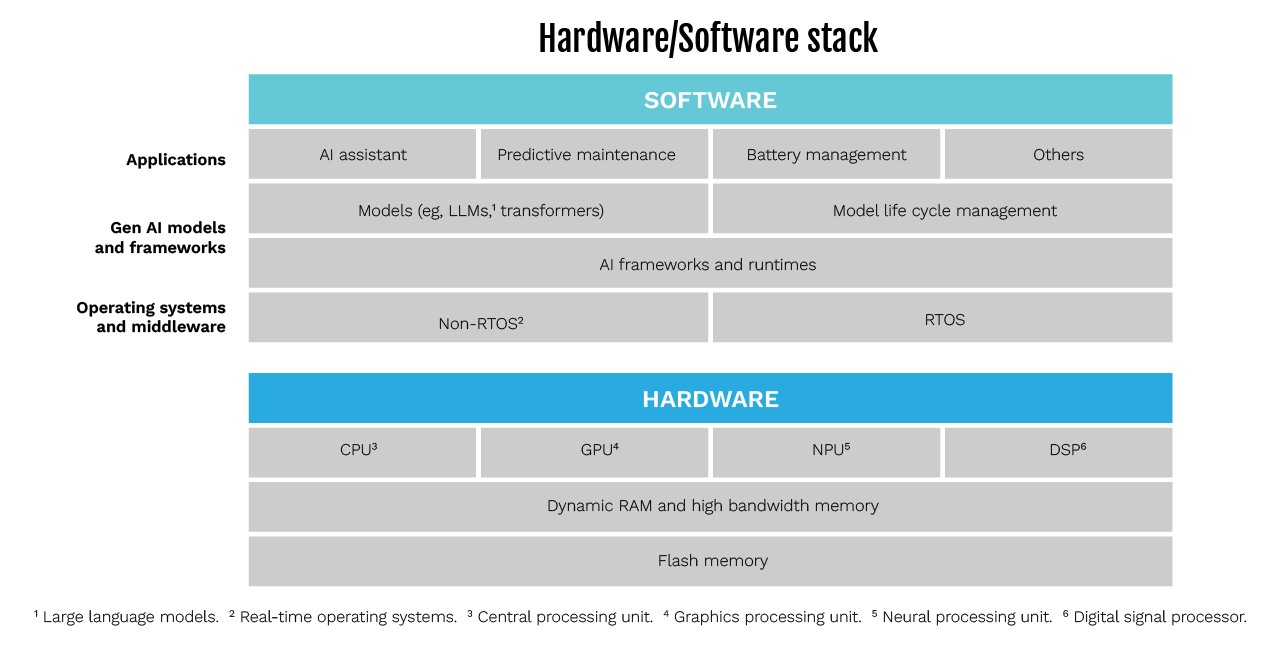
Vehicle SoC (System-on-Chip) architectures that are suitable for AI execution have four different processors. The CPU is used for basic vehicle control tasks, system-level orchestration, and managing defined workloads. Graphics processing unit (GPU) is used for parallel computing workloads such as some AI inference tasks and display rendering. Digital Signal Pprocessors (DSP) are commonly used for dedicated data processing related tasks from in-vehicle sensors. Now a days, advanced vehicle SoC designs have also incorporated Neural Processing Units (NPUs), they offer compute power and energy efficiency for intensive AI tasks.
However, there are certain hardware limitations, and therefore a scalable chip architecture is essential. Scalable architecture allows OEMs to future-proof their platforms and adapt to the growing demands of AI workloads. Hence, designing a modular design is important to process additional memory or processing units when required. New use cases and AI models keep emerging, and it’s more important than ever to have quicker development cycles to bring AI-defined vehicles to market sooner.
AI Adoption
The adoption of AI in the automotive industry is accelerating as companies seek to boost efficiency, enhance safety, and deliver superior customer satisfaction. Automotive companies are making significant investments in AI research and development, often collaborating with leading technology firms to create innovative AI-powered solutions. From optimizing production lines to developing intelligent vehicle systems, the use of AI in the automotive sector is expanding rapidly. As AI in the automotive continues to mature, it is expected to play an even greater role in shaping the future of mobility, helping automotive companies stay ahead in a highly competitive market.
Future of the Automotive Industry
Looking ahead, the future of the automotive industry will be defined by the continued integration of AI technologies. Autonomous vehicles and connected cars are set to become mainstream, offering unprecedented levels of vehicle safety, efficiency, and customer satisfaction. AI will enable new business models, such as mobility-as-a-service and personalized in-car experiences, while also driving improvements in energy efficiency and predictive analytics. However, as the industry embraces these advancements, it must also address critical challenges related to data privacy and security, as well as the impact of automation on the workforce. By navigating these challenges, the automotive industry can unlock the full potential of AI and usher in a new era of innovation and growth.
How eInfochips is driving the AI innovation in Automotive
eInfochips has a strong expertise in end-to-end Edge AI solutions for automotive applications. Various automotive OEM and Tier 1 suppliers are working with eInfochips on custom camera systems, sensors optimization, and synchronized data collection for ADAS and in-cabin applications. Our team also supports the full pipeline from data capture to real-time decision making. To safeguard personal data and maintain consumer trust, eInfochips implements strict data protection measures in all AI solutions.
NXP Semiconductors have recently signed a multi-year agreement with eInfochips. In this agreement, eInfochips supplies premium software packages and tools for NXP’s S32 family of microprocessors and microcontrollers to customers. Similarly, we have also partnered with Nvidia, Qualcomm, Ambarella, Infineon, Analog Devices, and ST.
With strong capabilities in hardware design, embedded software, multimedia, and manufacturing support, eInfochips delivers a complete AI stack that meets automotive safety, performance, and reliability requirements.