
Top Agentic AI Agents Use Cases in Healthcare
The first wave of Generative AI has enabled conversational Health AI systems to answer questions, to generate clinical documentation, to summarize health-related information. In HealthCare AI will move from Generative AI to Agentic AI.
These systems can interpret information that is input into the system. They can act on this information. For example, an intelligent health care system can interpret medical images. It can then decide on a course of action. It can interact with software that manages health care equipment, such as hospital beds. It can even manage the health care devices themselves, for example, a defibrillator. In extreme cases, the system could even call a health care professional for intervention.
However, healthcare cannot simply add an Agentic AI application to the current list of healthcare applications, for the engineering challenge involved is so much greater.
Such a system must be secure, interoperable, reliable, auditable and in addition comply with a variety of health care related regulations, e.g., HIPAA and FDA. The system has to interact with the Electronic Health Records (EHR) and other health care systems such as hospital information systems, connected medical equipment, cloud platforms and other health care related systems and devices in the Internet of Medical Things (IoMT) environment.
For Agentic AI to be adopted in the Healthcare sector it is mandatory for it to be secure, interoperable, reliable, auditable, and compliant with health care regulations such as HIPAA, FDA approved. Here are four high-impact use cases for Agentic AI in Healthcare. We need to focus on the engineering challenges of linking the AI to the physical/digital health care infrastructure to unlock value.
1. Autonomous Edge-driven Medical Imaging and Diagnostics
Medical imaging is already a field where artificial intelligence is used. The traditional analysis tasks of such AI systems include analysing a medical image, to identify patterns in it, and to identify the potential abnormalities.
Agentic AI in Autonomous Diagnostic Workflows for Medical Imaging
A schematic to illustrate an AI Agent working with medical images to perform diagnostics within healthcare as part of a broader workflow: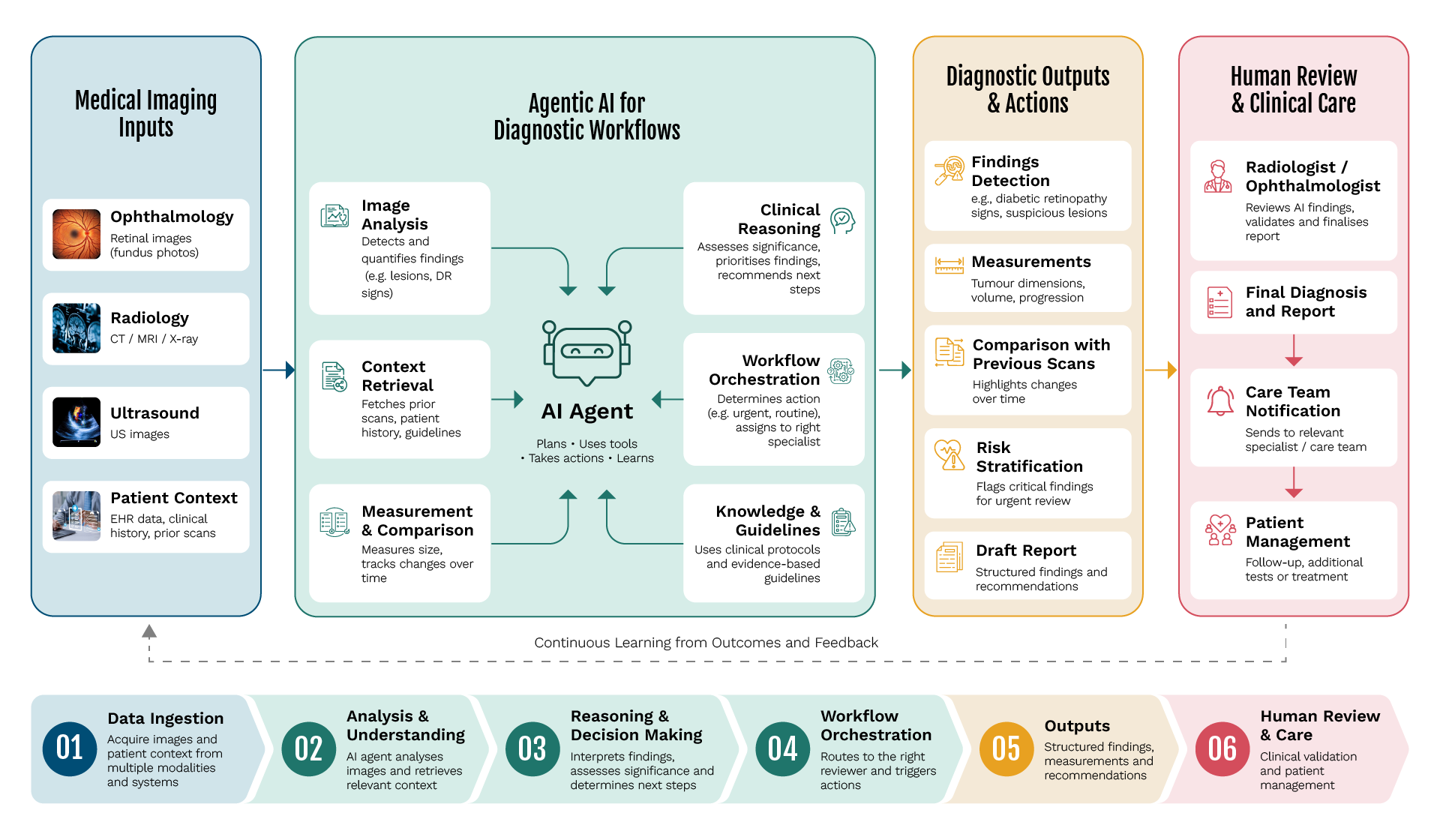
An apt example of the above would be the use of an agentic system to automatically analyse the retinal images of ophthalmology patients for signs of diabetic retinopathy and other retinal conditions. In the radiology department of a hospital, an agentic system could be used to identify suspicious lesions, measure the dimensions of tumours, compare the images of the current and past scans of a patient, and flag the most critical of the findings for review by a doctor.
It is vital to understand the distinction between answering a single question, such as “What abnormality is present in this image?” and participating in a complete workflow that includes activities like determining the significance of findings, determining the appropriate action within the approved workflow, determining who needs to review a case, etc.
Edge computing can be used to process medical images close to where the images are captured by a medical device. This can help to reduce latency, prevent the transfer of unnecessary data, and can even be used in cases where there is no connectivity to the cloud or the internet.
The value of automatically processing and diagnosing medical images can be significant to the clinician and to the organization. Not only does it help deal with large numbers of cases in a timely manner, but it can also help with the triage of emergency cases. Also, since the measurements of tumours and other abnormalities are consistent and accurate, it allows for earlier intervention in cases where treatment is required.
However, Agentic AI needs to be used in such a way that it supports the clinician, automates routine tasks, and helps with the clinician’s decision making.
2. Smart Remote Patient Monitoring and Proactive IoMT Agents
As remote patient monitoring (RPM) of patients becomes more common, it generates a large amount of health data. This health data can originate from various sources, including patient wearables, and other patient health information such as blood-pressure monitors.
The challenge of collecting health data from remote patients is no longer a challenge in itself. The challenge is to continuously understand the information being collected and to act in a timely manner when there are changes of clinical significance. Agents use patient data to identify emerging risks and early signs of deterioration.
Agentic AI works as a digital watchdog, to monitor and act upon IoMT-generated Health Data in high volume, high velocity environments and interpret trend, unified and normalized data from multiple health sensors and health devices for the interpretation of human physiological signals, to recognize, filter-out artifacts of specific health devices and of other interference to detect meaningful changes in a patient’s physiological signals.
An agent can look at individual readings that are within acceptable limits but recognize a trend that is deteriorating for that patient. The agent can make decisions based on that information and notify a caregiver or set up a telehealth visit. It can also support personalized care by evaluating patient histories to help refine treatment plans.
Both Agentic AI for health monitoring and for IoMT within the validated and authorized boundaries of monitoring are able to change monitoring parameters, send alerts, inform clinical staff in case of contact with patients, start telehealth sessions, etc. They can also support patient outreach by guiding patients through check-ins or explaining lab results during a patient interaction.
Edge-based as well as cloud-based health monitoring agents are able to manage time-critical monitoring and even to monitor a large number of patients. Instead of healthcare teams manually reviewing large volumes of continuous data, agentic systems can prioritize patients and events that require attention. This strengthens care coordination across care pathways and can reclaim thousands of nursing hours for care teams. This can be particularly valuable for chronic disease management, elderly populations, post-discharge monitoring, and patients
Agentic AI systems can continuously assess the clinical relevance of the health information that is continuously being generated by patients with chronic diseases, the elderly, post-discharge patients, and patients who are living in remote locations and are being monitored for their health on an ongoing basis by wearable health devices. In this way, for example, large amounts of health information can be identified and prioritized for clinical assessment.
Health care systems are able to track patient health deterioration and prevent relapses. In addition, the monitoring of patients in remote locations, and their treatment in locations outside of clinical environments are both made possible, improving patient engagement, the patient experience, and patient outcomes in care delivery outside traditional settings.
3. Autonomous Clinical Workflow and Interoperability Orchestration
In a health care organization that is made up of several departments, each department may be using a different set of Electronic Health Records (EHRs) and other clinical systems as well as a number of medical devices and databases and scheduling systems. Most of these systems are in silos and therefore can generate large amounts of fragmented data and administrative tasks that can consume time and effort of the clinical staff.
Agentic AI serves as an intelligent orchestration layer on top of the existing health care systems.
Workflows can be managed by a workflow agent using Natural Language Processing (NLP) and health care specific AI capabilities, such as interpreting clinical notes, extracting information from clinical notes, identifying missing information for clinical notes, scheduling appointments, and forwarding information between different health care systems.
Let us say there is a patient who requires an MRI of the chest. The intelligent workflow agent would first note that the patient has a pacemaker, cross reference the MRI safety guidelines for patients with pacemakers and determine if any further information is required. The case would then be sent to the relevant clinicians for review.
This is an example of how several agents may be required to coordinate an MRI for a patient with a pacemaker. This may involve coordination with various clinical departments including Radiology, Cardiology and Surgery. Each department would require the organization of a sequence of clinical events to achieve the desired outcome for the patient.
Administrative tasks, such as referral management, clinical documentation, prior authorization, patient communication and scheduling, can also be supported by intelligent agents in order to support the clinician in his or her daily work.
Interoperability between Agentic Healthcare Systems, Current Healthcare Systems, and between the Different Agentic Healthcare Systems.
To amend healthcare systems, and to support the goals of clinicians and patients, agentic healthcare systems interact with current healthcare systems by means of standards-based interfaces and APIs, with appropriate access control, audit trails, and robust data governance to support scalability.
Improved information exchange between health care systems can help to improve the quality of patient care. This can also reduce the health care administrative costs and also health care errors.
The end goal for the clinicians is to reduce the related administrative work to help reduce stress and burnout.
4. Intelligent Medical Device Firmware and Predictive Maintenance
In addition to supporting clinical decision making, there is a large body of healthcare software that consists of connected medical equipment such as patient monitoring systems, diagnostic devices, and infusion pumps.
As healthcare increasingly relies on connected medical devices to deliver care, the need to ensure availability, security, and proper functioning of these medical devices is critical.
Healthcare can benefit from Agentic AI being used for Predictive Device Management.
Once an AI agent is set up to monitor and manage the health of connected medical equipment, the agent can analyse the medical device information in real time to look for anomalies or signs of potential problems with the medical device such as hardware or software problems, supporting healthcare work in safety-critical operational workflows with minimal manual intervention only within clearly bounded conditions.
In addition to the above points, Agentic AI can support the secure Over-the-Air (OTA) update of the firmware of medical devices, check the software integrity, perform the diagnostics on the medical device under control, and create corresponding maintenance records. Similar monitoring patterns also matter in life sciences environments, including adverse events tracking where connected products are involved. In case of anomalies, it can trigger the corresponding clinical or engineering staff.
Medical device maintenance can be transformed from a reactive to a predictive maintenance approach.
Hospitals can benefit from using Agentic AI to increase the uptime of medical devices, to reduce the number of unexpected events, to optimize maintenance and to save operational costs. Medical device manufacturers can benefit from using Agentic AI to gain greater visibility and control into the management of the lifecycle of medical devices for their installed base of products.
For medical devices, however, we need to carefully control the level of autonomy granted to AI. The actions of AI need to be rigorously validated and monitored. Accountability and liability issues arise when autonomous actions affect safety-critical systems. The consequences of incorrect AI actions in healthcare can be serious and complex. In particular, the access to safety-critical actions of an AI agent needs to be controlled and clearly bounded for what it is allowed to do, and human oversight is required even when AI tools handle parts of device process management autonomously.
Conclusion
Agentic AI is transforming healthcare by embedding into clinical and operational workflows rather than remaining isolated point tools.
There are many applications of AI agents in healthcare, for example autonomous medical imaging, remote monitoring of patients, and clinical workflow management, as well as predictive maintenance of medical devices, supporting clinicians, improving patient care, and improving operational efficiency across healthcare organizations.
In addition to typical skills of software development for healthcare, several other skills are required such as an expertise in developing and using embedded systems and medical devices, expertise in monitoring remote medical equipment, and finally expertise in clinical workflow orchestration and in maintenance of medical devices, while healthcare innovation also depends on ai development and applying these capabilities to adjacent areas such as drug discovery and patient recruitment.
Frequently Asked Questions (FAQs)
1. What is the difference between Generative AI and Agentic AI in healthcare?
Generative AI primarily generates content, answers questions, summarizes clinical information, and assists with documentation. Agentic AI goes a step further by interpreting data, making decisions within predefined boundaries, and executing actions across healthcare systems. For example, while Generative AI can identify abnormalities in a medical image, an Agentic AI system can also prioritize the case, notify the appropriate clinician, and coordinate subsequent steps in the diagnostic workflow.
2. How is Agentic AI used in remote patient monitoring?
Agentic AI enables continuous monitoring of patient health data collected through wearables, blood pressure monitors, and other connected medical devices. It analyzes physiological trends, identifies early signs of deterioration, filters device-related artifacts, and prioritizes patients who require clinical attention. Within authorized boundaries, AI agents can trigger alerts, notify caregivers, schedule telehealth consultations, and support personalized care plans, making remote monitoring more proactive and responsive.
3. What are the key challenges in implementing Agentic AI in healthcare?
Implementing Agentic AI in healthcare involves challenges related to data security, regulatory compliance, interoperability, reliability, and patient safety. AI agents must integrate with existing Electronic Health Records (EHRs), hospital information systems, and connected medical devices while maintaining audit trails and appropriate access controls. Additionally, autonomous actions must be rigorously validated, clearly bounded, and subject to human oversight, particularly when they involve clinical decisions or safety-critical medical equipment.
4. How can Agentic AI improve medical device maintenance and operational efficiency?
Agentic AI can transform medical device maintenance from a reactive to a predictive approach by continuously monitoring equipment health, detecting anomalies, and identifying potential hardware or software failures. AI agents can also support secure over-the-air firmware updates, verify software integrity, perform device diagnostics, and generate maintenance records. These capabilities can help healthcare organizations improve equipment uptime, reduce unexpected disruptions, optimize maintenance costs, and enhance the lifecycle management of connected medical devices.