
Smart Buildings, Real Risks
Many of the critical procedures that keep modern structures running are managed by Building Management Systems (BMS) and Building Automation Systems (BAS). As these technologies get more interconnected, they also present cybersecurity concerns that may impact not only the data and operations but also the building’s occupants and physical surroundings. They are responsible for keeping a hospital’s operating room at a constant temperature, automatically dimming an office tower’s lights at nightfall, and keeping a data centre’s cooling system running smoothly. These systems have developed over the last 20 years from basic mechanical controllers to networked computer systems, carrying many of the same cybersecurity threats and vulnerabilities as conventional IT systems.
Due to this combination of essential, linked, and sometimes under-defended elements, BMS/BAS cybersecurity has evolved from a paragraph in the facilities manual to a topic of conversation in boardrooms. This blog explains the manner in which BMS and BAS function, the benefits they provide, the cybersecurity issues they encounter, and the practical steps that can help lower these risks.
What is a BMS/BAS?
A Building Management System, also known as a Building Automation System, is a centralized, computer-based platform that monitors and controls a building’s mechanical, electrical, and plumbing equipment, including the HVAC, lighting, fire and life-safety systems, physical access control, elevators, and, increasingly, also the energy management and video surveillance. Whereas a building used to rely on a facilities engineer traversing the plant room and manually manipulating valves, a network of sensors, controls, and software now performs that function continuously, making thousands of minor choices every minute.
Nowadays, buildings are computer networks which are connected to physical systems. Due to this, a lot of cybersecurity flaws that affect networks can also harm the building and the systems under its management.
The Real Benefits: Why buildings went smart in the first place?
It is important to fully understand the reasons behind this shift before talking about the cybersecurity threats. There are several operational and practical advantages in transitioning to automated and networked building systems.
- Automated scheduling, occupancy-based management, and demand response may significantly reduce a building’s energy consumption while maintaining comfort.
- Ensures comfort and productivity by controlling temperature, humidity, and air quality to maintain the required tolerances in both the clinical and lab environments.
- Automated fire detection, suppression, and access control systems provide faster and more consistent responses than manual operations.
- Historical trend data provides facilities teams with operational insights, allowing them to detect equipment degradation before it leads to failures.
- Remote and centralized administration allows for monitoring and adjusting many buildings from a single dashboard, eliminating the need for on-site technicians for every adjustment.
The problem is not the smart building. It is that Building Management Systems (BMS) were designed to automate physical spaces, not to withstand cyberattacks. By connecting these inherently insecure BAS networks to corporate IT, we have exposed critical infrastructure to threats that they were never built to manage.
The Hidden Cost of Connectivity
Today, three converging trends have turned that legacy design flaw into an urgent cybersecurity threat.
- IT/OT convergence means that building networks share architecture, credentials, and hardware with corporate IT, making it possible for a phishing email to reach a chiller plant.
- Vendors, integrators, and facilities teams are increasingly managing buildings remotely, which increases the amount of remote access pathways to operational technologies.
- Legacy protocols like BACnet and Modbus, built for interoperability rather than security, are nevertheless used in software for HVAC, lighting, and access control. These protocols often lack authentication and encryption.
Building Systems: Common Points of Attack
Attackers do not have to be specialists in the BMS protocol to breach a building. They rely on a few common entry points that are present in all real-world breaches:
1. The IT-to-OT Pivot
A phishing email or stolen credential compromises an ordinary IT workstation; the attacker moves laterally across IT systems using standard techniques; a flat network or an under-segmented boundary then allows access to a BMS server, from which unauthenticated building protocols can be directly commanded. According to an independent study, almost 96% of OT security events begin on the IT side of the network before reaching operational systems and this is by far the most typical scenario.
2. Internet-exposed Devices
Tools such as Shodan and other search engines regularly monitor internet-facing BACnet and Modbus interfaces, which are typically the result of a broken firewall rule or a vendor remote-access tool that exposes more than intended. These gadgets require no lateral movement and are accessible instantly over the internet.
3. Vendor and Remote-access Abuse
A legitimate vendor remote-access credential is trusted by design and often excluded from the monitoring applied to regular user accounts. This was the case in a widely reported 2013 retail breach that started with an HVAC vendor’s remote connection. Therefore, it is one of the most effective attack paths available.
4. Ransomware with a Physical Threat
Modern ransomware increasingly targets OT/BAS systems, either opportunistically during a larger IT penetration or purposefully, because threatening a building’s climate control or access systems adds pressure more than mere file encryption can.
5. Physical and Insider Access
Not every attack is conducted remotely. Physical access to an open controller panel or a disgruntled contractor with valid credentials completely defeats network-layer protections, which is why locked panels and access-controlled closets are still considered a legitimate cybersecurity measure rather than a facility problem.

Three Incidents that Changed the Conversation
| Incident | Year | Target/Sector | What Happened | Aftermath |
| Retail HVAC-vendor breach | 2013 | US retail – Target Corporation | Attackers stole login credentials from Fazio Mechanical Services, a Pennsylvania HVAC and refrigeration contractor with remote access to Target’s systems for billing and project management,
CBS News then used that foothold to move laterally into Target’s point-of-sale network. The breach ran from November 27 to December 15, 2013, exposing roughly 40 million payment card records and personal data for about 70 million customers. |
Unless appropriately scoped and controlled, vendor remote access provides a direct path into the main network this became the textbook case for third-party risk management. The incident cost Target hundreds of millions of dollars and caused a sharp drop in quarterly profit,
Byte Back and it pushed the industry toward stricter vendor network segmentation and least-privilege remote access. |
| Lappeenranta, Finland DDoS | 2016 |
Residential building automation two apartment blocks |
A DDoS attack that affected the internet connections for at least two housing blocks in Lappeenranta caused their heating systems to shut down, leaving residents without heat in freezing weather. The systems responded by repeatedly rebooting the main control circuit, so heating never came back on, at a time when temperatures had already dropped below freezing. | Availability attacks on Building Automation Systems (BAS) have immediate, physical, safety-related consequences this wasn’t data theft, it was heating loss for residents in winter. Building maintenance specialists noted that companies often skimp on security when installing building automation, and maintenance staff aren’t trained to handle network attacks on the systems they manage. |
| TRITON / TRISIS | 2017 | Middle East petrochemical plant (Saudi Arabia) Safety Instrumented System | Attackers exploited a buffer overflow to install a remote access trojan, then used a zero-day privilege-escalation flaw in Schneider Electric’s Triconex SIS firmware to gain read, write, and execute privileges,
Dover Microsystems aiming to reprogram the safety logic. A coding error by the attackers meant the plant was only temporarily shut down rather than suffering the intended catastrophic failure. |
Some attackers target the safety systems designed to prevent physical damage, rather than the industrial process itself meaning a failed or detected attack on the SIS removes the last line of defense before an explosion or toxic release. Investigators later found the group had also compromised a second industrial organization,
Dark Reading and it emerged that the attackers had infected six Emergency Shut Down systems rather than just one, with an earlier June 2017 outage misdiagnosed as a mechanical fault instead of a cyberattack Dark Reading a costly missed opportunity to catch the intrusion sooner. |
Practical Security Measures that Actually Work
The good news is that all the trends listed above have well-known solutions that do not need to be reinvented. A tiered, Defense-in-depth approach is the most effective paradigm, with no single control handling everything.
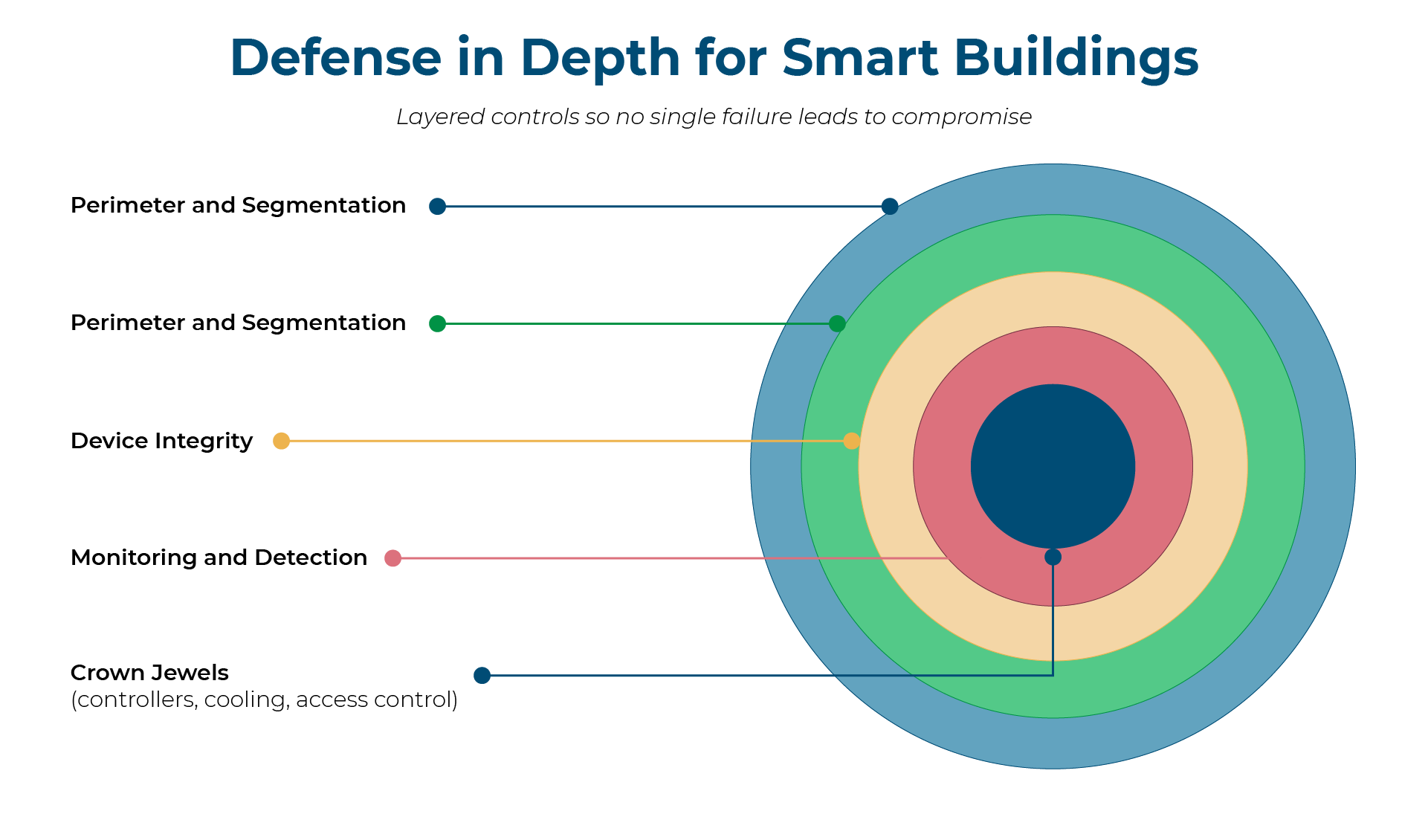
Defense in depth for smart buildings: layered controls, so no single failure leads to compromise.
Five Moves that Move the Needle
- Treat the building network as production OT, subject to real-world security policies, rather than as an unclaimed gap between facilities and information technology.
- Maintain a comprehensive asset inventory for all controllers, gateways, and sensors to ensure effective protection.
- Separate OT and IT via a firewalled DMZ barrier, not a common VLAN tag.
- Implement multi-factor authentication and logged remote access for all vendors and engineers, with no exceptions.
- Use a recognized framework like NIST CSF 2.0 or ISA/IEC 62443 as the foundation of a security program, rather than depending on informal practices.
Device- and Network-level Hardening
- Change all default credentials before commissioning since default passwords are a regular finding in BAS inspections.
- Disable unnecessary services, ports, and protocols on all controllers.
- Consider using secure protocol versions, such as BACnet/SC, which substitutes unauthenticated broadcasts with TLS-encrypted, mutually authenticated communication.
- Use OT-aware solutions that comprehend BACnet and Modbus protocols, as traditional IT security tools are ineffective for monitoring this traffic.
- Create a BAS-specific incident response plan, as a mere “isolate and rebuild,” the usual IT playbook, may not be safe to use on a live fire panel without a safety evaluation.
Navigating Compliance Effectively
There is no single standard that entirely addresses BMS/BAS compliance. Thirty-one separate standards, laws, and certification programs may apply to a building’s systems, depending on the architecture tier of the component, the building’s industry, and its jurisdiction. Instead of viewing “compliance” as a single requirement, the chart below breaks down which ones, classifying them into eight areas so one can quickly identify where a specific standard truly bites.
| Category | # | Standards / Regulations Used |
| Core OT & Enterprise Security | 6 | IEC 62443, NIST SP 800-82 Rev. 3, NIST SP 800-53, NIST CSF 2.0, ISO/IEC 27001, ISO/IEC 27002 |
| Protocol & Cloud Assurance | 4 | BACnet/SC, IEC 62351, CIS Controls v8, SOC 2 |
| Device / Product Certification | 6 | UL 2900-1, UL 2900-2-2, UL 2900-2-3, ETSI EN 303 645, OWASP IoT Top 10, ISA Secure |
| Data Privacy | 2 | GDPR, CCPA/CPRA |
| Sector-Specific Legal | 4 | HIPAA, FISMA, NERC CIP, PCI DSS |
| Physical & Life-Safety | 4 | TIA-1005/ISO 11801 (EN 50173 in Europe), NFPA 72, EN 54 |
| Emerging / Regional | 4 | EU Cyber Resilience Act, ISO/IEC 30141, ISO 50001, ISO/IEC 81001-1 |
| Portfolio Certification | 1 | TIA/UL SPIRE Smart Building Program |
Which of these Are Actually Required?
Nine of the thirty-one are legally binding, while the others are optional, a distinction worth noting since it affects how a security program should prioritize them.
The Bottom Line
In terms of energy, comfort, safety, and operational intelligence, smart buildings offer real, quantifiable value that will not decrease. The systems that provide it now play a significant role in the enterprise’s digital risk landscape, necessitating the same security precautions as any other important network. Instead of treating BMS/BAS as facilities equipment with an IP address, the companies who do this right use it as production infrastructure with a named owner, a real inventory, a segmented network, and a recognized framework, all without necessarily spending the most money.
You already have a PC in your building. Whether it is defended is the only serious question that remains.
Frequently Asked Questions – BMS/BAS cybersecurity
1. What is the difference between a BMS and a BAS?
Building Automation Systems (BAS) and Building Management Systems (BMS) are frequently used interchangeably in technical and vendor literature. Both speak of centralized platforms that keep an eye on and manage building systems, including elevators, HVAC, lighting, fire and life safety, and access control. Some companies differentiate between BMS, the more comprehensive management platform, and BAS, the equipment automation layer. There is no general distinction, though. From a cybersecurity standpoint, both need comparable layered security procedures to safeguard infrastructure and linked building systems.
2. Can I use my existing IT security tools to protect my BAS?
Building Automation Systems (BAS) cannot be secured enough by conventional IT security technologies alone. These tools may not fully comprehend specialist BAS protocols like BACnet and Modbus because their primary purpose is to inspect regular IT network traffic. Conventional security monitoring may be unable to detect malicious or unauthorized commands because these protocols were created for interoperability and may not have robust authentication or encryption. Effective BAS security requires strong network segmentation and OT-aware monitoring that can interpret industrial protocols. Use network zones and firewalls to separate BAS networks from corporate IT networks. Therefore, rather than being mutually exclusive, OT-specific controls and traditional IT security should be viewed as complementary.
3. Which BMS/BAS Cybersecurity Standards are mandatory for my building?
Only about nine of the about thirty-one relevant standards and frameworks may be required by law or contract, depending on the building’s industry, location, and relevant regulations. For instance, government facilities might have to adhere to NIST SP 800-53 and FISMA, whereas healthcare institutions might have to follow HIPAA. PCI DSS may apply to parking, hotel, and retail businesses that handle credit card information. Buildings that collect or handle visitor or tenant data may also need to comply with privacy laws like the CCPA/CPRA or GDPR. Depending on the region and system in question, fire and life-safety regulations, such as NFPA 72 in the US and EN 54 in Europe, may also be required. The other standards, such as NIST CSF 2.0 and IEC 62443, are widely acknowledged as cybersecurity best practices but are typically optional.
4. Can a cyberattack on a building’s BMS/BAS put people in physical danger?
Yes, because these systems manage actual machinery and procedures, cyberattacks on Building Management Systems (BMS) and Building Automation Systems (BAS) may pose a physical safety concern. Unauthorized access could allow an attacker to control systems like HVAC, access control, or other building infrastructure, which could have an impact on building operations and occupant safety. A DDoS attack that interrupted building heating and ventilation systems during the winter in Lappeenranta, Finland, in 2016 is a recorded example of how a cyberattack can have physical repercussions.
For this reason, operational and safety effects must be considered while responding to incidents in BMS/BAS environments. Critical building or life-safety systems should not automatically be subjected to standard IT procedures, such as quickly isolating or shutting down