
Abstract
This is the first part of a two-part series examining the architectural challenges of Remote Device Management (RDM) on the IoT scale. Across both parts, we shall analyze ten different challenge domains. From device connectivity and data ingestion through intelligent automation, enterprise integration, and system observability, providing production-validated design patterns and implementation guidance for each.
Part 1 begins by exploring the infrastructure layer of the system, focusing on those architectural decisions that form the basis of the system’s ability to deal with heterogeneous devices, to handle vast amounts of telemetry, to establish trusted relationships, to execute commands, and to manage the lifetime of data. These five challenging domains make up the infrastructure of the system and must be addressed correctly before any of the other layers of functionality such as operational intelligence, access control, enterprise integration, etc. can be successfully implemented at a large scale.
Part 2 will cover the operational and intelligence layer and will include topics such as automation, multi-tenant access control, enterprise system integration, Edge-Cloud coordination, and full-stack observability.

An Overview
With an increase in IoT devices deployed in industrial, healthcare, infrastructure, and consumer environments the modern environment has become highly heterogeneous in terms of technology and scale. A typical fleet management platform may have to deal with sensor nodes running very constrained operating systems, industrial devices communicating via outdated communication protocols (e.g. Modbus over serial lines), hundreds of thousands of Cloud-connected medical devices that have to comply with regulatory requirements, hundreds of thousands of devices that are behind NATs and firewalls in consumers’ homes, and all of them need to be regularly, remotely and automatically monitored (with little or no user intervention), updated and managed, with changed configurations being validated against overall policy sets and with remote access to back-end enterprise resources still being required. Remote Device Management can no longer be viewed as merely an ‘operations toolchain’. Today, managing large quantities of networked devices successfully requires a foundational set of technological and procedural principles, constituting what might be termed as a ‘Remote Device Management Architecture’.
Key technological design decisions are made early in the technology stack. Decisions around device classification, authentication, telemetry ingestion, processing and routing, and remote control command sending and acknowledgement typically occur at the fundamental hardware, operating system, communication protocol, and associated application levels. Each choice has far reaching implications throughout all aspects of the operational life cycle of remote managed devices and, if chosen poorly, can lead to performance restrictions, security holes, and the unnecessary expense of re-engineering systems in place of designed-in or inherent flexibility and elasticity.
This article discusses five fundamental challenging domains that underpin all large-scale IoT management platforms and identifies the technical problem, its systemic impact, and patterns and practices that can be derived from production IoT implementations for each of them.
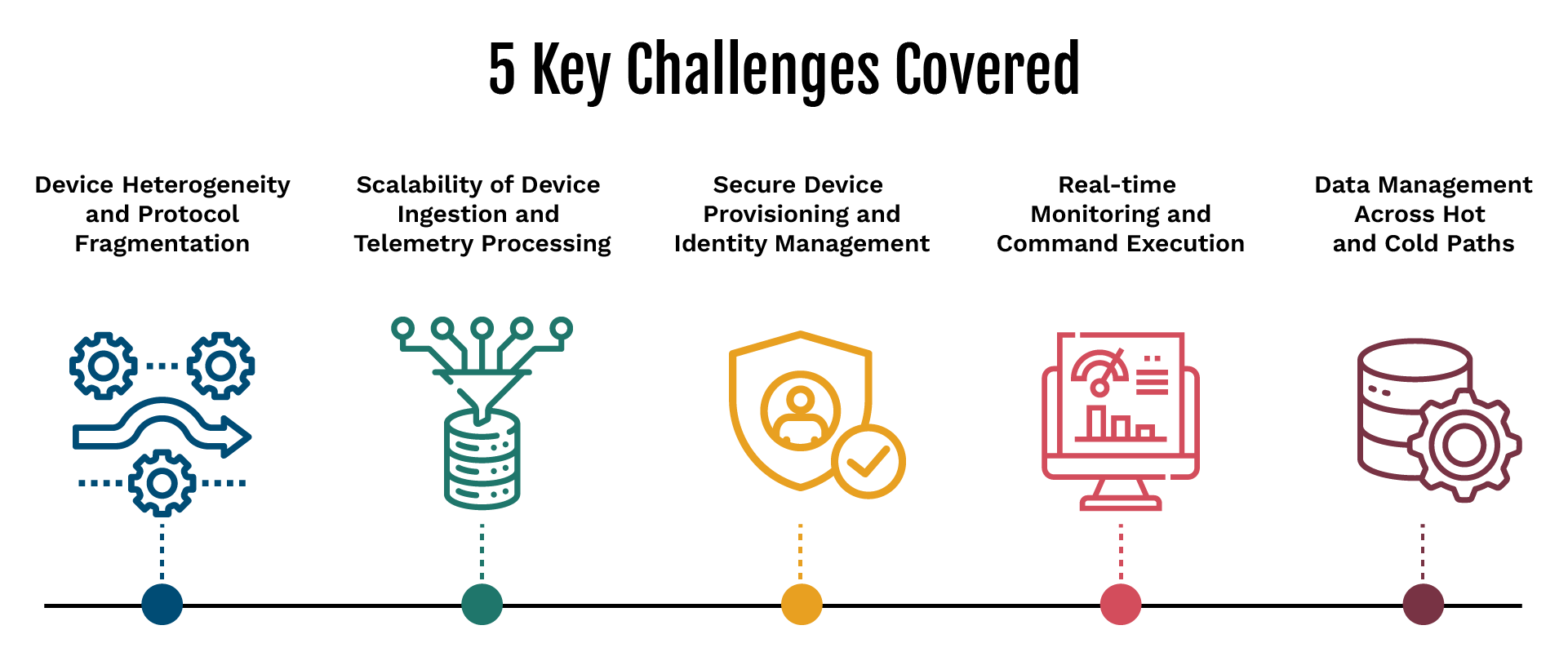
Challenges Covered in Part 1
Challenge 1 – Device Heterogeneity and Protocol Fragmentation
Challenge 2 – Scalability of Device Ingestion and Telemetry Processing
Challenge 3 – Secure Device Provisioning and Identity Management
Challenge 4 – Real-time Monitoring and Command Execution
Challenge 5 – Data Management Across Hot and Cold Paths
Challenge 1 Device Heterogeneity and Protocol Fragmentation
Problem Statement
Every large IoT project involves deployment of a wide variety of different types of devices, from small microcontroller based sensors and single board computers to full blown embedded Linux gateways, and older legacy SCADA devices. At the edge there are more modern Cloud-based Edge devices. The communication protocols between devices are many and varied: light-weight M2M publish/subscribe messaging using MQTT, enterprise-level message queues such as AMQP, Web-based HTTP/REST interfaces, the constrained protocol CoAP, and proprietary and often not officially documented, communication stacks of legacy industrial control systems. These differing communication stacks have a variety of different models and assumptions about the reliability of communication links, about the order in which messages need to be sent/received, about the quality of service, and how to represent and encode data within messages.
Architectural Impact
When backend systems speak to each protocol natively, the integration surface area explodes. Each new device class requires custom connector development, testing, and maintenance. Protocol idiosyncrasies leak into business logic, creating tight coupling between device implementations and backend processing pipelines. The result is a fragile system that resists extension and amplifies vendor lock-in.
Solution: Protocol Abstraction Layer
The solution is to introduce a dedicated protocol abstraction layer that normalizes all inbound device communication before it touches the core processing infrastructure. These layers are protocol-specific device message decoders and form the Device Protocol Decoder Layer. They take the unprocessed messages received from a device and change them into a format suitable for further processing. This typically involves parsing them into a device specific JSON structure containing device information, time stamps, message type, and the actual payload.
- Deploy protocol adapters at the rate of one per protocol family, as independently scalable services that handle the connection lifecycle and translate to a canonical event format
- Use a message broker (Apache Kafka, RabbitMQ, or AWS IoT Core) as the normalization boundary, adapters publish to the broker; downstream services consume only canonical events
- Define and version canonical data models using schema registries (e.g., Apache Avro with Confluent Schema Registry) to enforce consistency and enable schema evolution
- Implement bidirectional translation to support command dispatch back to heterogeneous devices in their native protocol
Canonical data models and protocol adapters are the architectural glue that decouple device diversity from backend complexity; they must be versioned and governed like public APIs.
Challenge 2 Scalability of Device Ingestion and Telemetry Processing
Problem Statement
The majority of current IoT platforms are not designed to handle the real-time ingestion of IoT data on a large scale. Currently, all current IoT platforms are only designed to handle a limited amount of real time IoT data from a small number of devices. They quickly become saturated with data as the number of IoT devices increases. Often IoT platforms need to handle telemetry data from millions of devices with high update rates ranging from sub-second to an hour. Any spikes in traffic, such as bulk firmware updates to an entire fleet of vehicles, or massive reconnections following a network failure, can increase data flows at magnitudes beyond the normal operating levels. Scalable stateful processing architectures cannot be economically sustained to handle such traffic levels by allocating one thread or connection per device.
Architectural Impact
All applications have a monolithic ingestion pipeline for processing data. Over time, this becomes the biggest bottleneck in the system and a source of backpressure in one place after another. This then leads to periodic queue overflows and message drops in other parts of the system, thereby decreasing telemetry quality and command reliability as a result. Lastly, highly provisioned resources often sit idle more than get used and have the associated expensive overheads.
Solution: Distributed Stream Processing Architecture
We are entering an era of exceedingly high ingestion rates, which impose vastly different demands on system architecture than earlier data processing systems did. What is needed is a system architecture that is truly stateless, horizontally scalable to the extreme. The ingestion layer needs to behave more like a reliable message queue which swallows bursty peaks in data flows and completely decouples the dynamically coupled data sources (e.g., device links) from the system that can often be scaled vertically and horizontally in order to process their respective message queues.
- Use partitioned, replicated message queues (Apache Kafka, AWS Kinesis) as the ingestion backbone, partition by device ID to preserve per-device ordering while enabling parallel consumer scaling
- Implement stateless ingestion microservices that accept device connections, validate messages, and publish to the queue without performing downstream processing
- Deploy stream processing engines (Apache Flink, Spark Streaming, or AWS Kinesis Data Analytics) for real-time aggregation, anomaly detection, and routing
- Apply backpressure signaling at the ingestion boundary to protect downstream systems during burst events
- Use consumer group auto-scaling triggered by queue lag metrics to maintain processing SLAs without over-provisioning at rest
The ingestion tier and the processing tier must scale independently. Coupling them is the single most common cause of IoT platform performance ceilings.
Challenge 3 Secure Device Provisioning and Identity Management
Problem Statement
The Trust and Identity at the Edge (TIE) project is a part of the larger Cyber-Physical Systems (CPS) Secure 2.0 project. In the Internet of Things, device provisioning is the first step in IoT device management processes, and the most architecturally significant challenge is trust at the edge, achieved through the art of bootstrapping. The timing, mechanism and user experience of provisioning, enrollment, device onboarding and onboarding are all attack surfaces for connected devices in remote device management in iot. Without strong identity, all other security controls such as authorization, encryption, and code signing of software updates fall apart. While provisioning processes need to be highly automated through automated provisioning to facilitate scale, this remote management function also reduces errors in large-scale iot device management without compromising the security of the trust established in the Edge device. Zero-touch provisioning enables secure onboarding of new devices online.
Architectural Impact
Weak provisioning processes create exploitable enrollment vulnerabilities, enable device spoofing and man-in-the-middle attacks, and complicate incident response when the device identity records are incomplete or inconsistent. Identity lifecycle gaps, particularly around revocation, allow compromised devices to maintain system access long after they should be isolated.
Solution: Zero-Trust Device Identity Architecture
- Zero Trust Device Identity Definition: Zero Trust Device Identity refers to a posture or approach that treats all devices as untrusted as a baseline. This model assumes that no device should be considered trusted under any circumstances, regardless of whether it is on or off the corporate network, or whether it has been authenticated to resources in the past. To mitigate risks to users and data, all devices must provide cryptographic proof of their identity every time they are engaged with, so only authorized devices can join IoT networks, and any identity that is shared must be tied to hardware attributes wherever possible.
- Issue unique X.509 device certificates at manufacturing time using a dedicated device PKI, with certificates bound to hardware identifiers (serial number, MAC address, TPM-backed keys)
- Implement a Device Registration Service that validates certificate chains, checks revocation status (OCSP or CRL), and issues short-lived access tokens for all Cloud service interactions so access control security is enforced for authorized devices and sensitive data is protected with data encryption
- Maintain a device shadow/registry that tracks full identity lifecycle state: registered, provisioned, active, suspended, decommissioned, supports device configuration and device settings through remote configuration, and ensures decommissioning safely wipes sensitive data from devices at end of life
- Implement automated certificate rotation before expiration, with revocation workflows integrated into device lifecycle events (theft report, end-of-life, ownership transfer), including timely security patches
- Apply mutual TLS (mTLS) for all Device-to-Cloud communication to enforce bidirectional identity verification
Device identity is the root of trust for the entire IoT security architecture. Compromising it at provisioning time renders all higher-layer controls ineffective.
Challenge 4 Real-Time Monitoring and Command Execution
Problem Statement
Communication for fleet management must be bidirectional: on one side the service needs to handle remote monitoring of device health, device status, and device performance metrics for diagnostics and troubleshooting so teams can manage devices, and it must support device control by sending commands, configuration updates, reboots, or calibrations, etc. with small latency and high reliability. While polling in fleet management is not optimal (very inefficient for device fleets, especially large device fleets), designing a connection management strategy for managing this persistent communication flow at scale has several implications including connection state management, ordered message handling and guaranteed message delivery, while also reducing field service calls and lowering operational costs.
Architectural Impact
Command latency due to a polling interval is not acceptable in safety-critical or mission critical applications. Today there is no unified observability of the system, and any anomalies that are reported via telemetry are difficult to correlate with the sequence of commands that have been sent to the system, slowing up diagnosis and thereby increasing mean time to repair (MTTR).
Solution: Event-Driven Bidirectional Control Architecture
- Real-time RDM is all about getting the event-driven architecture of low latency devices working in a way that has always-on, always-on multiplexed channels to the Cloud control plane for each device. Real-time RDM is thus about two things:
- Instantaneous reactions to telemetry that triggers certain conditions
- Instantaneous command being “pushed” to devices without the devices having to initialize a connection first, which also lets teams push updates and other software updates over the air to IoT devices through the same event-driven path
- Use MQTT with QoS level 1 or 2 for command delivery to ensure at-least-once or exactly-once semantics that are critical for state-changing operations and changes to operational parameters
- Implement a Command Dispatch Service that manages command queues per device, tracks acknowledgment status, and retries unacknowledged commands with configurable backoff during software maintenance
- Deploy rule engines (AWS IoT Rules, Apache Flink CEP, or custom ECA frameworks) that evaluate telemetry streams in real time and trigger automated remediation actions that protect device functionality
- Build a unified device timeline that correlates telemetry events, command dispatches, acknowledgments, and state transitions for each device — essential for audit and diagnosis across device deployment
- Implement shadow state synchronization to handle devices that are intermittently connected, delivering queued commands upon reconnection
Challenge 5 Data Management Across Hot and Cold Paths
Problem Statement
IoT projects constantly produce large amounts of time series data that change rapidly. A single device can emit dozens of data points per second. With a fleet of millions, the data generated can be several orders of magnitude larger than any data an enterprise has seen before. With such large amounts of data, the challenge is to serve two vastly different query patterns efficiently:
-High-performance real-time monitoring and
-Alerting applications that require query latency of seconds or less
All this while also having to support longer-term historical analytics and compliance reporting use cases where latency is less important, but data has to be queried across the entire fleet for months or even years.
Architectural Impact
We cannot fit both use cases into a single storage system and have it functioning perfectly. While a relational database is a great storage system for a transactional workload, it is unable to handle the ingestion rates of a time-series workload. A data lake with a batch analytics workload can barely handle a few hundred GB of data, it is also unable to deliver query latency that makes sense for a real-time analytics workload. It is always retroactive and the result is some sort of poorly bolted-on data path, which then generates all sorts of inconsistencies, redundancy, and other operational pain points.
Solution: Tiered Hot-Warm-Cold Data Architecture
Implement a storage solution using- a multi-tiered architecture that dynamically directs data to targeted storage systems based on the criteria of data recency and query patterns. The storage solution uses automated lifecycle policies to ensure that the data is migrated to the most optimal tier.
- Hot path: Route recent telemetry to time-series databases (InfluxDB, TimescaleDB, or Amazon Timestream) optimized for high-ingestion and real-time range queries with retention windows of hours to days
- Warm path: Aggregate and downsample data to columnar stores (Apache Parquet on S3, or Azure Data Lake) for week-to-month range analytics queries
- Cold path: Archive raw telemetry in compressed object storage (S3 Glacier, GCS Nearline) for compliance, audit, and long-range ML training workloads
- Implement schema evolution strategies (backward-compatible Avro schemas, partitioning by device type and date) to accommodate fleet-wide firmware changes that alter the telemetry structure
- Apply data aggregation at the stream processing layer, pre-computing roll-ups (hourly min/max/avg) before storage to reduce query-time computation
Data tiering is not storage optimization. It is an architectural prerequisite for any IoT system that must simultaneously serve operational dashboards and historical analytics at fleet scale.
Conclusion
The five challenges addressed in this article represent the infrastructure foundation on which every other RDM capability is built. Protocol normalization determines how broadly a platform can serve diverse device ecosystems. Ingestion architecture sets the performance ceiling for everything that depends on telemetry data. Device identity establishes the root of trust that makes all security controls meaningful. Bidirectional command execution enables the control loop that closes the gap between the platform and the device. Data tiering ensures that transactional and analytical workloads do not interfere with each other.
These are not independent concerns. They form a tightly coupled foundation. A weakly provisioned identity system undermines the trustworthiness of telemetry data. An under-scaled ingestion pipeline creates gaps in the data that real-time control systems depend on. Decisions in any one of these layers propagate constraints and opportunities into the others. Architects who treat them as five separate engineering tasks rather than one integrated foundation system typically encounter systemic failure modes on a scale. Read more for Part 2.