
Today, choosing an appropriate technology for mobile app development is not just a technical choice anymore, but also a key business decision for organizations. An approach which is carefully chosen for mobile development helps teams build fast, scalable, and easy-to-maintain applications. Attractive interfaces and fancy features alone are no longer sufficient for success of a mobile product, the underlying architecture, application performance, development efficiency, scalability, and user experience are equally crucial.
At present, there are multiple options available for businesses and development teams for developing mobile applications. The common methods for mobile application development are Progressive Web Apps, React Native and Native mobile applications.
All these methods come with inherent merits and demerits. An approach ought to be chosen based on factors such as the user requirements, performance expectations, availability of resources, user experience priorities, and long-term maintenance convenience.
Let us understand and compare the PWA, React Native, and Native apps, considering their offerings, the limitations, and when it makes the most sense to use them.
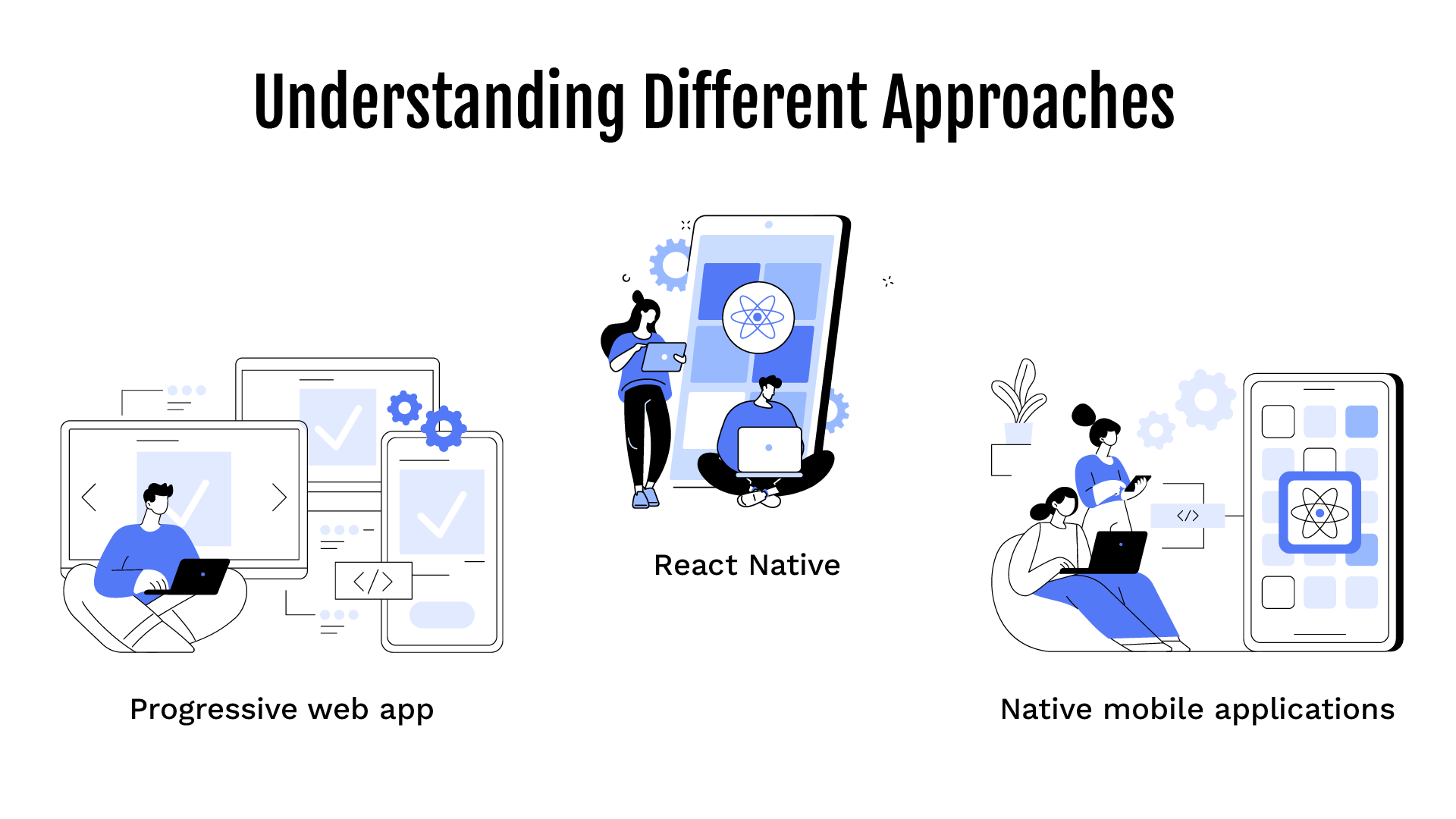
Understanding different approaches
Progressive web app (PWA) is an app that is built using web platform technologies, but it provides a user experience like that of a platform-specific app. Like a website, a PWA can run on multiple platforms and devices from a single codebase. Like a platform-specific app, it can be installed on the device, can operate while offline and in the background and can integrate with the device and with other installed apps. A PWA is used on platforms like Social Networking-X Lite (formerly Twitter Lite) and others like Starbucks and Pinterest.
React Native is an open-source framework which allows developers to build mobile applications using JavaScript and React. It supports cross-platform development, which means a single codebase can run on both Android as well as iOS devices. React Native bridges JavaScript with native components, which helps developers to create applications which provide the look-and-feel of native applications. React Native is used in social networking platforms like Facebook and Instagram, and e-commerce platforms like Shopify.
Native mobile applications are built specifically for a particular platform using platform-specific languages and tools. For example, Swift or Objective-C is used for iOS development, while Kotlin or Java is used for Android. Native applications provide a good level of control over device features, superior performance, and user experience as well. Native mobile applications are used in instant messaging platforms like WhatsApp and Telegram, music applications like Spotify, and on-demand transportation platforms like Uber.
All these approaches serve distinct purposes and suit different needs.
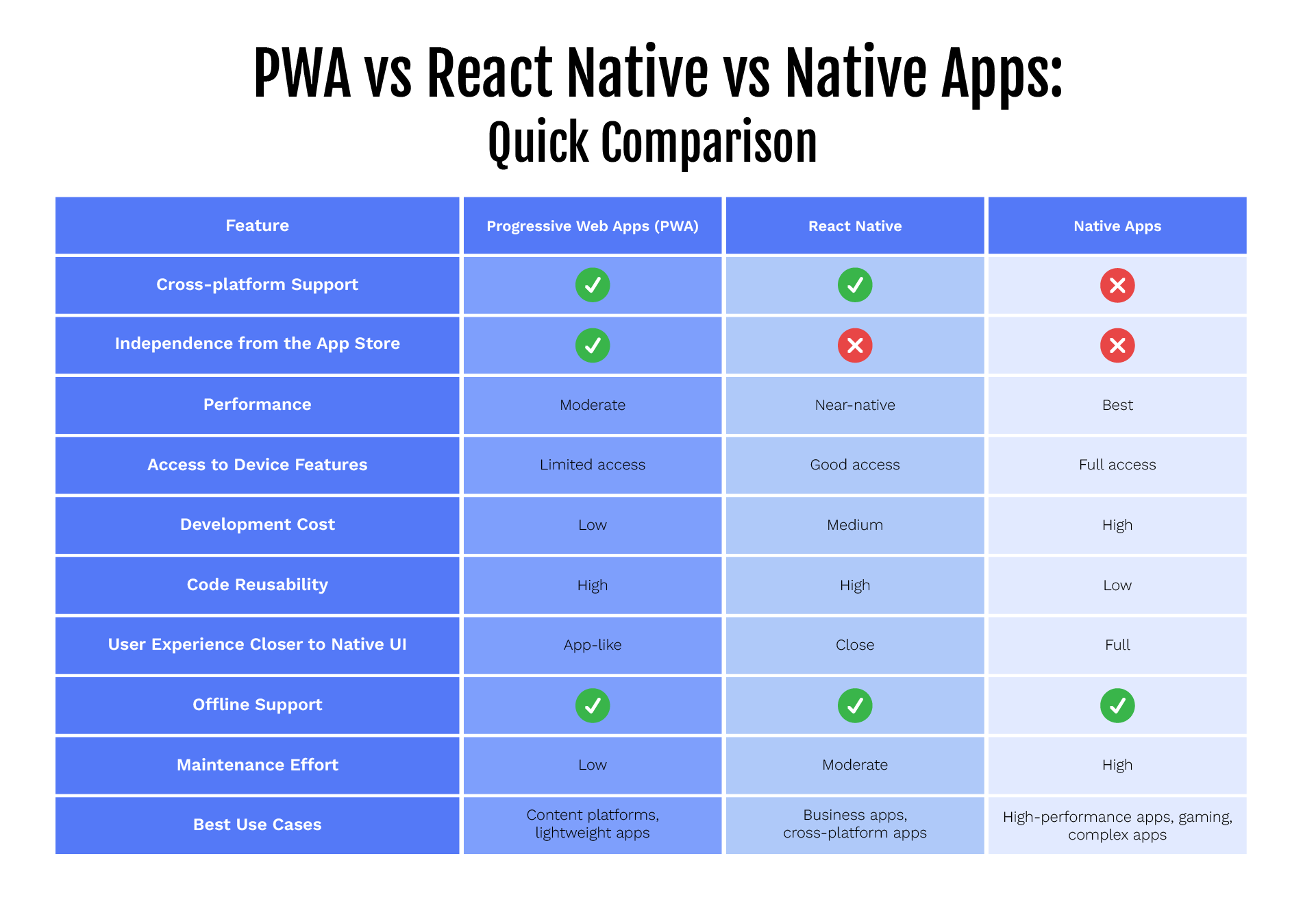
PWA vs React Native vs Native Apps: Quick Comparison
Key Features of Mobile Application Development
Progressive Web Apps (PWA)
Progressive Web Apps provide multiple features of mobile applications in the web environment.
- PWAs are designed to demonstrate behaviors like native applications and support features like full-screen mode, effortless navigation, and responsive layouts, which gives the look-and-feel of installed applications.
- PWAs can be directly accessed from web browser without having the need to download from any app store which further simplifies their distribution and also reduces the number of steps required to onboard new users.
- PWAs utilize service workers to cache content which allows users to access certain features when they are in no/low network connectivity areas.
- PWAs allows developers to reuse existing web development skills and codebases because of the fact that PWAs are built using web technologies.
- PWAs do not have dependency on any device or OS and can run on multiple platforms and devices without needing separate builds
- While PWAs have multiple advantages, they come with a certain limitation of access to device features as compared to native applications.
React Native
React Native, developed by Facebook in 2015, provides a balance between native performance and cross-platform development efficiency.
- React Native supports Android iOS development from one codebase, significantly reducing development time.
- React Native uses native UI components, which help provide a flexible user interface and a responsive user interface close to native apps.
- React Native facilitates reusable UI components like React which ensures easier maintenance and scalability of the codebase.
- Large community of developers and a wide range of libraries of React Native support features such as navigation, state management, etc.
- Developer can see code changes in real time without having to rebuild the application because of the hot reload feature, which speeds up the development process.
Flutter is another cross-platform option teams use to create apps for iOS, Android, and web from one codebase.
.NET MAUI is another option, and Visual Studio is ideal for building .NET MAUI apps that support Android, iOS, macOS, and Windows, including desktop.
Native Mobile Applications
High levels of integration with device capabilities as well as the performance are achieved by native mobile development using native code, with native Android offering stronger platform-specific optimization that can improve the app’s performance.
- Native apps deliver faster performance and smoother animations since they run directly on the device operating system and are optimized for the platform
- Apps can directly access the native capabilities of the device like camera, Bluetooth, GPS, sensors, etc. using native development
- Native apps provide extremely seamless and consistent user experience because they follow platform-specific design guidelines
- Advance security measures can be implemented using native applications and platform level protections can also be leveraged
- Native development proves to be highly beneficial for applications requiring heavy processing, high performance, or complex animation
While native development has multiple advantages, it comes with a drawback. It requires separate teams and codebases for Android and iOS, resulting in increased development effort and maintenance cost.
Comparison and Selection of Approaches for Cross Platform Development Based on Different Factors
Performance and User Experience-based Selection
Native Applications have mostly proven to have the best performance due to the fact that they run on the device directly and they use device environment specific languages and frameworks. In case of React Native, the performance of the application remains lower than but closer to native performance as they use native components and native API integration through JavaScript. Finally, the Progressive Web Apps run on browser environments, because of which they lag in performance as compared to React Native and Native application in some scenarios which involve graphics intensive tasks or complex animations.
Applications which require advanced capabilities of the device or high processing power should utilize Native development as it is more reliable.
Development Effort and Cost based comparison
Development time taken: PWAs < React Native < Native Apps.
PWAs use standard web technologies because of which they require least development efforts and also provide ease of deployment across the multiple platforms without any additional development efforts thus saving costs. In React Native we use the common codebase therefore it reduces the time required for development and still provides the mobile app experience, however, it takes more time than PWAs. Finally, in Native apps, we need to carry out development separately for each platform which results in increase in development and costs making it the costliest.
Choosing between PWAs, React Native, or Native Apps
On the basis of organizational goals and project requirements, a development approach should be chosen. Listing some scenarios below:

Conclusion
In conclusion, there are multiple methods using which mobile applications can be built, each of them is suited for a different use-case as per the requirement. While fast development and broad accessibility via usage of browsers can be achieved in PWAs, efficient cross-platform development without compromising on the native experience is achievable by React Native. Lastly, the highest performance and smooth integration with device capabilities is possible with the Native mobile applications. In short, we can choose the method on the basis of the project requirement, performance expectations, availability of resources and user experience intended. Last but not the least, long-term project maintenance is also an important factor that can guide the selection of an appropriate development approach.
Examining all the necessary factors, a mobile development method should be selected which supports both the immediate project needs as well as future growth and long-term sustainability.
Frequently Asked Questions
1. Which one is faster, React Native or native app development?
The short answer is that development is faster using React Native. If we deep-dive into the details, React Native app development enables developers to reuse most of the code across Android and iOS, resulting in reduced development time, testing effort, and maintenance. And in the case of native development, it requires separate codebases. In certain scenarios, the runtime performance of React Native apps is slightly lower than that of fully native apps, especially for graphics-intensive or CPU-intensive apps.
2. Can Progressive Web Apps (PWAs) replace mobile apps?
Progressive web apps can replace mobile apps in some cases, such as content-driven, e-commerce, and news platforms. They don’t require app store downloads and can still offer offline support and app-like interfaces. Despite all the advantages, PWAs cannot fully replace native apps in scenarios that require deep hardware access, advanced animations, or high-performance processing.
3. Can I convert an existing web application into a PWA?
In many cases, yes, we can do it. Existing web applications can often be converted into PWAs by adding service workers, caching strategies, responsive design, and installability features, making a Progressive Web App a cost-effective option for businesses with a web product that wants to improve mobile accessibility without building a separate mobile application.