

Executive Summary
Intelligent buildings are transforming how commercial, industrial, and residential spaces operate. By combining embedded systems, Internet of Things (IoT) connectivity, cloud platforms, analytics, and Artificial Intelligence (AI), smart building technologies enable smart buildings to autonomously optimize building operations and energy usage, improve occupant comfort and safety, and reduce operating costs. This document outlines the evolution of building technologies, a layered smart-building architecture, and practical guidance for designing and deploying effective Building Management Systems (BMS), including region-specific requirements for fire panel HMI displays.
Section 1: Evolution of Building Technologies
1.1 Market Outlook
- The smart building market continues to grow steadily, fueled by rapid urbanization, increasing decarbonization initiatives, evolving ESG compliance requirements, and the ongoing transformation of workplace environments in the post-pandemic era. Key market indicators include:
- Market size: Smart building solutions are projected to grow at a CAGR of 10–15% over the next decade, with fastest adoption in commercial buildings, especially across commercial properties such as offices, healthcare, data centers, and mixed-use developments.
- Adoption accelerators: Net-zero goals, rising energy costs, regulatory pressure, workforce hybridization, and occupant wellness expectations are driving investment.
- Technology convergence: IT/OT integration, digital twins, edge AI, 5G/LPWAN, cloud-native BMS platforms, advanced systems, and management software are reshaping the competitive landscape.
- Services opportunity: A significant portion of market value is shifting from hardware sales to software subscriptions, managed services, and outcome-based energy contracts.
1.2 Business Drivers
Organizations pursue intelligent building initiatives for a combination of strategic and operational reasons:
- Sustainability and net-zero commitments: Reduce scope 1/2 emissions through optimized HVAC, lighting, and demand response.
- Cost reduction: Lower energy, maintenance, and lifecycle expenditures by reducing operational costs and improving building performance through predictive maintenance, automation, and analytics.
- Regulatory compliance: Meet local codes for energy performance, fire safety, indoor air quality, accessibility, and data privacy.
- Workplace experience: Attract tenants and employees with healthy, safe, responsive, and flexible environments.
- Risk mitigation: Improve business continuity, asset protection, and emergency response through integrated safety and security systems.
- Asset valuation: For building owners, smart-building certifications and operational data support investment in future-ready solutions that increase property value and lease ability.
1.3 Benefits: Occupant Experience and Operational Efficiency
| Benefit Category | Occupant Experience | Operational Efficiency |
| Comfort | Personalized climate, lighting, and space booking | Zone-based environmental control reduces waste |
| Health & Safety | Indoor air quality (IAQ) visibility, touchless interfaces, wayfinding | Remote monitoring of critical systems; faster incident response |
| Productivity | Quiet zones, occupancy-aware services, seamless access | Automated workflows and reduced manual inspections |
| Sustainability | Tenant engagement dashboards | Energy optimization, waste reduction, predictive maintenance |
| Cost | Transparent billing in multi-tenant environments | Reduced energy, maintenance, and capital expenditure |
1.4 Why Product Engineering Matters
Strong product engineering transforms generic IoT components into reliable, scalable, secure, and certifiable building systems. Critical engineering capabilities include:
- Embedded hardware design: Ruggedized controllers, sensor modules, and gateways that operate 24/7 across diverse building environments.
- Firmware and edge software: Real-time control loops, protocol stacks, cybersecurity, and over-the-air (OTA) update mechanisms.
- Connectivity expertise: Multi-protocol integration (BACnet, Modbus, LoRaWAN, Zigbee, Wi-Fi, Thread, Matter, OPC UA, MQTT).
- Cloud and analytics platforms: Scalable data ingestion, device management, digital twins, AI/ML services, and Application Programming Interface (API) ecosystems.
- HMI and mobile applications: Intuitive interfaces for facility managers, tenants, and first responders.
- Compliance and certification: UL, FCC, CE, BSI, NFPA, BS 5839, IEC, and energy-efficiency certifications.
Without disciplined product engineering, smart building deployments can lead to vendor lock-in, interoperability issues, security vulnerabilities, and poor return on investment.1.5 Smart Building Maturity Model
The maturity model gives CXOs a clear way to assess current capabilities and define a roadmap.
| Level | Name | Characteristics | Focus Areas |
| 0 | Traditional | Siloed electromechanical systems; manual operations; no data visibility | Baseline assessment; asset inventory |
| 1 | Connected | Devices networked; basic monitoring dashboards; limited automation | Connectivity; data normalization; pilot use cases |
| 2 | Intelligent | Integrated systems; analytics-driven insights; automated workflows | BMS integration; AI analytics; energy and fault optimization |
| 3 | Predictive | Predictive maintenance; digital twins; scenario simulation | Advanced AI/ML; cross-system orchestration; occupant-centric services |
| 4 | Autonomous | Self-learning, self-healing, self-optimizing buildings with minimal human intervention | Fully automated control; generative AI; closed-loop sustainability; continuous compliance |
Section 2: Smart Building Technology Architecture
2.1 Overview
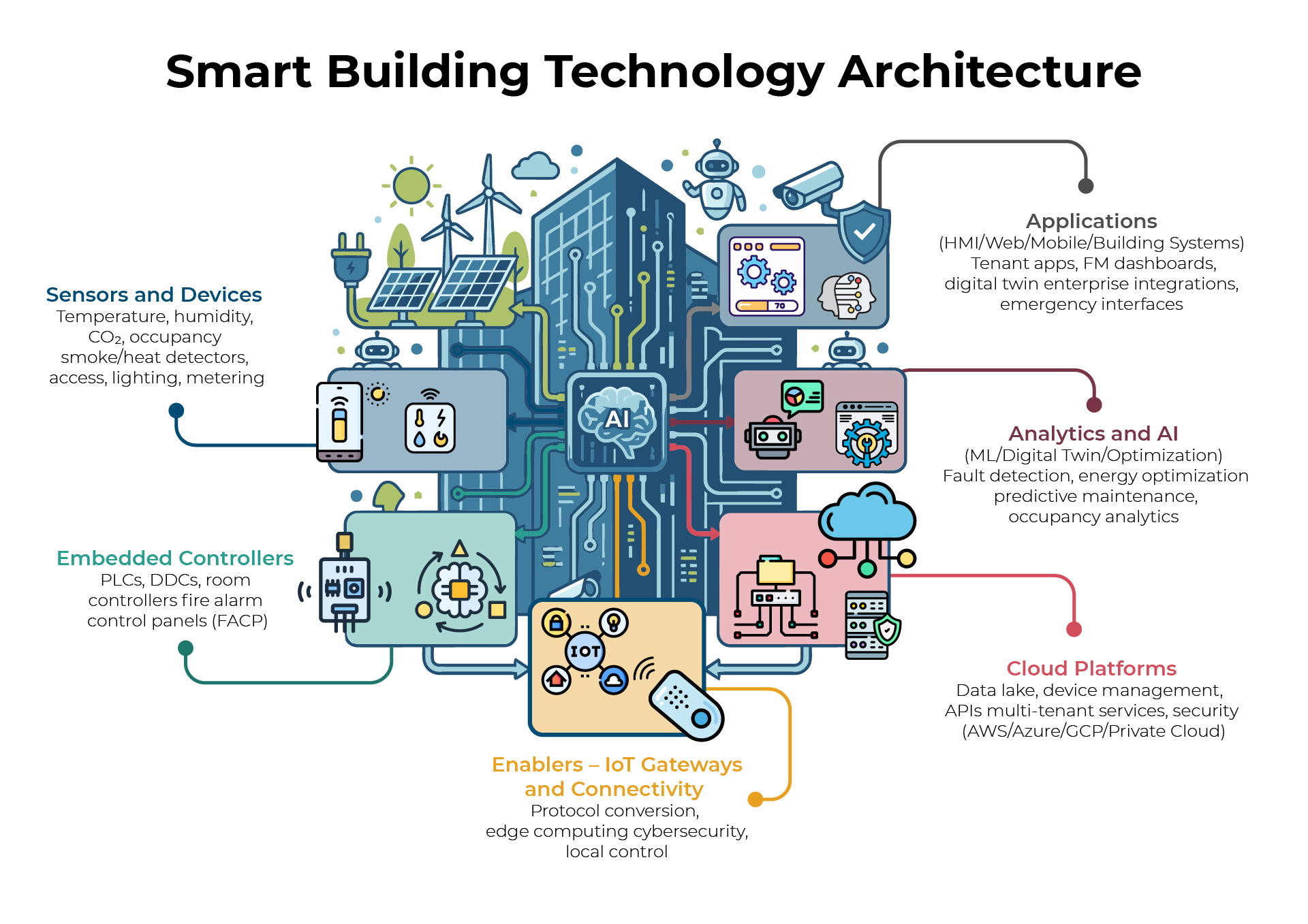
A modern smart building architecture consists of multiple layers: edge devices collect data, connectivity and gateways transmit it, cloud and analytics platforms process it, and applications turn that data into value to occupants, operators, and business systems.
2.2 Technological Advancements
Key advancements transforming building controls include:
- Touchless controls: Voice, gesture, mobile apps, and BLE/NFC credentials reduce physical contact and improve hygiene.
- Energy-efficient systems: Variable refrigerant flow (VRF), LED lighting with daylight harvesting, demand-controlled ventilation, grid-interactive efficient buildings (GEB), and smart HVAC systems and smart lighting solutions as examples of intelligent technology improving energy efficiency.
- Edge AI: Local inference for occupancy counting, anomaly detection, and predictive equipment health.
- Digital twins: Virtual replicas for simulation, commissioning, scenario planning, and continuous optimization.
- Wireless and mesh connectivity: Reduces cabling costs and simplifies retrofits in existing buildings, while automation systems increasingly include automated water conservation systems that detect leaks and monitor usage.
- Cyber-physical security: Zero-trust architectures, encrypted device onboarding, and secure boot.
eInfochips’ Role Across Every Layer
eInfochips contributes end-to-end product engineering across the architecture:
| Layer | eInfochips Capability |
| Sensors and Devices | Sensor module design, edge sensing, signal conditioning, power optimization |
| Embedded Controllers | SoC/MPU selection, DDC/FACP development, real-time firmware, BSPs, RTOS/Linux |
| IoT Gateways and Connectivity | Multi-protocol gateways, protocol converters, edge analytics, 5G/Wi-Fi/BLE/Zigbee/LoRa |
| Cloud Platforms | Cloud-native architecture, device management, microservices, data pipelines |
| Analytics and AI | ML model development, digital twins, predictive maintenance, energy optimization |
| Applications | HMI/web/mobile UI/UX, tenant portals, facility manager dashboards, SCADA/BMS front ends |
2.3 Applications Layer
The top layer delivers actionable interfaces and system integrations:
- Facility manager dashboards: Real-time monitoring, alerts, work orders, and energy reports.
- Tenant/occupant apps: Space booking, comfort voting, IAQ visibility, visitor management.
- Digital twins: 3D visualization, simulation, and scenario analysis.
- Enterprise integrations: Enterprise Resource Planning
(ERP), Computerized Maintenance Management Systems
(CMMS), sustainability reporting, and workplace experience platforms. - Emergency and life-safety interfaces: Fire panel Human-Machine Interfaces
(HMI), mass notification, first responder displays, and access control systems.
2.4 Analytics and AI Layer
This layer turns raw data into insight:
- Energy optimization: Load forecasting, peak shaving, demand response, and HVAC setpoint optimization.
- Fault detection and diagnostics (FDD): Rule-based and ML-driven identification of equipment anomalies.
- Predictive maintenance: Remaining useful life estimation and condition-based service scheduling.
- Occupancy analytics: Space utilization, density mapping, cleaning scheduling, and rightsizing.
- Indoor air quality management: Correlating CO2, VOCs, particulates, and ventilation rates.
2.5 Cloud Platforms Layer
Cloud platforms provide the scalable backbone:
- Device management: Onboarding, provisioning, configuration, and OTA updates.
- Data ingestion and storage: Time-series databases, data lakes, and streaming pipelines.
- APIs and integration: Representational State Transfer
(REST)/ Graph Query Language
(GraphQL) APIs, event streaming, and enterprise connectors. - Security and identity: Identity and Access Management (IAM),encryption, certificate management, and audit logging.
- Multi-tenancy: Isolation, billing, role-based access, and per-tenant analytics.
2.6 Enablers: IoT Gateways and Connectivity
Gateways bridge the OT/IT boundary:
- Protocol conversion: BACnet/IP to MQTT, Modbus to OPC UA, Zigbee/Thread to Ethernet.
- Edge computing: Local aggregation, filtering, and preprocessing to reduce cloud bandwidth and latency.
- Connectivity options: Ethernet, Wi-Fi, cellular (4G/5G), LoRaWAN, Zigbee, Thread, Matter, BLE.
- Cybersecurity: Firewalling, intrusion detection, secure boot, and device authentication.
- Reliability: Watchdogs, failovers, local storage, and offline operations.
2.7 Embedded Controllers Layer
- Direct digital controllers (DDC): For HVAC systems, air conditioning, lighting, and environmental control.
- Programmable logic controllers (PLC): For industrial and plant-room applications.
- Room controllers: For localized comfort, heating systems, and energy management.
- Fire alarm control panels (FACP): Life-safety controllers with local display and annunciation.
- Edge AI modules: For video analytics, occupancy sensing, and anomaly detection
2.8 Sensors and Devices Layer
The foundation of the smart building:
- Environmental: Temperature, humidity, CO2, VOCs, PM2.5, light, sound.
- Occupancy: PIR, mmWave, BLE beacons, Wi-Fi/LoRa presence, desk/chair sensors.
- Energy: Smart meters, sub-meters, current transformers, power quality monitors.
- Safety and security: Smoke/heat detectors, flame detectors, leak sensors, access readers, cameras.
- Actuators: Dampers, valves, VAV boxes, motorized shades, lighting ballasts.
Section 3: Fire Panel HMI Display: US vs. UK Requirements
Fire alarm control panels (FACP) and their HMI displays must meet different standards, terminology, and data requirements in the US and UK. Product engineering teams need to design region-specific HMI variants or configurable localization to ensure compliance and usability.
3.1 Standards and Certification
| Aspect | United States (US) | United Kingdom (UK) |
| Primary fire code | NFPA 72: National Fire Alarm and Signaling Code | BS 5839-1: Fire detection and alarm systems for buildings |
| Electrical safety | NFPA 70 (NEC), UL 864, UL 268 | BS 7671, EN 54 series, EN 12101 |
| Product listing | UL listed / FM approved | BSI Kitemark / LPCB / EN 54 certified |
| Monitoring | NFPA 72 requires alarm, supervisory, trouble | BS 5839 requires fire, fault, disablement, test, power indications |
3.2 HMI Display Data Differences
| Data Element | US Requirement | UK Requirement |
| Alarm terminology | “Alarm” / “Trouble” / “Supervisory” | “Fire” / “Fault” / “Disablement” / “Test” |
| Zone/address display | Zone number and device address (e.g., Z001 D012) | Zone and device address; may also use loop number |
| Audio-visual status | Horn/strobe, speaker, NAC circuits | Sounder, visual alarm device (VAD), beacon circuits |
| Evacuation message | “EVACUATE” / voice evacuation per NFPA 72 | “FIRE” / voice message per BS 5839 |
| Mimic diagram | Optional; often panel-level zone list | Mandatory or strongly recommended in larger systems with graphical zone plans |
| Cause-and-effect | Programmed per Authority Having Jurisdiction (AHJ) | Programmed per BS 5839 category (L1, L2, L3, etc.) |
| Disabled device indication | “Deactivated” or trouble condition | Explicit “DISABLED” indication; logged and visible |
| Test mode | Walk test, sensitivity test | Test / engineer mode with clear display indication |
| Power supply status | Battery trouble, charger status | Mains, battery, charging fault per EN 54-4 |
| Network/Panel interconnection | Network panel ID, node trouble | Panel network and repeater panel status |
| Event log | 500–1000 events typical; UL 864 requirements | 1000+ events; time-stamped per EN 54-2 |
3.3 HMI Design Implications
- Localization engine: HMI firmware should support locale-specific terminology, color conventions (e.g., UK red/yellow/blue/white indicators), and menu navigation.
- Certifiable code paths: Alarm logic and display behavior may need separate software builds, or feature flags validated to UL vs. BSI/EN standards.
- Field configuration: Installer menus must allow region selection, zone plan import, and cause-and-effect mapping aligned with local codes.
- Color and iconography: US systems often use red for alarm and yellow for trouble; UK systems may use red for fire, yellow for fault, and blue/cyan for disabled/test.
- Font and accessibility: High-contrast, large-font displays; audible annunciation synchronized with visual status.
3.4 Recommended Engineering Approach
- Build a configurable HMI framework with region profiles (US, UK, EU, APAC).
- Separate core fire logic from display/presentation logic to ease certification.
- Use an event bus where alarm/fire/fault/disablement/test events map to region-specific labels and colors.
- Provide panel-silencing and reset workflows appropriate to each standard.
- Ensure time synchronization (NTP/SNTP), battery-backed RTC, and tamper-evident event logging.
Section 4: Building Management Systems (BMS)
4.1 Core Components and Data Flow Architecture
A BMS integrates mechanical, electrical, and life-safety systems under a unified control and monitoring platform.
A BMS functions as one of the core building automation systems, unifying monitoring and control across mechanical, electrical, and life-safety systems.
Core Components:
- Field devices: Sensors, actuators, meters, and fire/safety devices.
- Controllers: DDCs, PLCs, and edge controllers running control loops.
- Gateways and network infrastructure: Protocol translators, switches, routers, and wireless access points that connect energy management systems, including a building energy management system used primarily for energy monitoring.
- Server/cloud layer: SCADA/BMS server, historian, analytics engine, and application services.
- Client layer: HMI workstations, web dashboards, mobile apps, and API consumers.
Typical Data Flow:
- Sensors sample environmental and equipment data.
- Controllers execute local control logic and publish data to the network.
- Gateways normalize protocols and route data to the BMS server/cloud.
- The historian stores time-series data; the analytics engine runs FDD and optimization algorithms.
- HMI/web panels present status, alarms, and trends to operators.
- Operators issue commands (setpoints, schedules, overrides) back through the control path to help optimize building performance.
4.2 Integration of Thermostats, Smart Sensors, and HMI/Web Panels
Multi-tenant BMS supports office buildings, shopping malls, co-living, and mixed-use developments:
- Tenant isolation: Per-tenant data segregation, access control, and billing boundaries.
- Sub-metering: Individual energy, water, and gas metering for accurate cost allocation.
- Tenant portals: Self-service apps for comfort control, service requests, and sustainability reporting.
- Common area management: Shared HVAC, lighting, elevators, and safety systems under landlord control.
- Flexible billing: Utility cost allocation, common area maintenance (CAM) charges, and ESG reporting.
- Scalability: Cloud-native multi-tenant architecture with white-labeling and per-tenant configuration.
4.4 Role in Energy Optimization, Fault Detection, and Real-time Control
| Function | Role |
| Energy optimization | Dynamic HVAC setpoints, demand-controlled ventilation, continuous monitoring of energy usage, load shedding, peak demand management, and renewable integration to reduce energy costs through smarter control strategies. |
| Fault detection and diagnostics (FDD) | Continuous comparison of actual vs. expected performance; early detection of valve/damper/sensor faults. |
| Real-time control | Millisecond-to-second control loops for VAV boxes, chilled water loops, lighting zones, and safety interlocks. |
| Compliance and reporting | Automated energy and carbon reporting, indoor air quality logs, and audit trails. |
| Predictive maintenance | Transition from calendar-based to condition-based maintenance, reducing downtime and extending asset life. |
4.5 Guidelines for Designing an Efficient Building Management System
- Start with outcomes: Define KPIs (energy savings, comfort, uptime, cost reduction) before selecting technology.
- Design for interoperability: Prefer open protocols and semantic data models to avoid vendor lock-in.
- Use layered architecture: Separate edge, gateway, cloud, and application responsibilities.
- Embed cybersecurity from day one: Zero-trust networking, device authentication, encryption, and secure update mechanisms.
- Plan for scale: Choose cloud-native, containerized, and multi-tenant architectures.
- Prioritize user experience: Intuitive HMI, role-based dashboards, and mobile-first occupant apps.
- Implement analytics early: Even simple rule-based FDD delivers value; evolve toward ML-driven optimization.
- Validate regulatory compliance: Understand local fire, electrical, energy, accessibility, and data privacy codes.
- Design for maintainability: Remote monitoring, OTA updates, modular hardware, and standardized field commissioning tools.
- Iterate with pilots: Start with a representative zone or building, measure ROI, and scale proven use cases.
Section 5: Conclusion
Engineering intelligent building technologies requires a disciplined, end-to-end approach spanning embedded devices, connectivity, cloud platforms, analytics, and user applications. The Smart Building Maturity Model provides CXOs with a practical framework to assess their current state and plan the transition toward autonomous buildings. Building Management Systems remain at the operational core, integrating thermostats, smart sensors, HMI panels, and enterprise systems to support energy optimization, fault detection, and real-time control. For global product engineering teams, region-specific requirements—such as differences in fire panel HMI data and display conventions between the US and UK—must be addressed early through configurable, certifiable, and localization-aware designs.
References and Standards
- NFPA 72: National Fire Alarm and Signaling Code
- NFPA 70: National Electrical Code (NEC)
- UL 864: Control Units and Accessories for Fire Alarm Systems
- BS 5839-1: Fire Detection and Alarm Systems for Buildings
- EN 54 series: Fire Detection and Fire Alarm Systems
- BACnet ANSI/ASHRAE Standard 135
- Modbus Organization Protocol Specifications
- ISO 16484: Building Automation and Control Systems (BACS)
- IEC 62443: Industrial Communication Networks – Network and System Security
Frequently Asked Questions – Intelligent Building Technologies
1. What is an intelligent building?
An intelligent building integrates sensors, controllers, connectivity, cloud platforms, and AI to automate and optimize operations. It uses real-time data from systems like HVAC, lighting, fire safety, and access control to improve energy efficiency, occupant comfort, security, and maintenance. Beyond basic automation, intelligent buildings can predict faults, adapt to occupancy patterns, and support sustainability goals, turning a traditional facility into a responsive, data-driven asset.
2. What are the main layers of smart building architecture?
A smart building architecture typically has five layers. The bottom layer contains sensors and devices that collect data. Above that are embedded controllers and IoT gateways that process and transport data. The connectivity layer links edge devices to cloud and analytics platforms, which store, analyze, and apply AI to the data. The top applications layer delivers dashboards, mobile apps, and interfaces for occupants, operators, and business systems.
3. Why does product engineering matter for smart building projects?
Product engineering turns generic IoT components into reliable, secure, and certifiable building systems. It covers hardware design, firmware, connectivity, cloud platforms, analytics, HMI development, and compliance with standards like UL, CE, BSI, and NFPA. Strong product engineering prevents vendor lock-in, interoperability failures, security breaches, and poor returns, while ensuring systems can scale and meet regional certification requirements.