
Software testing, however complex, has traditionally been about giving a certain input that returns a cognizable, checkable output. An AI agent breaks this mapping. Rather than simply producing an answer, an agent takes a path. Running an agent on the same prompt twice can give you two different answers; or can still get you the same answer, albeit due to two different chains of reasoning.
Most conversations about testing AI agents thus seem to settle quickly into checklists and benchmarks. Although this approach is not wrong, it is increasingly starting to look incomplete. The current practice of testing AI agents primarily borrows ideas from two older disciplines without fully adapting either:
- From machine learning, it borrows the benchmark. Running the agent against a curated task set, measuring the pass rate, treating a score as the quotient of readiness.
- From traditional QA, it borrows the test case. Defining the expected behaviour, testing accordingly, and adding it to a regression suite.
Although both are useful, neither is meant for a non-deterministic system, and can often result in false confidences.
The Split Tool-Stack
If we were to ask ‘n’ number of teams about the tool-stack they use for testing agents, we would get ‘n’ different answers. However, zoom out and most of them converge on two disciplines: pre-deployment validation and post-deployment monitoring.
For pre-deployment testing, there are libraries like DeepEval and RAGAS, which act as testing frameworks within broader testing strategies. DeepEval takes a pytest-style approach, letting teams measure task completion, hallucination rate, faithfulness, tool usage, and regression performance. RAGAS on the other hand goes deep on retrieval, checking context relevance, context recall, answer quality, and grounding in RAG pipelines specifically. But teams still need unit tests and integration tests around individual components as well as end-to-end flows, since those tools do not cover the full testing process across software engineering and other forms of agent behavior.
These tools answer a narrow set of questions:
- Did the agent finish the task?
- Did it pull the right information?
- Did it pick the right tools?
- Did it stay grounded in the evidence it had?
- What was the latency from task submission to the final output?
- Do the test results show quality and appropriateness when scored with LLM-as-a-judge?
Then, there are tools and platforms built for path-level observability. For example, LangSmith appeals to the teams already on LangChain or LangGraph, supporting end-to-end trace visualization, human review, LLM-as-a-judge scoring, A/B comparison testing, real-time visibility, production monitoring, and online evals.
Whereas an open-source tool like Arize Phoenix would enable drift detection, monitoring, framework-agnostic tracing leveraging OpenTelemetry (OTel). Performance testing also matters here, because it evaluates response speed and system stability under load.
Teams can adopt the following best practices:
- Picking up two tools instead of one, one for regression checks, and another for production platform monitoring, mandatorily.
- Set up test automation so running tests happens automatically after code changes, which makes regression testing far more reliable.
- Keep switching up the evaluation sets and avoid reusing them. Retire them every few cycles and building fresh ones from real usage.
- Pulling test cases from production traces, continuously; sampling interactions from real users and feeding them back into the suite.
- Benchmarking against a holdout that the agent never sees during training, since that is a better proxy for real world performance.
One also needs to remember that if the benchmark score only goes up, that is usually a sign that the evaluation itself, and not the agent, is the thing being optimized. Also, track success rate as the percentage of completed tasks, but do not treat it as the only metric.
The Blind Spot in AI Agents
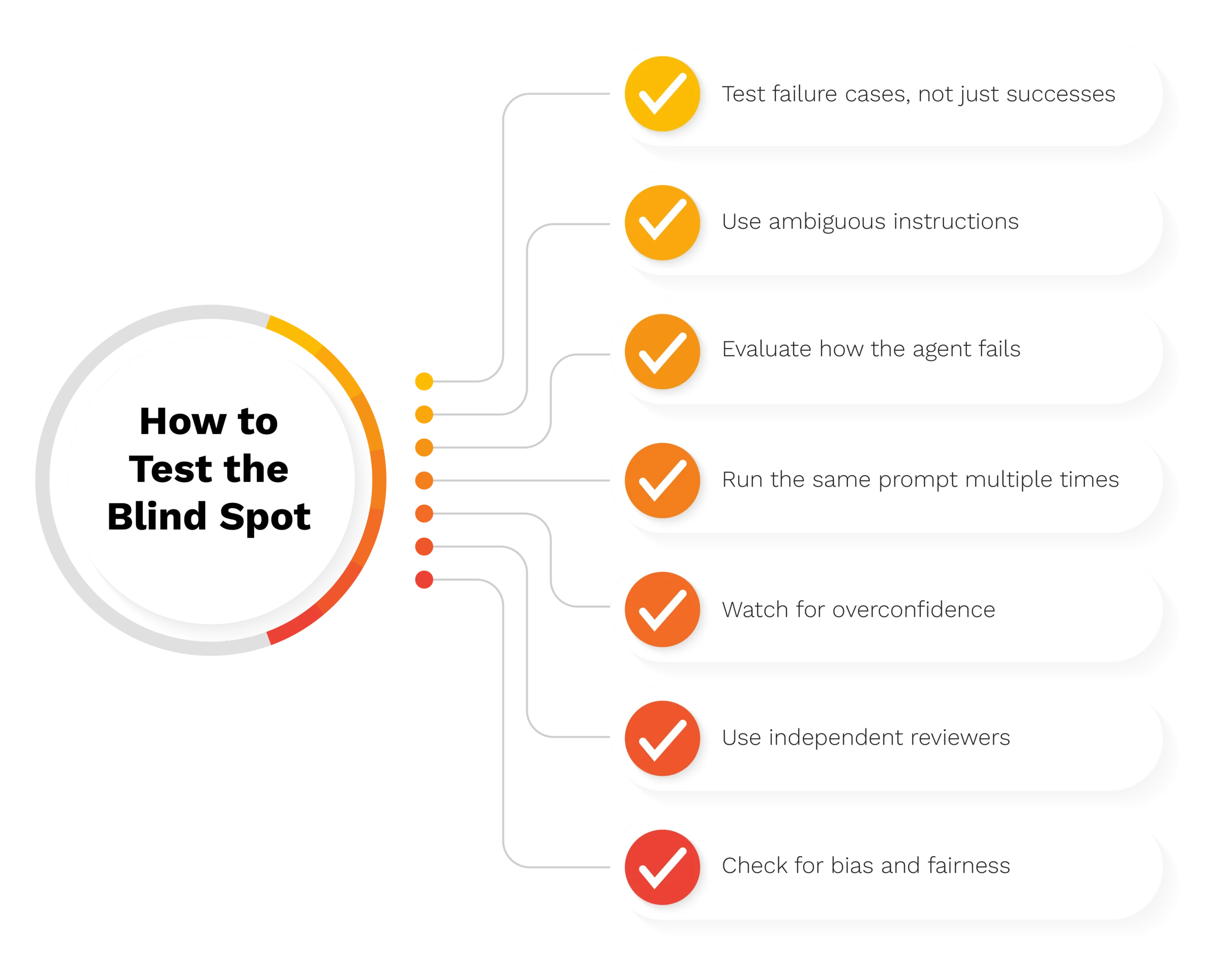
How to Test the Blind Spot
- Test failure cases, not just successes
- Use ambiguous instructions
- Evaluate how the agent fails
- Run the same prompt multiple times
- Watch for overconfidence
- Use independent reviewers
- Check for bias and fairness
Every testing effort goes into checking whether or not an agent is getting things right. However, only a few tests go into checking whether it knows or when it does not know. This gap is where costly failures happen: misinterpretations, hallucinated responses, and task failures when the agent does not know enough to proceed safely, and that is what separates a capable system from one you would actually trust.
What actually covers this blind spot:
- Treating failure cases explicitly as real test cases, not noise to filter out, and using balanced test sets with both easy examples and edge cases. Tools like DeepEval can score and track failure scenarios right alongside the successes.
- Giving ambiguous instructions to the agent and monitoring whether it asks a clarification or carefully infers the user’s intent instead of guessing.
- Paying attention to how it fails, not only whether it fails. A task that stops safely when something is wrong often beats one that finishes and gets it wrong quietly.
- Running the same prompt many times and tracking the spread in behaviour, not just the average outcome, to improve reliability.
- Watching for overconfidence specifically. A wrong answer delivered with total certainty is often a bigger risk than a hesitant one.
- Using independent reviewers, human or a second model, who were not part of building the thing, so that one is not assessing the agent with the tool and sets that it was trained to satisfy. This can complement manual testing processes.
Rigorous testing here should also include bias and fairness checks across different user groups.
The Sequence, Not the Score: The Need for Rigorous Testing
Fixing a blind spot is not just a matter of adding more scenarios to the test list; rather it is a matter of changing what gets evaluated in the first place. Evaluating an agent properly thus would entail:
- Evaluating the path, not just the output. Trace-first tools like W&B Weave or LangSmith, evaluate one span per agent step rather than one log line per conversation. An agent that gets the right answer through a wrong route still fails the test.
- Separating capability from behaviour, which means checking if the agent is staying within the scope limitations, checking on ambiguous instructions, and stopping instead of guessing the answers.
- Re-running evaluations constantly. A model update, a tool change, or a small prompt edit can quietly invalidate last week’s results.
- Pushing adversarial pressure into testing on purpose, like missing tools, contradictory instructions, hostile prompts. These discover more real problems than a clean benchmark run ever will.
- Treating cost and efficiency as qualifying criteria. Cost-tracking layers like Helicone or Langfuse can attach a token and cost figure to every test run, so a bloated call-count fails the test on cost, not just on time and efficiency.
The Finish Line that Keeps Moving
For agents, testing is a continuous process for agent systems, not a handoff from QA to production. This shift is re-shaping the next generation of AI engineering platforms, such as eInfochips NomAIzoTM. With the focus shifting from isolated model performance to the long-term management of agentic systems in production, enterprises can adopt the following measures:
- For agents, testing is a continuous process for agent systems, not a handoff from QA to production. This shift is re-shaping the next generation of AI engineering platforms, such as eInfochips NomAIzoTM. With the focus shifting from isolated model performance to the long-term management of agentic systems in production, enterprises can adopt the following measures:
- Shadow and canary deployments, i.e., running the agent alongside the existing process before the full rollout, should exercise real world scenarios and conversational ai agents to reveal gaps missed during the entire testing lifecycle.
- Regular, low-stakes proactive review of real interactions catches drift while it is still small. Tools like Braintrust and W&B Weave make it easy to pull a weekly sample and score it against the same rubric used before launch.
- Ongoing security assessments with tools like Garak, testing for new jailbreaks as they emerge, along with traditional penetration testing of the APIs, auth, and infrastructure that the agent sits on top of, help ensure compliance with GDPR and HIPAA and confirm that AI agents meet compliance and data protection standards.
- Ownership needs to be explicit across many teams, so that production monitoring is clearly responsible for agent behavior after launch and treats it as continuous validation and improvement.
- Assessing an Agentic system continuously and not like a one-time pass certificate means connecting the earliest stages of development to validation later in production, especially for autonomous systems, so that the real question stops being “did the agent pass” and turns into “is it still passing.”
Many of these measures have been concretized and validated through hands-on experience of building and evaluating agentic systems ourselves. The principles mentioned have been put into effect during the design and evolution of NomAIzoTM AI Studio, treating agent testing as an ongoing engineering discipline rather than a one-time certification exercise.
Conclusion
Better test suites, coverage for the failure modes, continuous monitoring after launch, etc. all of that still matters. Nevertheless, building agents that can differentiate between “I’ve got this” and “I don’t”, and testing for that difference directly and concretely remains the toughest part. The teams getting this right are not the ones with the most test cases stacked up, or the tightest pre-launch gate. They are the ones who have accepted that evaluating an agent is less like checking a function once and more like evaluating a decision-maker on an ongoing basis. That shift, from certifying an agent once to living with it, is the bigger change most teams have not fully made yet.
Frequently Asked Questions
Q1. How do you know when to pull an agent out of shadow mode?
No hard rule exists for this. Watch the mistakes it is making on live traffic instead. If they look about the same, or fewer, than what your current process already puts up with, that should be your green light, especially if user satisfaction is holding up and latency is good enough for real time interactions.
Q2. Why not just auto-generate fresh test cases instead of worrying about reuse?
Generated cases end up looking like tests. Predictable, clean, close to whatever the agent was already built to manage. Real production traffic does not play by that script. It throws things at the agent nobody sat down and designed, which is exactly what a generator cannot fake. That includes messy natural language prompts that unexpectedly trigger web search or call external tools. Reused user stories and captured user interactions from production also cover more of the input space than synthetic generators usually can.
Q3. Does testing after every small change not slow everything down?
No, it just moves the cost to a cheaper spot. A quick automated check right after code changes takes minutes, and that should include unit tests and regression testing, plus integration tests for how agents work when they depend on other agents or a web search tool. Finding that same bug three weeks later, from a user complain, costs a lot more.