
Artificial Intelligence (AI) is rapidly reshaping our everyday life today, from how we search on internet to how we perform our jobs. AI development was heavily dependent on Cloud infrastructure, where expansive computational resources were available for training, processing and inference. Recurring Cloud costs, latency, bandwidth costs, data privacy concerns, and intermittent connectivity have driven a shift from Cloud to Edge: intelligence moving to the Edge, as edge ai differs from traditional ai and cloud-based AI that rely on cloud based infrastructure and a centralized data center.
Edge Artificial Intelligence refers to the deployment of AI inference capabilities directly on embedded devices, and it is critical for applications that demand speed, privacy, and efficiency by processing data locally at the source and acting in real time. Whether it is a vehicle identifying a pedestrian/obstruction, an industrial controller detecting an abnormal bearing vibration pattern, or a wearable device monitoring health conditions, Edge AI enables decisions to be made where the data originates, keeping sensitive data on-device to improve data privacy and support operation with limited or no internet connection while reducing costs.
At a broader level, every Edge AI solution follows a common pipeline. Sensors generate raw data, the embedded platform performs signal conditioning and preprocessing, an AI model executes inference, and the application layer translates results in actions. This can now be performed to some extent using Generative AI (Gen AI) which also is being brought to Edge, as chipset manufacturers keep enhancing Edge processing capabilities.
Edge AI is a transformational opportunity to build smarter, safer, and more autonomous products. This article explores the technical foundations, challenges, and future opportunities of Edge AI in embedded systems.
Edge AI-typical Architecture
Modern Edge AI platforms increasingly adopt heterogeneous computing architectures. A general-purpose CPU manages operating system functions and application logic, while computationally intensive AI workloads are offloaded to specialized hardware accelerators such as GPUs, DSPs, or NPUs.
Typical Edge AI architecture can be classified as
- Capture: Sensor input and fusion (input to Micro-processor/Micro-controller over MIPI, I2C, SPI, GPIO interfaces)
- Pre-process : On-device filtering and normalization (on CPU, GPU or DSP cores)
- Infer: Light-weight AI models, event-based decision, TinyML/tensor framework execution (on NPU/CPU as necessary)
- Decision/Action: An application layer (may include Gen AI) shall interpret the AI outputs and make recommendations/take actions (which may include alarms, notifications, displays or shutting sensor off)
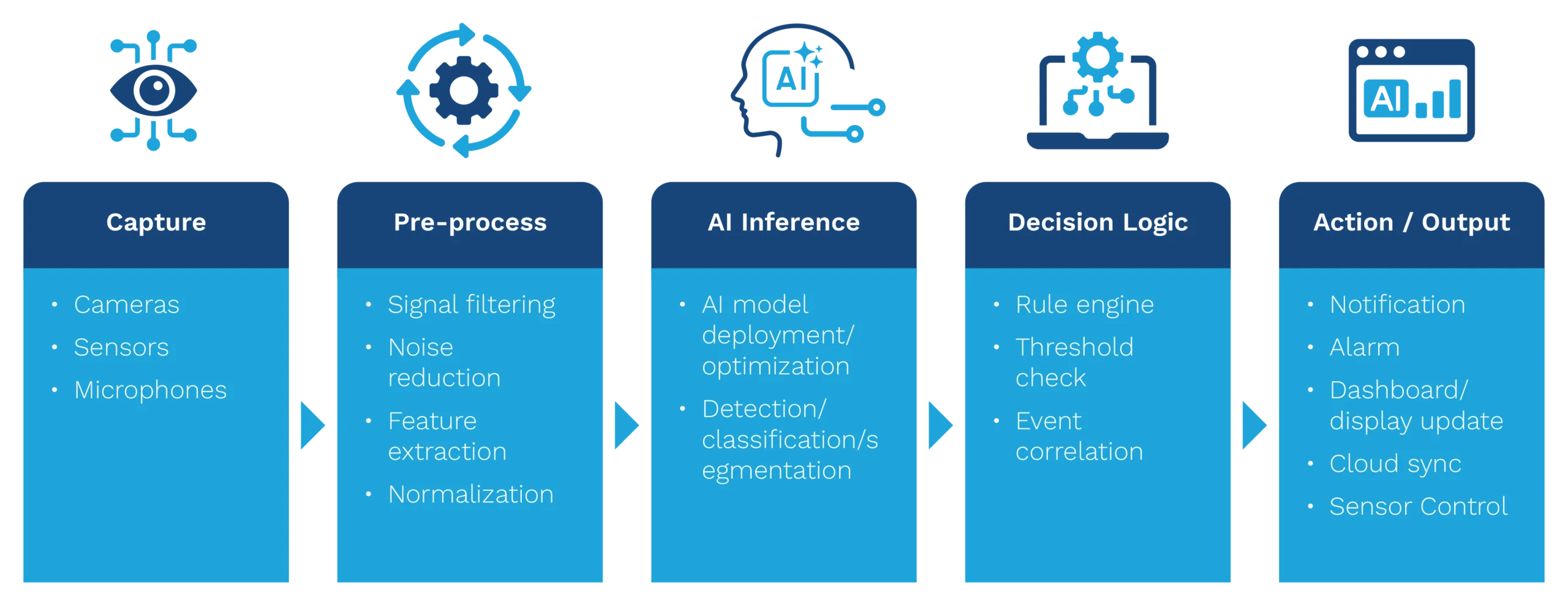
- The choice of the platform depends on application, security and industry requirements. Resource-constrained products may utilize ARM Cortex-M microcontrollers running FreeRTOS, bare-metal or Zephyr. More demanding workloads, such as computer vision or multi-sensor fusion, often require ARM Cortex-A processors, embedded Linux and dedicated hardware accelerators as part of an edge computing stack for edge AI systems and edge AI devices.
- Integrating AI into deterministic systems requires engineers to carefully evaluate inference execution times, task scheduling strategies, memory allocation schemes, and worst-case response behavior. Edge AI success depends not only on model accuracy but also on predictable and reliable execution.
- In deploying models in a resource-constrained Edge environment, there is a critical step to consider which is optimizing the AI model trained on extensive datasets in cloud computing for embedded deployment. Model conversion is not sufficient to achieve this. It also requires re-training the model for target use-case, model quantization from FP32 to INT8 and pruning, with optimized compact AI models required because of hardware constraints on local devices. Teams typically train models in cloud AI environments before deployment, while immediate inference and data processing stay on-site and more detailed analysis can remain in a central location. Model quantization significantly reduces memory usage, improves inference speed, and lowers power consumption but adversely affects accuracy. Pruning removes low-impact neural network connections to decrease computational complexity and also trading accuracy.
Key matrices to profile the execution pipeline for are:
- Inference time
- Core utilization for CPU, GPU, NPU/DSP
- Memory utilization
- Thermal and power behaviour
- Startup performance
Hardware Acceleration and Data Processing
Another critical aspect is hardware acceleration. Neural network workloads are highly parallel in nature. Operations such as convolution, matrix multiplication, tensor transformation and activation functions involve significant computational overheads when executed exclusively on general-purpose processors. Semiconductor vendors have thus integrated accelerating cores on-chip to off-load AI processing, and deploying edge AI depends on ai algorithms being mapped efficiently to accelerators for real time processing. Some of the edge ai solutions include, Arm Ethos NPUs, CUDA and RT cores, Qualcomm Neural Processing unit/digital signal processor and graphics processing unit, NXPs eIQ Neutron NPU, Texas instruments TinyEngine NPU and DSPs. These accelerates not only specialize in the required faster mathematical operations but also maintain low power consumption and stronger edge ai capabilities.
Commonly people associate performance with TOPS (Tera-operations per second) or GFLOPS (Giga-Floating operations per second), but holistically other criteria like inference time, power efficiency per inference, memory utilization, ecosystem maturity and support, functional safety/security support as well as throughput, operation temp/thermal profiles, and business operations needs such as reliability and sustained throughput must be considered while designing a product.
Increasing Resource-constraints: Bringing AI to Micro-controllers (TinyML and Edge AI Work)
TinyML focuses on executing machine learning models on microcontrollers operating with extremely limited computational resources. Frameworks such as TensorFlow Lite Micro enable deployment on microcontrollers with only a few hundred kilobytes of RAM and minimal storage. This architecture is especially valuable for battery-powered products that must remain operational for months or years.
Industrial predictive maintenance provides a compelling example. Rather than streaming continuous vibration data to a Cloud platform, a TinyML-enabled sensor can identify abnormal equipment behavior locally and transmit alerts only when necessary. Additional applications include:
- Wake-word detection
- Gesture recognition
- Smart environmental sensing
- Energy management
- Wearable health monitoring
- Asset tracking
Security and Functional Safety Considerations
AI models represent valuable intellectual property and can become targets for tampering, theft, manipulation, or reverse engineering. Therefore, security must be integrated throughout the product lifecycle.
Unlike Cloud-hosted AI, Edge AI models reside on devices that may be physically accessible to attackers. Some security systems and security cameras rely on local processing for high reliability during network outages. A tampered model can be modified to misclassify defects on a production line or ignore safety violations in surveillance systems. Changes to model weights can significantly impact inference behavior.
Secure boot, hardware root of trust, and trusted execution environments are required to ensure that only authenticated software and AI models are executed on the device. As models continuously learn and update to improve accuracy or support new use cases, over-the-air (OTA) updates must be authenticated and integrity-checked to prevent malicious model replacement, and edge AI models improve through cloud retraining and redeployment while runtime inference stays on-device.
Running an entire neural network inside a secure environment can add overheads due to secure/non-secure context switches and memory isolation. The same is true for encrypting and decrypting models. Hence, a layered security strategy needs to be employed such that it does not compromise of inference and memory parameters.
Consider securing the model at rest, verify it at load time, protect cryptographic keys in hardware, and perform inference on dedicated accelerator hardware when integrating Edge AI securely into edge AI devices instead of relying on cloud processing for sensitive workloads.
A Forward-looking Perspective: Benefits of Edge AI
Looking ahead, several trends are expected to shape the future of Edge AI and largely impact semiconductor vendor roadmaps:
- Small Language models optimized for Edge devices
- Edge-generative AI capabilities
- AI-powered software-defined products
The evolution of software-defined products is especially significant. Future products will not simply receive firmware updates. They will continuously improve through AI model updates delivered across their operational lifetime.
Conclusion
Edge AI is steadily being considered a core design principal for embedded products. With semiconductors adding increasing processing capabilities at the device level, more intelligence can be executed locally, and edge AI technology performs best in environments where fast decision-making is essential while reducing reliance on cloud based ai infrastructure. At the same time, cloud processing still supports large-scale analysis, while immediate decisions stay on-device. Reducing connectivity needs can enable a path to more Edge devices running in local network, preventing cyber threats.
The challenge is not only achieving model accuracy on Edge, but balancing power consumption, memory footprint, thermal limits and security.
Looking forward, advances in hardware accelerators, model optimization techniques, and lightweight language models will enable a broader range of applications to run directly on Edge devices. This is also how edge ai work in practice: inference happens near the data source, while broader model updates remain centralized. Products will become more software-defined, gain new capabilities through model updates over their operational lifetime rather than traditional firmware changes alone. There will be more value in protecting AI models and ensuring their trustworthy operation.
Frequently Asked Questions on Edge AI Applications
1. How do you know if your system is limited by compute or memory?
TOPs itself doesn’t guarantee performance. At time, moving data between sensors, memory, and processing cores takes longer than the inference itself and hence optimizations and profiling for the same may be needed.
2. How to decide the task split across CPU, DSP, GPU, or NPU?
When different parts of the pipeline have different needs, and the split also depends on the edge AI applications involved, such as retail smart shelves or medical devices. For example, signal processing may run on a DSP, inference on an NPU, and application logic on the CPU. Also power requirements and type of mathematical operation matters.
3. Why does memory bandwidth matter so much for Edge AI?
The processor needs to fetch and move large amounts of data across cores. Memory availability often is the limiting factor along with throughput and latency.
4. Should I focus on average inference time or worst-case latency?
I’d say worst-case latency considering that must remain responsive even when AI, communications, graphics, and application are all running at the same time, especially in healthcare wearable devices and other medical tools analyzing data in real time.
5. How much headroom should be reserved for future AI models?
Model sizes and feature expectations tend to grow over a product’s lifetime as the models continually learn, so leaving compute and memory margin can avoid a costly redesign later, especially when deployments span smart home appliances and other endpoint classes that may need room for supply chain analytics or newer features.
6. How do you use AI in a safety-critical system?
AI is rarely for the only decision-maker. Most designs combine model outputs with rules, confidence checks, and fallback mechanisms to ensure predictable behaviour when the model is uncertain, which is why healthcare and retail are common deployments, including smart shelves for inventory management.