
Digital filters are the powerhouses of modern signal processing that provide a crucial base for everything from audio clarity to complex control systems. Among them, the Infinite-Impulse Response (IIR) filter has been a highly impressive yet computationally efficient filter quietly powering many real-time designs, even though its design requires careful consideration to ensure both stability and desired performance.
Another major class of digital filters is the FIR filter. FIR filters are often preferred for their linear phase response and ease of design, but they typically require a higher order than IIR filters to achieve the same filtering requirements.
In this blog, we will cut through complexity by looking at the most fundamental visualization tool in digital filter design – the Pole-Zero plot. We use a simple biquad low-pass filter to intuitively demystify what poles and zeros are, and how their placement directly translates into filter characteristics.
Revisiting a Biquad Filter
Biquad filters are a set of instructions that tell a system exactly how to calculate its next output sample (y[n]) based on its current and past inputs. The output of a second order biquad filter is given by the following standard form:
y[n] = b0 * x[n] + b1 * x[n-1] + b2 * x[n-2] – a1 * y[n-1] – a2 * y[n-2]
The magic, however, lies in the coefficients b0, b1, b2, a1, and a2. These are the precise, numerical values that are used to create different types of biquad filters, like low-pass, high-pass, or a band-pass filter. They are the mathematical language that defines every aspect of the filter’s behavior.
But how do we, as humans, intuitively understand these filter types and their behaviors? This is where our journey to the Z-plane begins.
A Hike Across the Z-Plane
To truly understand a biquad filter, we need a more intuitive view than just a list of coefficients. We need a map!
Imagine a 3D terrain map with a “Unit Circle” road – a path with a radius 1 unit from the center of the map (see Figure 1). This road is crucial because it represents all the frequencies our signal sample can possibly have:
– z = 1, i.e., the far right of the circle, represents 0 Hz (DC and very low frequencies).
– As you hike counterclockwise around the circle, you move toward higher frequencies, reaching the maximum possible frequency (Nyquist frequency) at z = -1, or the far left of the circle.
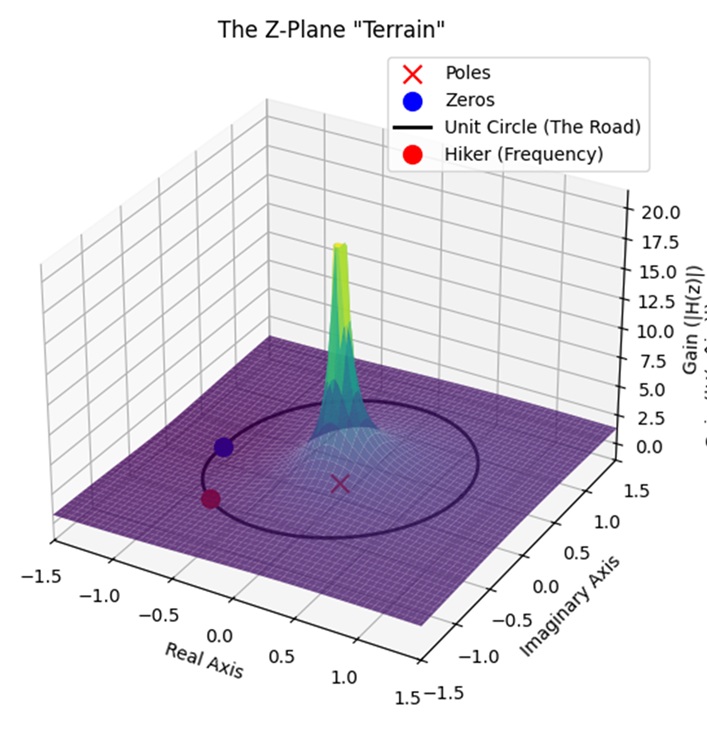
Figure 1: The Z-plane where we can see the hiker (red dot) traversing along the unit circular path (black).
Now, let us introduce the two critical features you get to place on this map:
- Poles (marked by ‘X’): These are like peaks on our terrain. The closer your “road” passes to a pole, the higher the terrain rises. This means the filter amplifies signals at that frequency.
But be warned: the poles must always stay inside the Unit Circle. Placing one on or outside the road makes the mountain infinitely tall and unstable, causing our signal to explode (see Figure 2)! - Zeros (marked by ‘O’): These are like deep sinkholes or valleys. The closer the road passes a zero, the deeper the terrain plunges. This means that the filter attenuates (reduces the gain of) any signals at that frequency.
If the road goes right through a zero, the gain drops to zero and the frequency is completely blocked.
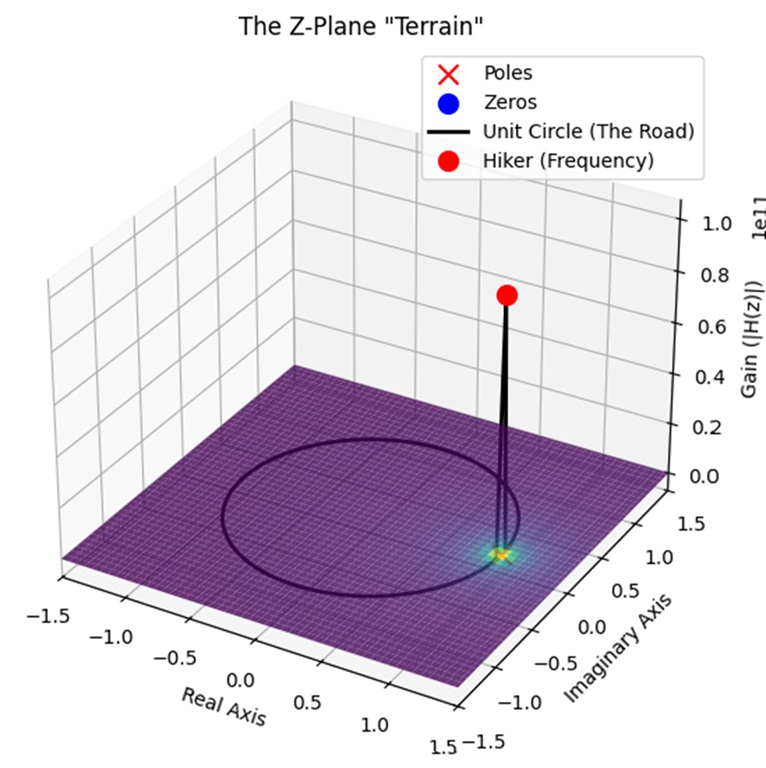
Figure 2: Pole at a value 0.99999999999 (~1). The gain value goes upto approximately 111 .
As you travel along the “Unit Circle” road, your view at the altitude that you are at represents the filter gain at that specific frequency. This is called your filter’s frequency response. If the road goes over a peak, the gain increases. If it goes through a valley, the gain reduces.
Low Pass Filter: The Factored Form
The above visual intuition is taken directly from the factored form of the biquad filter’s mathematical description. This is one way to express the filter; the general form of a digital filter’s transfer function relates the output to the input via numerator and denominator polynomials. Instead of using just coefficients, the factored form represents the filter as a ratio of terms, directly revealing the locations of its poles and zeros in the z-plane.
Let us see how we can use this map to intuitively design a common filter, a low-pass filter. We know that a low-pass filter passes low frequencies and blocks high frequencies, so we need to achieve the following goals:
- Pass low frequencies: To make low frequencies loud, we place a pole near z = 1 at the start of our journey. The closer they are to the circle, the higher the gain for low frequencies.
- Block high frequencies: To silence high frequencies, we place a zero at z = -1 at the end of our journey. These zeros create deep valleys, effectively blocking those unwanted high tones.
The pole-zero plot is a graphical representation of the discrete time transfer function, showing how poles and zeros are distributed in the Z-plane and how they influence system stability and frequency response.
As we travel along the road, the terrain rises near the pole and resonates with lower frequencies to let them pass. Towards the end of our journey, the road drops into a deep valley near the zero, blocking the high frequencies (see Animation 1).
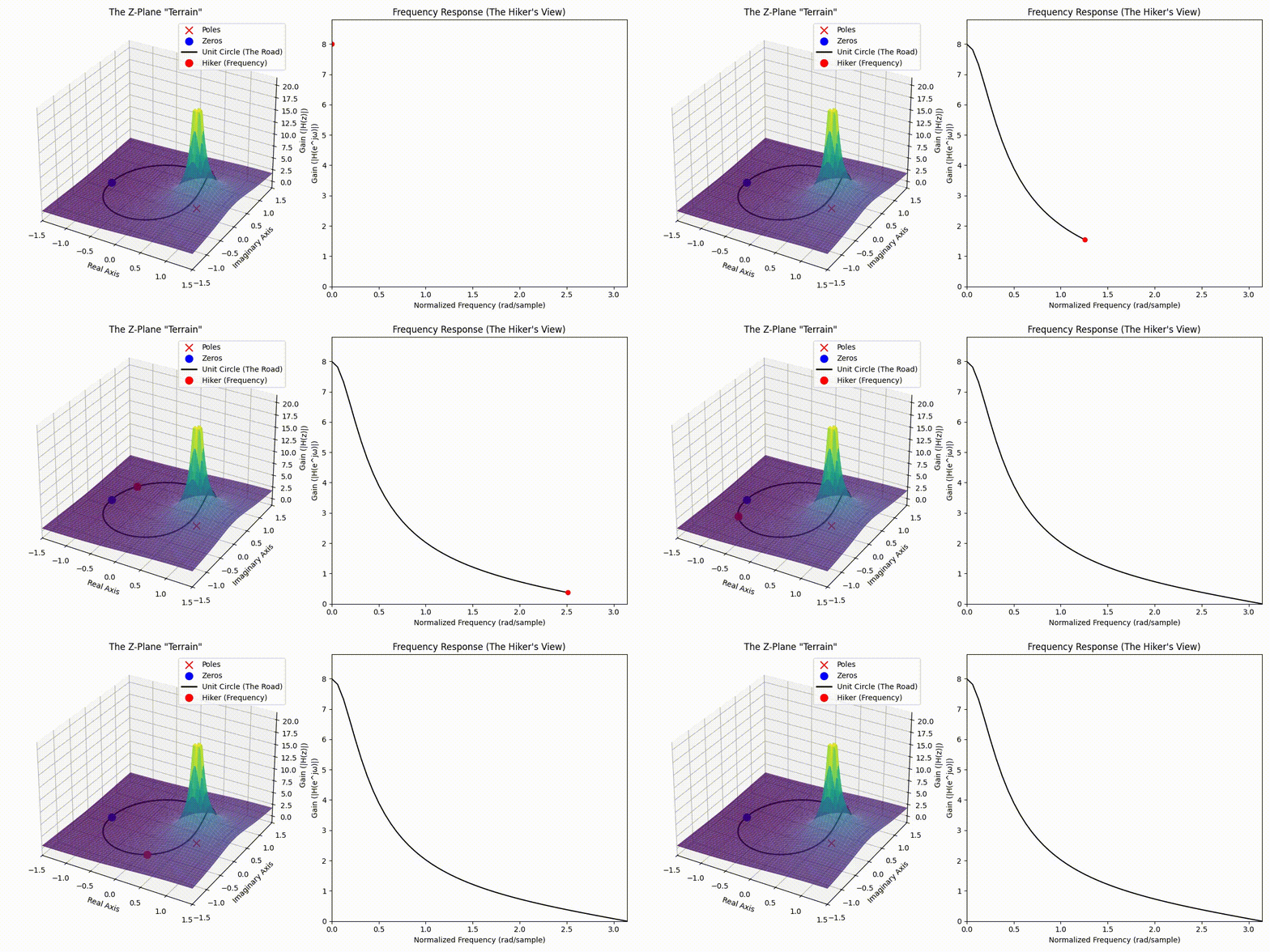
Animation 1: Left – Unit circle with a Zero (O) placed at -1 and a Pole (X) at 0.75. Right – The gain value of different frequencies on the unit circle (frequency response).
Since we placed only one pole at z = 0.75 and one zero at z = -1, this frequency response is called a first-order low pass filter. As you might expect, the response of the bottom half is a mirror image of the frequency response of the top half.
Now, let us place another pole and another zero at the same locations as before. Hence, we now have two zeros at z = -1 and two poles at z = 0.75 (see Animation 2).
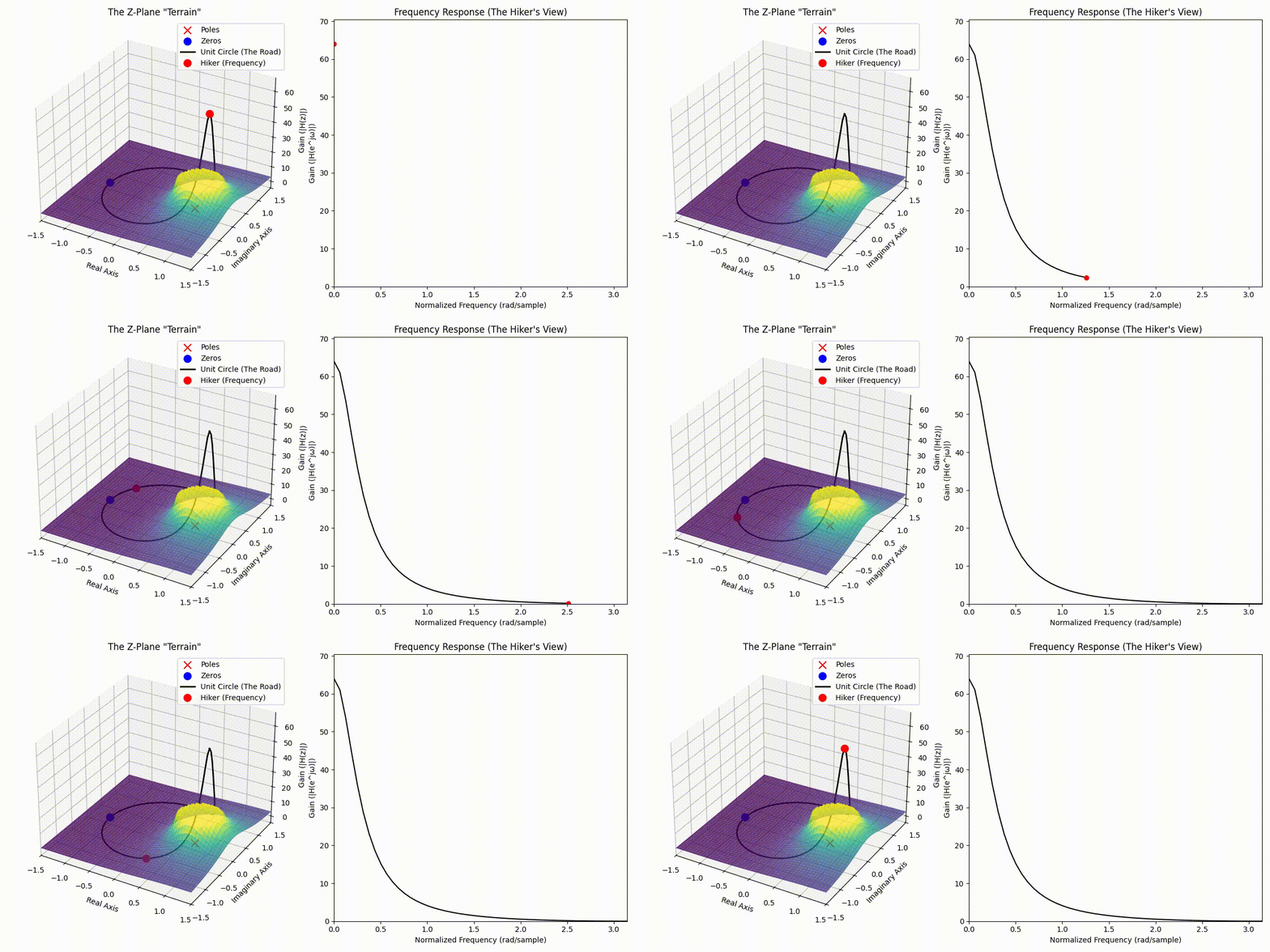
Animation 2: Left – Unit circle with two zeros (O) placed at -1 and two poles (X) at 0.75. Right – The gain value of different frequencies on the unit circle (frequency response).
This two pole-two zero filter configuration is called a second-order low pass filter or a biquad low pass filter. This configuration gives us a much steeper filter roll-off that attenuates the higher frequencies much quicker than a first-order filter.
From Pole-Zero to Coefficients: Factored to Standard Form
We now have two powerful ways to describe a biquad filter:
- Our Intuitive Design Map (Factored Form): This is an “architect” view that is like a high-level design plan for a building.
- The Difference Equation Blueprint (Standard Form): This is like a “builder’s” detailed blueprint plan that is used to create the building.
How do we translate our elegant pole-zero design into the precise coefficients that a processor needs?
The process involves different techniques like polynomial expansion and coefficient matching to give us standard equations to calculate these coefficients. They help transform the coordinates of poles and zeros as standard form descriptions to implement any filter of our choice exactly as we designed on our pole-zero map.
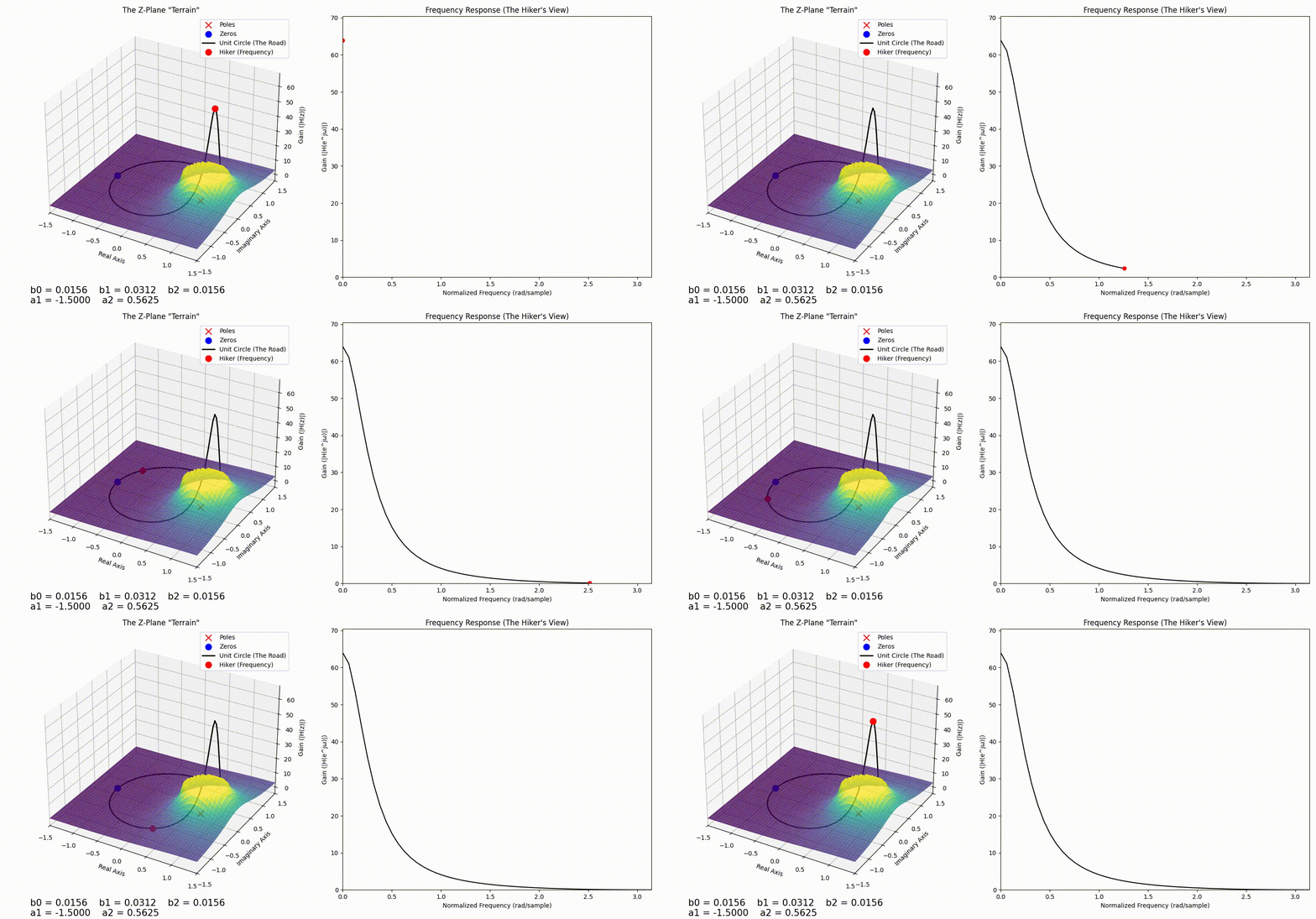
Animation 3: Coefficient values for b0, b1, b2, a1 and a2 are displayed at the bottom for the biquad low pass filter of two poles at 0.75 and two zeros at -1.
We can use these expansion techniques to get all the five coefficients needed for our biquad low-pass filter in the previous section (see Animation 3). This conversion is the invisible bridge that connects our creative filter design to its practical, real-world implementation.
Filter Characteristics and Applications
Understanding the characteristics of your digital filter is crucial for ensuring it meets the needs of your application. The most important properties of an IIR filter are rooted in its transfer function and the placement of its poles and zeros in the z-plane.
Frequency response is a key characteristic, describing how the filter amplifies or attenuates different frequency components of the input signal. The magnitude response shows how much each frequency is passed or blocked, while the phase response indicates how the filter shifts the timing of those frequencies. The steepness of the roll-off near the cutoff frequency is determined by the number and placement of poles and zeros—more poles near the unit circle result in a sharper transition between passband and stopband.
Another defining property of IIR filters is their infinite impulse response: a single input sample can, in theory, affect the output forever, due to the feedback from previous outputs in the recurrence relation. This allows IIR filters to achieve a desired frequency response with fewer filter coefficients and lower computational cost compared to FIR filters, which have a finite impulse response and rely solely on past input samples.
However, the feedback in IIR filters means that stability is a critical concern. All poles must remain inside the unit circle in the complex z plane; otherwise, the filter’s output can grow without bound. Careful filter design and analysis using the pole zero plot help ensure robust, stable operation.
IIR filters are widely used in applications where efficient, sharp filtering is required. In audio processing, they serve as low-pass, high-pass, and band-pass filters to shape sound and remove noise. In communications, they help extract signals of interest and suppress interference. Control systems rely on IIR filters for real-time feedback and signal conditioning, while biomedical devices use them to isolate physiological signals from noise.
By mastering the interplay between the transfer function, pole-zero placement, and implementation methods, you can design digital filters that are not only mathematically elegant but also practical and powerful for a wide range of signal processing challenges.
Summary
The complex world of biquad filters, the difference equations, and their coefficient calculations can be understood intuitively simply by visualizing them as a map. The pole-zero plot is essentially a filter fingerprint, and by learning to read it, we can easily figure out a filter’s behavior.
So, the next time you see a different equation, do not be intimidated. Just remember the Z-plane map, the circular road, and the location of the peaks and valleys that shape your journey. You now have the tools to understand the hidden mechanics of one of Digital Signal Processing’s most important components.
At eInfochips, we apply this deep engineering insight to design high-performance, resilient systems that reliably power the next generation of intelligent devices and applications for our partners.