
Real-time 3D perception enables machines, autonomous vehicles, and Augmented/Virtual Reality systems to instantly interpret, map, and interact with the physical world in three dimensions. It typically relies on sensors like LiDAR, stereo cameras, or radar to capture depth data, which AI models then process into spatial maps and actionable insights.
Typical Applications
Autonomous Simultaneous Localization and Mapping (SLAM) and navigation: It is one of the major applications where robots rely on 3D perception to understand the environment, avoid obstacles, and build accurate 3D maps of the unknown environment to navigate safely.
Augmented/Virtual Reality: 3D reconstruction captures the geometry of real-world objects, enabling virtual content to seamlessly integrate with the physical environment and deliver a more immersive user experience.
Pick and Place: In an industrial environment, through 3D perception, robots / mechanical arms can spot objects for pick and place operations. Robots use depth information to determine object position, orientation, and shape, enabling accurate grasping and manipulation even in cluttered or complex scenes.
Self-driving cars: 3D perception plays an important role in self-driving cars, as it helps with object detection, lane understanding, and scene segmentation.
What is an RGB-D camera?
RGB-D camera system combines a color camera with one or more depth-sensing components to acquire the RGB and depth images. The RGB image provides the visual details including color and texture, while the depth image measures how far each pixel is from the camera, giving us the geometric structure and scale of the environment; devices can measure depth using time-of-flight or stereo vision methods. The main functional blocks of an RGB-D camera are the RGB sensor, depth sensor, followed by the process of calibration and image alignment, with time-of-flight cameras measuring distance from light travel time and stereo vision cameras using two images to calculate depth for depth sensing.
Cameras for 3D Perception and Depth Sensing
There are various camera solutions that can be leveraged for 3D perception. The comparison table below outlines the typical features provided by different cameras:

A standalone RGB camera provides rich color information through traditional color imaging, but like standard cameras it does not capture depth. Another option is a depth camera that provides accurate distance information but does not contain color details. A stereo camera follows stereo vision inspired by human binocular vision, using two viewpoints to estimate depth. In regions with low texture or uniform surfaces, stereo depth becomes unreliable. Structured light cameras and tof cameras are common RGB-D options for short-range depth sensing.
RGB-D camera is one of the best options because it provides both color information and depth measurement in a single solution. This combination gives us much richer understanding of the scene than a standalone RGB and depth camera. With depth data available in real-time, RGB-D camera makes it possible to perform quick 3D perception. The key differences versus lidar cameras are that LiDAR measures distance with laser pulses for high precision and stronger depth accuracy, works across lighting conditions including low light and complete darkness, and can capture data from over 100 meters away, while RGB-D cameras typically work within a range of 10 meters or less and are more affected by ambient light. In short, they provide a practical and cost-effective solution for modern 3D vision, while LiDAR cameras are generally more expensive than RGB-D cameras.
However, combining RGB and depth information introduces several challenges that generate the need for accurate calibration and alignment.
Implementation Challenge: Depth Accuracy
Different Resolutions & Field of View – The RGB camera often has a higher resolution and different Field-of-View (FOV) compared to the depth sensor. As a result, the two images capture different portions of the scene, leading to spatial misalignment when overlaying depth information onto the RGB image.
This naturally leads to misalignment between the RGB and depth frames, where edges, object boundaries, and fine details do not correspond pixel to pixel. Such misalignment can introduce errors in tasks like 3D reconstruction, object detection, and robotic navigation, where precise spatial correspondence is critical.
Different Intrinsic Parameters – Each camera has unique properties such as focal length, principal point and lens distortion that must be modelled accurately for correct projection. Ignoring these differences can lead to distorted depth mapping onto the RGB image. Additionally, the viewpoints of the sensor differ because the RGB and depth units are physically separated within the camera model. These separations introduce parallex, meaning objects at different depths appear different. Without compensating for this offset, overlapping the RGB and depth frames results in spatial errors specially at object edges and depth discontinuities.
Camera Registration: The registration problem arises because the RGB and depth images are often misaligned and captured at different resolution and field of view as shown in the left-hand side figure. These discrepancies make it difficult to directly use the RGB and depth data together.
To address this, we perform four major steps:
- Calibration: Computes the intrinsic parameters, distortion coefficients for the RGB camera and depth camera and computes extrinsic parameters for both RGB and depth sensors.
- Undistortion: Corrects the lens distortion in both images by removing radial and tangential distortion.
- FOV matching, we resize and crop the images so that both sensors cover the same field of view using focal length base scaling.
- Registration: Aligns the depth image to the RGB image using the estimated calibration parameters to achieve fixer to fixer correspondence.

After completing these steps, we obtain the aligned RGB and depth images.
RGB calibration workflow
Calibration is a crucial step for accurately aligning the depth map with the RGB image by using intrinsic and extrinsic parameters.
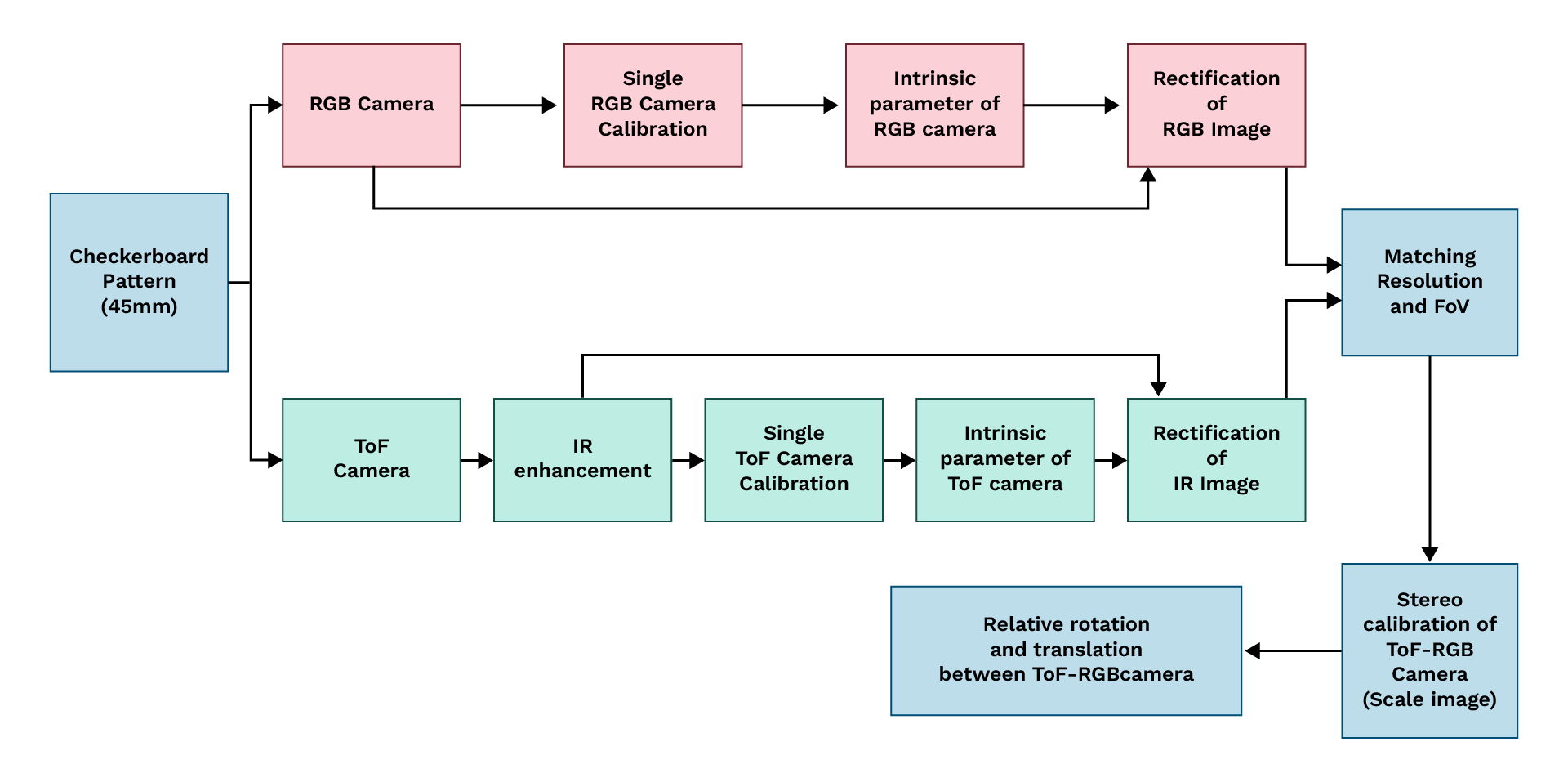
Data collection is the first step of calibration, where Time-of-Flight (ToF) and RGB camera captures the image of calibration pattern like a checkerboard. The ToF camera captures both the Infrared (IR) and depth images, using infrared light and reflected signals to estimate distance, and some compact designs use infrared lasers to derive depth from travel time or phase shift.

IR images are essential to detect the calibration pattern and estimate the ToF intrinsic parameter calculations. For accurate parameter calculations, the IR image is enhanced. The RGB camera captures color images used for its own intrinsic calibration. Both cameras are connected to the compute board (like NVIDIA AGX) that manages synchronization, data acquisition, and processing during the calibration workflow.
The key components of calibration are intrinsic parameters, distortion coefficient, extrinsic parameters, and calibration pattern board. Intrinsic parameters describe the internal characteristics of each camera such as focal length, principal point, and lens distortion. Intrinsic parameters are used to project 3D points onto the 2D image plane, with depth computed per sensor pixel before alignment.
Distortion coefficients are used to collect lens distortion. Extrinsic parameters define the rotation and translation between the RGB and depth sensors, enabling them to map into a common coordinate system.
Single camera calibration
In this step, the RGB camera is calibrated independently, and the ToF sensor is calibrated using the Hanan’s IR images. This enables estimation of each camera intrinsic parameters including focal length, principal point, and distortion coefficients. However, even after calibration, the RGB and ToF images typically differ in resolution and field of view, and their sensors remain physically separated.
Resolution and FOV Matching
This is done by resizing, cropping, or transforming the images so they cover the same region of the scene and achieve pixel by pixel alignment.
Extrinsic Factor Estimation
Once the sensors are individually calibrated and their resolution and FOV are aligned, stereo calibration is performed between the RGB and top cameras. This step estimates the extrinsic parameters describing the rotation and translation between the two sensors and capturing how they are physically positioned connected to each other within the device. The final output of this workflow is the relative rotation and translation matrix between the ToF and RGB camera.
Image Registration
This is the final step of RGB-D image mapping that enables accurate registration of the depth map onto the RGB image and show pixel to pixel alignment.
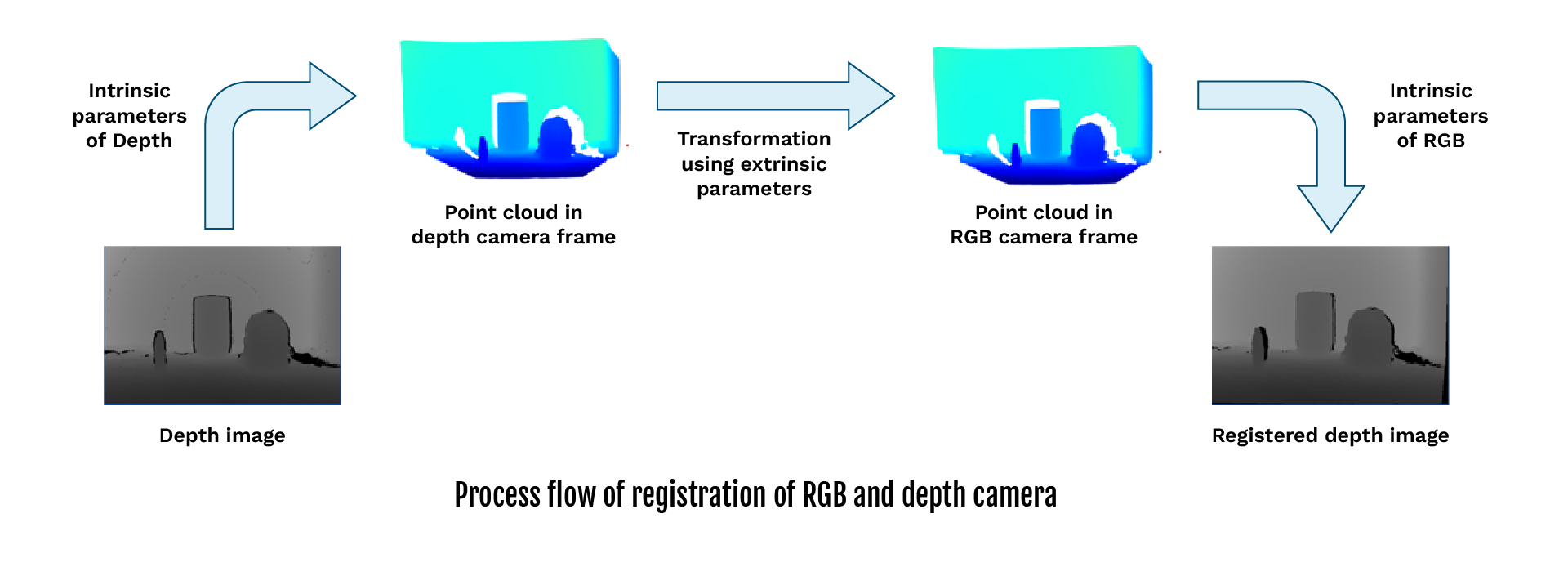
This stage produces the overlapped register output, where every 3D point from the ToF sensor is aligned with its corresponding RGB pixels, resulting in complete color point cloud. The workflow begins with a depth image captured by the ToF camera, where each depth value represents an object’s location in three dimensional space and is first projected into a 3D point using the camera’s intrinsic parameters. Next, we apply extrinsic parameters o transform the resulting point cloud from the ToF camera coordinate frame into the RGB camera coordinate frame. Once the 3D points are correctly positioned in the RGB frame, we use intrinsic parameters of the RGB camera to project those points back onto the RGB image plane. This projection gives us a registered depth image where each depth value is aligned with the corresponding RGB setting, producing a complete color point cloud that combines rgb data with depth for better understanding of the scene.
Conclusion
In this blog, the proposed RGB-D implementation pipeline effectively outputs the registered depth image with the RGB image with differing resolutions and fields of view. The pipeline provided satisfactory real-time performance results. However, to perform the computations, an appropriate hardware platform must be selected.
Frequently Asked Questions
1. What is an RGB-D Camera?
An RGB-D camera (Red, Green, Blue + Depth) is a specialized imaging device that captures standard color images alongside depth information for every pixel. This allows machines and computers to perceive the physical world in 3D, mapping not just what an object looks like, but exactly how far away it is.
2. What are typical implementation challenges for RGB-D camera?
Different Resolutions, Field of View, Intrinsic parameter and Misalignment of the RGB and depth cameras are some of main typical implementation challenges for RGB-D camera.
3. What are the main steps to address the implementation challenges?
- Calibration: Computes the intrinsic parameters, distortion coefficients for the RGB camera and depth camera and computes extrinsic parameters for both RGB and depth sensors.
- Undistortion: Corrects the lens distortion in both images by removing radial and tangential distortion.
- FOV matching, Resize and crop the images so that both sensors cover the same field of view using focal length base scaling.
- Registration: Aligns the depth image to the RGB image using the estimated calibration parameters to achieve fixer to fixer correspondence.