
Mixed-signal PCBs are an important aspect of modern electronic systems because they connect real-world analog inputs to fast digital processing. They are found across a wide range of applications, from medical diagnostic equipment and automotive ECUs to smart sensors, consumer IoT devices, and industrial control platforms. A mixed signal board integrates both analog and digital circuits on a single PCB, requiring careful attention to layout, grounding, and shielding to manage the challenges of combining these domains.
What makes mixed-signal boards tough to test is the inherent tension between their two domains. Analog circuitry requires a clean, low-noise environment to preserve precision, while digital parts bring quick switching edges, ground disturbances, electromagnetic interference, and rigorous timing requirements. As a result, testing must evaluate not only the operation of each analog and digital block independently but also how they interact under genuine operational conditions. Signal interference between analog components and digital circuits can compromise the integrity of continuous signals in analog circuits, making mixed signal design and robust test methodologies essential for ensuring reliable performance.
Effective mixed-signal PCB test methodology must therefore account for factors such as temperature shifts, dynamic load changes, clock jitter, switching noise, power-rail fluctuations, and cross-domain coupling. These conditions can cause a subtle performance degradation and functional testing must be able to detect this reliably
This document walks through the essential considerations for evaluating mixed-signal PCBs and explains how each test technique works, highlighting where each method is most effective within the overall test strategy.
Introduction to Mixed Signal PCBs
Mixed signal PCBs are at the heart of today’s most advanced electronic systems, enabling seamless interaction between the analog world and digital processing. By combining analog and digital components on a single circuit board, these designs allow for the handling of both continuous analog signals—such as those found in audio processing or sensor inputs—and discrete digital signals used for computation and control. This integration is essential in applications ranging from consumer electronics and medical devices to automotive engine control units.
However, mixed signal PCB design presents unique challenges. Analog and digital circuitry must coexist without introducing noise interference that can degrade performance. Careful attention to layout, component placement, and signal routing is required to ensure that sensitive analog signals are not corrupted by the high-speed switching of digital components. By understanding the complexities of mixed signal PCB design, engineers can create robust systems that deliver reliable operation and high performance across a wide range of demanding applications.
Challenges in Mixed-Signal PCB Testing
Mixed-signal PCB testing is complicated due to the nature of simultaneous analog and digital operations. The next sections break out these challenges in detail.
1. Ground Bounce and Power Supply Noise Coupling
Fast-switching digital logic creates large, transient current spikes (ΔI) that flow through the parasitic inductance (L) of the power and ground paths. This causes a temporary voltage rise [ΔV=L⋅ ΔI/Δt] on the digital ground/power, which then couples into the sensitive Analog Ground (AGND) or Analog Power (AVCC). This noise directly corrupts the reference voltage and analog signals.
To improve signal integrity and reduce noise interference, it is essential to use a dedicated digital ground plane, digital power supply, and digital supply lines, keeping them well-isolated from analog planes and supplies. This separation helps prevent digital switching noise from coupling into sensitive analog circuitry.
The table below shows the key tests used to detect and measure ground bounce and power-rail noise in the mixed-signal PCBs
| Tests | Methodology | Key Tool/Metric |
| Measure Noise Differentially | Use a low-inductance probing method (like a tip-and-barrel or coaxial probe) to measure the AC ripple and transient noise directly on the AVCC or AGND relative to the true local ground. | High-Bandwidth Oscilloscope |
| PSRR or Clean Reference Check under Digital Load | Operate the digital circuit at its highest switching rate (worst-case di/dt) while monitoring the output of a sensitive analog component (e.g., an LNA or voltage reference). | Oscilloscope / Spectrum Analyzer |
| Decoupling Effectiveness Test | Place the scope probe across the decoupling capacitor pins of a noisy IC. A large transient voltage here means the capacitor is not effective, often due to high trace-inductance. | Oscilloscope |
| Check for Logic Glitches | Monitor a critical, slow-changing digital signal near a noisy source. Ground bounce can cause the logic-low voltage to briefly rise enough to be misinterpreted as a logic-high, leading to glitches. | Logic Analyzer or MSO |
2. Clock Jitter and Skew
The performance of an Analog-to-Digital Converter (ADC) or Digital-to-Analog Converter (DAC) is vitally dependent on a clean, accurate sampling clock. Noise or interference on the clock line creates jitter (random timing variation), which translates straight to noise in the sampled analog data. Any Skew (arrival time difference) between the clock and data might create setup/hold time violations.
The table below shows the key tests used to measure clock jitter and skew in mixed-signal systems.
| Tests | Methodology | Key Tool / Metric |
| Jitter Measurement (Time Domain) | Measure the clock signal directly at the ADC/DAC clock pin so PCB routing noise and component jitter are included. Use oscilloscope jitter analysis to compute RMS jitter and identify timing instability. | High-Speed Oscilloscope with Jitter Analysis Package |
| Phase Noise Measurement (Frequency Domain) | Analyze the clock’s frequency spectrum for noise skirts and spurs around the carrier. A higher noise level indicates poor clock purity and possibly timing mistakes.
|
Spectrum Analyzer / Phase Noise Analyzer |
| Verify Setup/Hold Time | Probe the clock and related data lines simultaneously to ensure that the data transition occurs within the specified setup/hold window relative to the clock edge. | High-Channel Logic Analyzer or MSO |
3. Crosstalk and Signal Integrity
High-speed digital traces act as noise aggressors, inductively or capacitively coupling noise onto the neighboring sensitive analog traces, reference traces, or clock lines (victims). This is most common where analog and digital traces are routed close and parallel.
High frequency noise generated by digital switching can couple into adjacent signal paths, especially in mixed signal components and sensitive analog components. It is critical to minimize noise coupling through careful PCB layout, shielding, and proper separation of analog and digital traces.
The table below shows the key tests used to measure crosstalk and signal integrity in mixed-signal systems.
| Tests | Methodology | Key Tool / Metric |
| Near-Field Scanning (EMI) | Use a Near-Field Probe and Spectrum Analyzer to scan the PCB surface, especially above parallel traces, or noisy digital components. High emissions indicate poor return-path control or insufficient shielding. | Spectrum Analyzer / Near-Field Probe |
| Time Domain Reflectometry (TDR) | Use a TDR to check the characteristic impedance of controlled-impedance traces such as clock or high-speed data lines. Impedance discontinuities (from trace width changes, poor vias, or gaps in ground planes) create reflections that appear as ringing or noise. | TDR Instrument |
| Aggressor-Victim Test | Disable the digital aggressor signal and measure baseline noise on a nearby analog victim trace. Then enable the aggressor and measure again. The increase in noise shows how much crosstalk is occurring. FFT can help isolate the noise frequency. | Oscilloscope |
4. ADC/DAC Performance Degradation
All the previously mentioned noise issues (ground bounce, jitter, crosstalk) combine to degrade the overall performance of the mixed-signal interface. Testing must provide a quantitative measure of this degradation.
It is important to verify analog performance and ensure that sensitive analog components are protected from digital noise and interference in mixed-signal systems.
The table below shows the key tests used to measure ADC/DAC performance degradation in mixed-signal systems.
| Tests | Methodology | Key Tool / Metric |
| FFT Analysis (ENOB / SNR) | Apply a clean, pure sinusoidal signal to the ADC input.
Capture the digitized output data and apply a Fast Fourier Transform (FFT) to evaluate noise, distortion, and harmonic content.
|
FFT Software or Signal Analyzer |
| Key Performance Metrics | Calculate system performance metrics from the FFT results. Lower-than-expected values confirm noise coupling or timing issues. Common metrics include ENOB, SNR, and THD. | Effective Number of Bits (ENOB), Signal-to-Noise Ratio (SNR), Total Harmonic Distortion (THD) |
| Stress / Margin Testing | Run performance tests (including FFT) across full temperature ranges and supply voltage limits. Many noise-coupling issues appear only under extreme or stressful conditions. | Thermal Chamber, Variable Power Supply |
5. Improper Terminations
High-speed digital signals (e.g., clock lines, data buses, differential pairs) might experience distortion when the signal channel is not appropriately terminated. Improper termination causes the signal energy to reflect back along the line, generating overshoot, undershoot, and ringing. These distortions can lead to erroneous clock edges, setup/hold time violations, data corruption, and increased EMI.
The table below shows the key tests used to measure improper terminations in mixed-signal systems.
| Tests | Methodology | Key Tool / Metric |
| Check Termination Effectiveness | Monitor the signal at the receiving pin of the high-speed IC. Look for repeated overshoot/undershoot or sustained ringing at each transition. Persistent ringing shows that the termination is not adequately absorbing the signal energy. | High-Bandwidth Oscilloscope |
| Measure Edge Rate / Ringing | Use the oscilloscope to analyse the rise and fall times of high-speed signals. Excessive ringing or unstable transitions can indicate that the termination does not match the signal’s electrical characteristics, generating reflections along the line. | Oscilloscope |
Key PCB Test Strategies for Mixed-Signal Boards
To do mixed-signal testing well, you need to employ more than one approach because no one test can properly check both the analog and digital domains. PCB functional test and testing boards play a critical role in validating mixed-signal designs, ensuring that both analog and digital functions operate reliably before deployment.
Below are listed the key test strategies used in mixed-signal PCB validation:
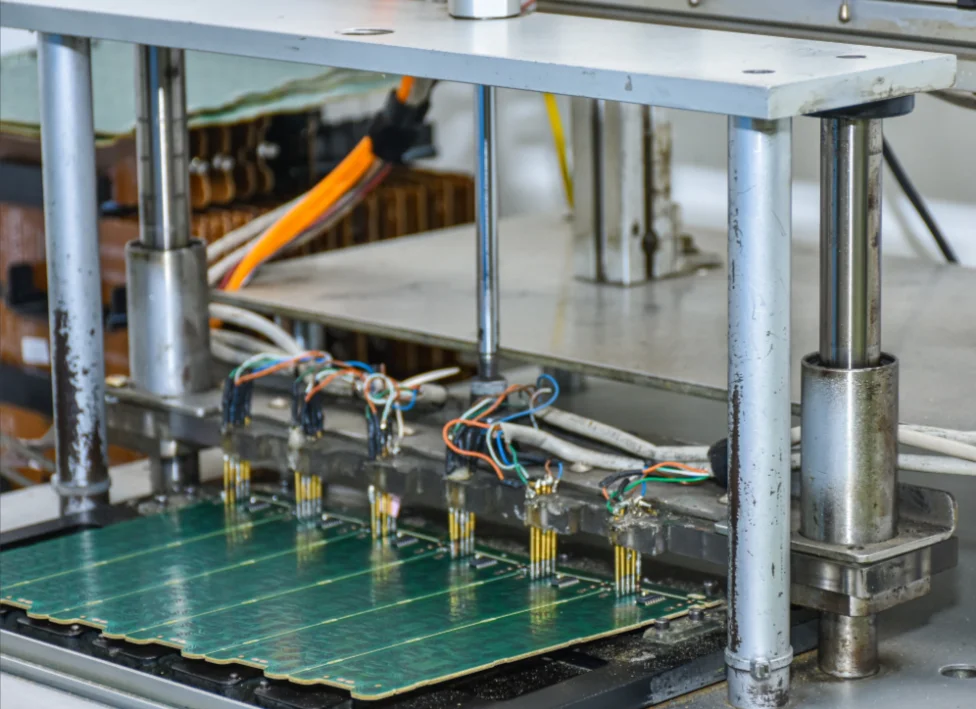
1. In-Circuit Testing (ICT)
An ICT is essential for mass production because it reduces debug time for functional failures.
Usage:
- Open and short circuits in critical nets
- Solder bridges under high-density pads.
- Incorrect passive values and wrong tolerances
- Faulty transistors or diodes
- Component Misorientation/Polarity
- Vector less testing for BGAs.
- Analog component testing through clamp circuits
- Power-off leakage measurement to find defective ICs.
2. Functional Circuit Testing (FCT)
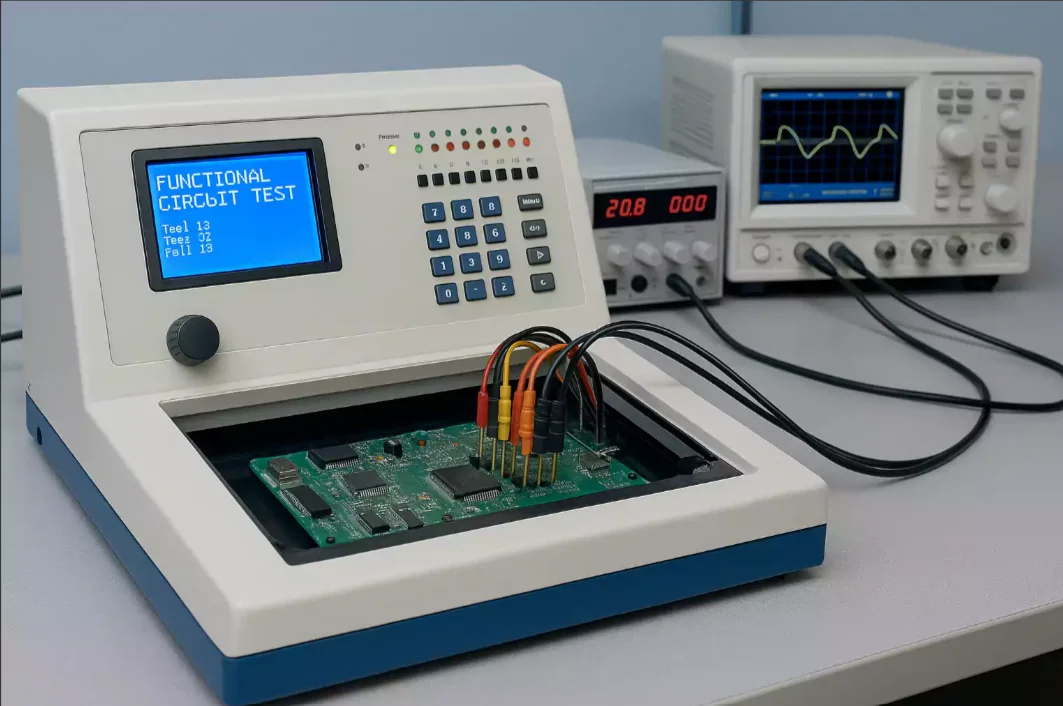
FCT simulates real-world operations. FCT tests the complete system in its powered-on, functional state.
Usage:
- To validate total system functionality under powered conditions
- To test end-to-end analog and digital signal flow
- To measure ADC, DAC, amplifier, and filter performance
- To evaluate digital interfaces (SPI/I²C/UART/CAN/LVDS/etc.)
- To check power-rail behavior, sequencing, and protection
- To analyze timing-critical operations and firmware routines
- Measuring system response during dynamic load, noise, and transients
- To detect functional faults not covered by ICT or AOI
- To confirm behavior during brownouts, resets, and restart conditions
- To validate overall mixed-signal interaction and noise immunity
3. Boundary Scan / JTAG Testing
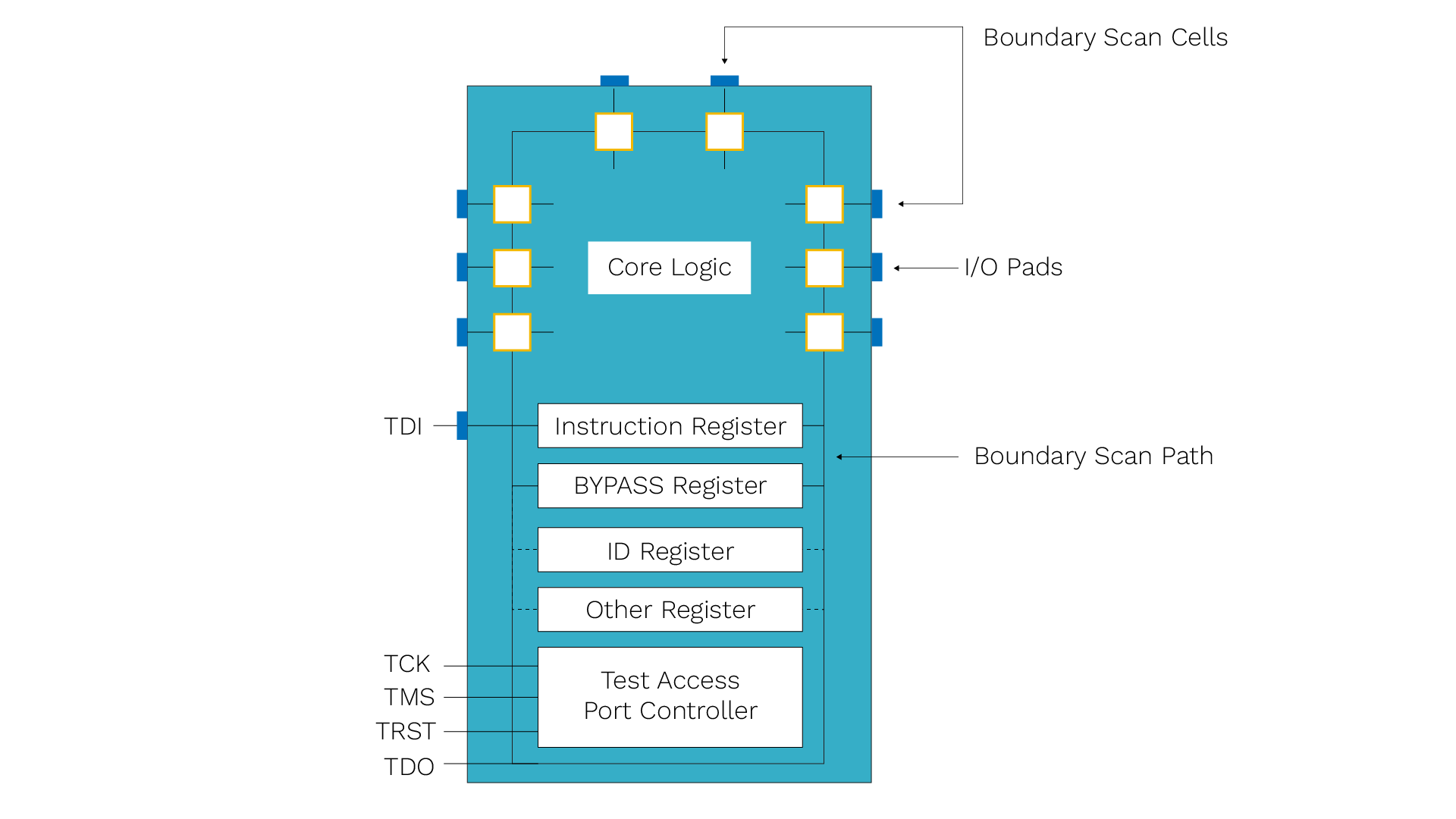
This is ideal for digital-heavy mixed-signal boards with minimal probe access. Alternative fixtureless testing methods for printed circuit boards, such as probe test and flying probe test, are also used for flexible and cost-effective validation, especially in small batches or prototypes.
Usage:
- Detecting BGA short/open circuits
- Verifying power-rail sequencing
- Testing flash-programming interfaces
- Monitoring pin-level responses during the system boot
- Validating processor-to-ADC, processor-to-memory, or other digital interconnects
Boundary Scan / JTAG Testing
4. Automated Optical Inspection (AOI) and X-Ray
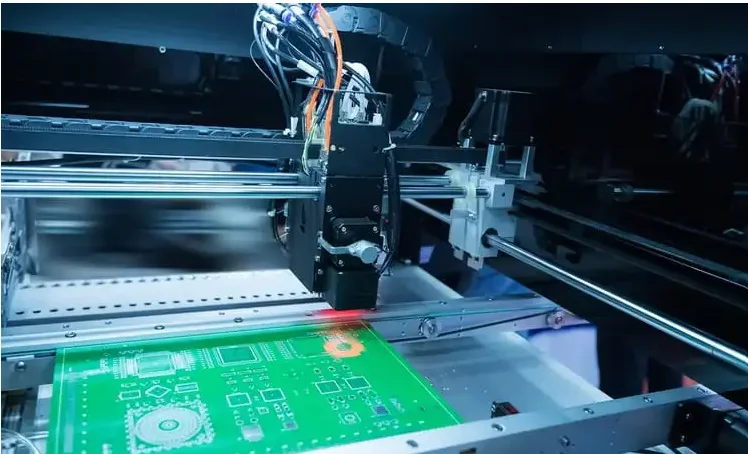
Both are crucial for guaranteeing long-term reliability.
Usage of AOI
- Detecting coplanarity problems via 3D inspection
- Verifying solder paste height and placement quality.
- Identifying faults in fine-pitch components
Usage of X-Ray Inspection
- Detecting internal trace problems in multilayer PCBs
- Identifying cavities inside thermal pads
- Finding barrel fractures in vias
- Checking for partial or hidden-pin solder wetting
Automated Optical Inspection (AOI)
5. Signal Integrity (SI) Testing
SI testing ensures that the analog and digital subsystems communicate appropriately and fulfill performance criteria.
Usage:
- Checking ADC spurious-free dynamic range (SFDR)
- Evaluating frequency response of analog filters
- Measuring regulator PSRR under dynamic loads
- Assessing DAC settling time
- Evaluating noise coupling during digital transmission bursts
- Using FFT-based analysis to measure harmonic distortion
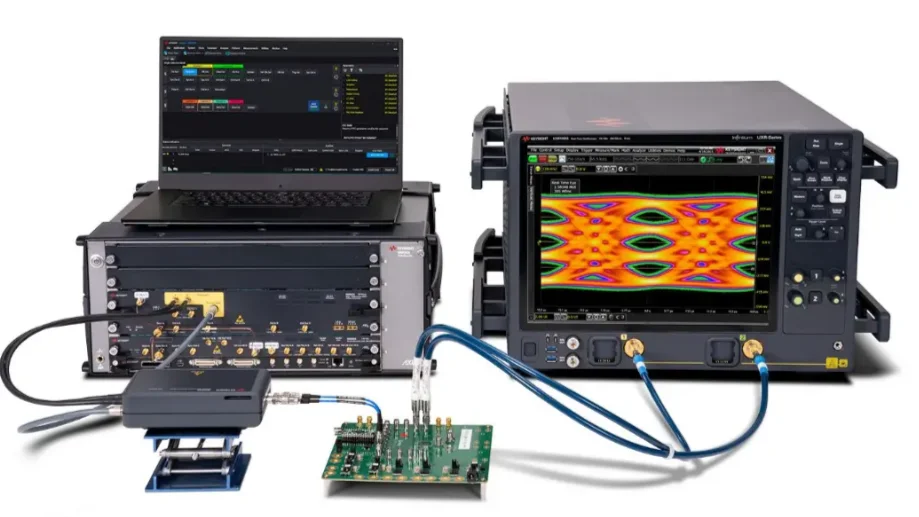
Signal Integrity (SI) Test Setup
Selecting the Right Test Strategy: Key Factors to Consider
The best test strategy depends on a project’s unique requirements. The table below outlines the important criteria that determine this decision.
| Factor | Considerations | Recommended Strategy |
| Production Volume | Prototype, low-volume, or high-volume mass production | Prototype: AOI + SI Testing Low volume: ICT + FCT High-volume: ICT + AOI/X-Ray |
| Cost Constraints | Budget available for fixtures, equipment, and test execution | Low cost: AOI + basic ICT Moderate cost: ICT + FCT High-reliability budget: ICT + FCT + SI Testing |
| Reliability Requirements | Consumer-grade vs. automotive, medical, or industrial systems | Consumer devices: ICT + AOI High-reliability systems: FCT + SI Testing + JTAG |
| PCB Complexity | High-density BGAs, multilayer routing, analog–digital overlap | High complexity: AOI/X-Ray + JTAG + SI Testing Medium complexity: ICT + FCT Simple boards: AOI + ICT |
| Signal Performance Sensitivity | Precision analog paths, ADC/DAC noise limits, high-speed digital buses | Precision analog: SI Testing + FCT High-speed digital: JTAG + SI Testing |
| Debug Requirements | Need to isolate faults at component level or system level | Component-level debugging: ICT + JTAG System-level debugging: FCT + SI Testing |
| Manufacturing Yield Concerns | Expected defects: solder issues, drift, noise, intermittent faults | Structural defects: AOI/X-Ray + ICT Functional issues: FCT + SI Testing |
Future of Mixed Signal PCB Testing
The landscape of mixed signal PCB testing is rapidly evolving, driven by advances in automated test equipment and the integration of artificial intelligence into testing algorithms. These innovations promise to deliver faster, more accurate, and more comprehensive testing, reducing the risk of undetected defects and enhancing overall system reliability. As the adoption of internet of things (IoT) devices and other connected technologies accelerates, the demand for efficient and scalable testing methods will only increase.
Looking ahead, engineers will need to stay abreast of the latest developments in mixed signal PCB design and testing, including new approaches to pcb testing, smarter automated test equipment, and data-driven analysis techniques. By embracing these advancements, designers can ensure that their mixed signal PCBs continue to meet the rigorous demands of modern applications, delivering high performance and reliability in an increasingly connected world.
Conclusion
This document has thoroughly discussed the core challenges and corresponding multi-layered testing strategies essential for validating mixed-signal PCBs. It is critical to recognize that while advanced testing provides diagnosis and validation, the fundamental resolution for a majority of the issues identified such as ground bounce, crosstalk, and timing instability lies primarily at the PCB layout and design level.
Mixed-signal PCB testing requires a multidimensional strategy that addresses analog precision, digital correctness, timing coordination, signal integrity, and environmental robustness. By combining ICT, AOI, JTAG, Functional Testing, and Analog SI analysis and by increasing test cases to incorporate noise, load transients, temperature change, and cross-domain interactions engineers can confidently confirm the system performance.
A well-designed mixed-signal test strategy is not only about discovering problems but also ensuring that the product performs reliably under all real-world conditions. This builds long-term reliability, consumer trust, and consistent performance across manufacturing batches.