Introduction
Selecting an Internet of Things (IoT) development partner differs from selecting a typical software vendor, and recognizing this difference early can save you trouble later. IoT involves hardware, connectivity, cloud infrastructure, data, and ongoing device management. A gap in any of these areas does not stay isolated; it affects the entire solution.
What is often not said upfront is that most IoT projects don’t fail because of the technology itself. They fail due to poor planning, security treated as an afterthought, or a partner who can build a pilot but struggles to support the solution as it expands.
The right partner understands your business problem first and develops technology around it, not the other way round. This guide walks you through eight practical parameters to help you find exactly that.
What Does an IoT Development Partner Do?
Before you start evaluating vendors, it’s important to clarify what you are purchasing because IoT development is broader than most people realize. Unlike a typical software project, IoT involves building IoT systems where physical devices, software, and data work together. A development partner in this field is responsible for much more than just writing code. Their work usually covers device and hardware selection, hardware development, firmware development and embedded systems, connectivity and protocols, cloud integration, data management, user-facing applications (dashboards, mobile apps, and APIs), security, and post-launch support and maintenance, and strong IoT development services should span end-to-end hardware and software capabilities, including cloud infrastructure setup and system integration.
An IoT development partner also supports in component sourcing and supply chain management by assisting in managing hardware availability, component lifecycle, and sourcing choices that impact both cost and long-term deployment reliability.
This is why a general software vendor isn’t always suitable. IoT ecosystems are vulnerable targets and must comply with industry regulations, which is why a software development company may not be enough. They may handle certain parts well, but IoT requires coordination across all these layers, not just a few. A strong IoT partner doesn’t need to do everything in-house, but they should understand each layer and take responsibility for all of it.
Start With Business Fit, Not Tech Credentials
Technical expertise is important, but it shouldn’t be the first thing you assess. The best IoT partners don’t kick off with platform suggestions or technology stacks. Instead, they begin by understanding your business objectives, operational challenges, and what success looks like for your organization. Whether you’re aiming to reduce equipment downtime, enhance asset visibility, or optimize energy use, the technology should support those goals, not define them. Well-designed custom IoT solutions can also automate routine tasks and improve operational efficiency. Effective IoT applications can also enhance customer engagement and create new revenue streams, including through innovative business models.
An early good indicator is simply how well they listen. Do they inquire about your business before proposing a solution? Do they grasp your constraints, users, and growth plans? The optimal solution isn’t always the most advanced on paper. It’s the one that aligns with your use case, timeline, and future direction, and the right development partner will connect that fit to your long-term commercial goals. Technical credentials always matter, but they should not dominate the conversation.
8 Parameters to Evaluate
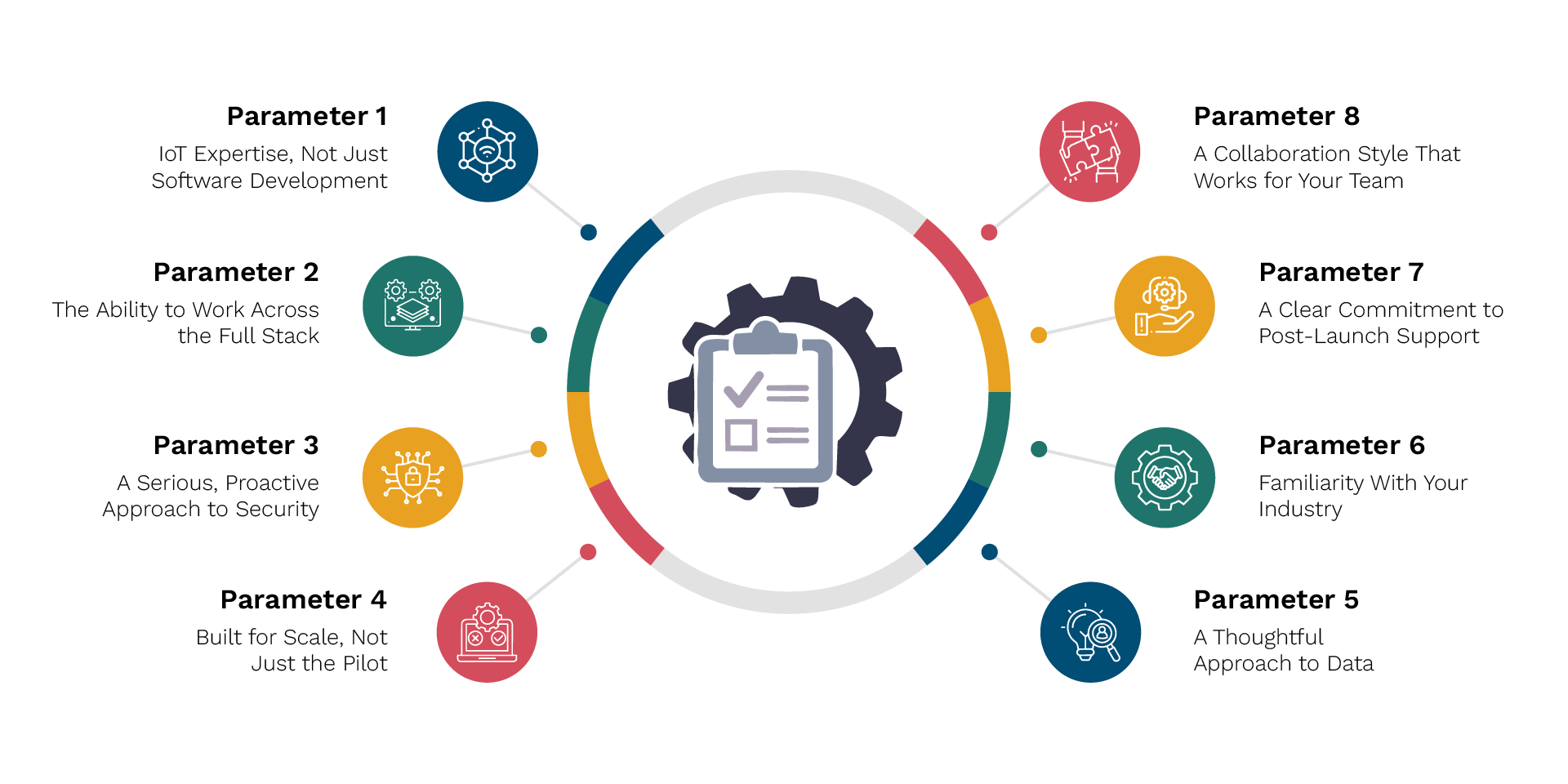
Parameter 1: IoT Expertise, Not Just Software Development
Developing an IoT solution is challenging. IoT includes hardware, firmware, connectivity, cloud platforms, and data, so the real value comes from a partner who understands how all these parts work together. Look for experience with device integration, communication protocols, and edge computing, rather than just general software delivery.
Parameter 2: The Ability to Work Across the Full Stack
IoT spans multiple layers, from device firmware and connectivity to cloud infrastructure, dashboards, mobile apps, and Application Programming Interfaces (APIs) that power everyday operations. A partner capable of working across this stack can minimize integration gaps, streamline coordination, and keep the solution aligned from the outset. Even when different specialists are involved, there should be a clear approach to connecting the entire system.
Parameter 3: A Serious, Proactive Approach to Security
Security should be integrated into the solution from the beginning, not added later as an afterthought. A capable partner naturally raises issues like secure boot, device authentication, data encryption, access control, and secure updates during early discussions. If security only becomes a concern when you bring it up, that’s something to watch out for.
Parameter 4: Built for Scale, Not Just the Pilot
A pilot can demonstrate whether an idea works, but the real test is whether the solution can expand with your business. What is effective for a small deployment may not be suitable at a much larger scale. The right partner should consider volume, performance, and operational complexity early on so that scaling up doesn’t require starting from scratch.
Parameter 5: A Thoughtful Approach to Data
IoT is not just about collecting data; it’s about making that data valuable. A reliable partner should help define how data flows, where it is stored, how it integrates with your systems, and how it supports better decisions. Without this strategy, IoT data can quickly become disconnected.
Parameter 6: Familiarity With Your Industry
Every industry has its own workflows, regulations, and operational realities. A partner with relevant sector experience is more likely to understand your environment, ask better questions early, and avoid generic assumptions. It is not the only thing that matters, but it can significantly shorten the learning curve.
Parameter 7: A Clear Commitment to Post-Launch Support
IoT projects do not conclude at deployment. Devices need monitoring, Over-the-Air (OTA) firmware updates, performance tuning, and ongoing maintenance, sometimes urgently and at scale. A partner with established supply chain relationships can also help manage component availability, pricing, and obsolescence over time, which becomes increasingly important as deployments expand globally. Before proceeding, it is vital to understand the level of post-launch support required and how the partner manages issues after go-live.
Parameter 8: A Collaboration Style That Works for Your Team
Technical skill gets the work done, but working style determines how smoothly the engagement feels. Look for a partner who communicates clearly, sets realistic expectations, and raises issues early rather than late. In IoT projects, where requirements often evolve, a good collaboration style can make a difference.
A Quick Checklist Before You Shortlist
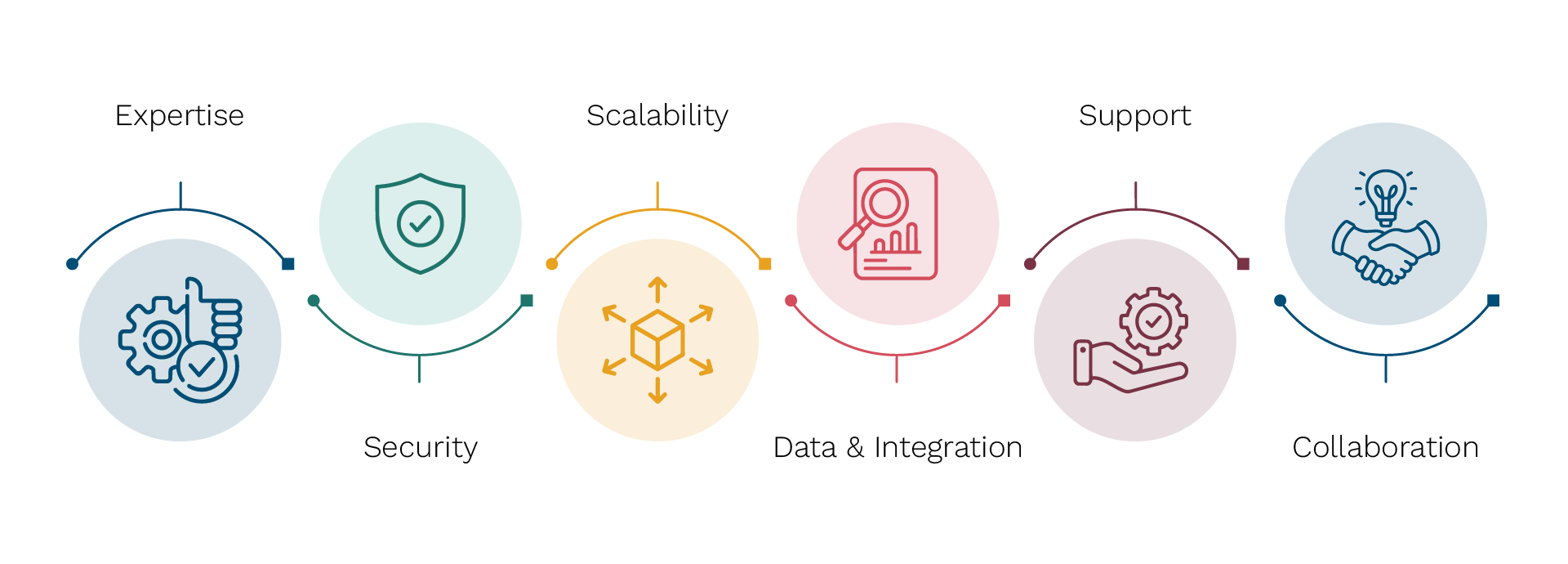
Expertise
- Do they have proven experience in IoT, beyond general software development?
- Can they speak confidently about hardware, firmware, protocols, and cloud integration?
Security
- Is security built into their approach from the start, or treated as an afterthought?
- Can they clearly explain device authentication, data encryption, secure firmware updates, and compliance requirements?
- Can they operate as a reliable IoT development company for regulated or mission-critical deployments?
- Do they understand relevant industry compliance requirements for your sector?
Scalability
- Can they show examples of solutions scaled beyond the pilot stage?
- Are they designing for long-term growth, not just the immediate build?
Data & Integration
- Do they have a clear strategy for data management and analytics, especially when IoT software development or IoT app development includes user-facing tools?
- Can they integrate with your existing business systems?
Support
- Is post-launch support clearly defined in their engagement model?
- Do they offer ongoing monitoring, continuous monitoring, device management, maintenance, and updates?
Collaboration
- Do they ask thoughtful questions before recommending solutions?
- Are they transparent about timelines, trade-offs, and potential risks?
Closing Thought
Selecting the right IoT development partner involves more than just technical skills. It requires finding a team that understands your business objectives, can manage the complexity of connected solutions, and remains dependable as the project progresses. The best partners often stand out early by asking relevant questions, being transparent about trade-offs, and linking technology choices to real business results. This blend of technical expertise and business insight is what differentiates a vendor from a true long-term partner. Taking the time to carefully evaluate potential providers may seem slower initially, but it can help prevent costly issues in the long run.
Frequently Asked Questions
Q1. What is the difference between an IoT platform provider and an IoT development partner?
An IoT platform provider usually supplies the tools or infrastructure to connect and manage devices. An IoT development partner takes on a broader role; they assist in designing, building, integrating, and supporting a customized solution tailored to your specific business needs. One provides the foundation, while the other helps turn your idea into a fully operational, end-to-end solution.
Q2. How many IoT vendors should I evaluate before deciding?
Three to five is generally a practical range. That is sufficient to compare approaches, capabilities, and communication styles without making the process overwhelming. Instead of focusing only on cost, consider how well each vendor understands your business goals and how clearly they present their approach; those signals often matter more in the long term.
Q3. What are some red flags to watch for in an IoT vendor proposal?
Be cautious if a vendor focuses heavily on features without asking about your actual business problem. Other warning signs include unclear timelines, limited mention of security, vague post-launch support, or a lack of detail about scalability and integration. A strong proposal should feel specific, practical, and genuinely aligned with your use case.