
Overview
Cloud adoption has transformed the way organizations build, deploy, and manage applications. Enterprises today operate across AWS, Microsoft Azure, private clouds, edge environments, and on-premises infrastructure, creating highly distributed technology ecosystems. Cloud platforms provide greater agility, scalability, and innovation opportunities, but they also introduce significant operational complexity.
Modern applications generate massive amounts of operational data as big data, pulled from multiple data sources across the IT environment, including infrastructure, applications, databases, networks, containers, and security systems. AIOps reduces manual effort and the need for human intervention for IT teams managing complex IT environments, even as they face thousands of alerts, performance anomalies, resource utilization challenges, and increasingly complex service dependencies. Traditional monitoring tools, designed for static environments, struggle to keep pace with dynamic cloud-native architectures.
This growing complexity has driven the adoption of Artificial Intelligence for IT Operations (AIOps). By combining artificial intelligence, machine learning, observability, automation, and big data analytics, AIOps helps organizations apply data science across development and operations processes to transform cloud operations from reactive issue management to proactive and predictive operational excellence.
Whether operating in AWS, Azure, or hybrid cloud environments, organizations are leveraging AIOps to improve service reliability, resolve issues faster for critical services, optimize cloud costs, and enhance operational efficiency.
What is AIOps and Artificial Intelligence?
Cloud-native environments are part of dynamic cloud environments. Resources scale automatically, applications are deployed continuously, and workloads are distributed across multiple regions and platforms.
This introduces several operational challenges.
Alert Overload
Organizations often receive thousands of monitoring events every day. Many of these alerts are repetitive, symptom-based, or false positives, making it difficult for operations teams to identify critical issues quickly, so AIOps helps reduce alert fatigue and lets them focus on the most important incidents.
Limited End-to-End Visibility
Multiple teams frequently use different monitoring tools for infrastructure, applications, networks, and cloud services. This fragmented approach creates silos and visibility gaps, which AIOps monitoring tools can help address by improving collaboration and transparency across teams.
Complex Root Cause Analysis
Modern applications consist of interconnected services, databases, APIs, and cloud components. A single performance issue may have multiple underlying causes, making troubleshooting time-consuming, but advanced analytics and event correlation can accelerate root cause analysis.
Rapid Infrastructure Changes
Autoscaling, Kubernetes orchestration, infrastructure-as-code deployments, and cloud-native architectures continuously change application environments, making manual monitoring increasingly difficult. AIOps also establishes dynamic performance baselines for cloud environments, so teams can evaluate changes against shifting normal behavior.
Why Cloud Operations Need AIOps
Cloud-native environments are inherently dynamic. Resources scale automatically, applications are deployed continuously, and workloads are distributed across multiple regions and platforms.
This introduces several operational challenges.
Alert Overload
Organizations often receive thousands of monitoring events every day. Many of these alerts are repetitive, symptom-based, or false positives, making it difficult for operations teams to identify critical issues quickly.
Limited End-to-End Visibility
Multiple teams frequently use different monitoring tools for infrastructure, applications, networks, and cloud services. This fragmented approach creates silos and visibility gaps.
Complex Root Cause Analysis
Modern applications consist of interconnected services, databases, APIs, and cloud components. A single performance issue may have multiple underlying causes, making troubleshooting time-consuming.
Rapid Infrastructure Changes
Autoscaling, Kubernetes orchestration, infrastructure-as-code deployments, and cloud-native architectures continuously change application environments, making manual monitoring increasingly difficult.
Cloud Cost Challenges and Cost Optimization
Without intelligent monitoring and optimization, organizations risk overprovisioning resources and incurring unnecessary cloud expenses.
AIOps addresses these challenges by providing a centralized intelligence layer capable of analyzing operational data and driving automated decision-making.
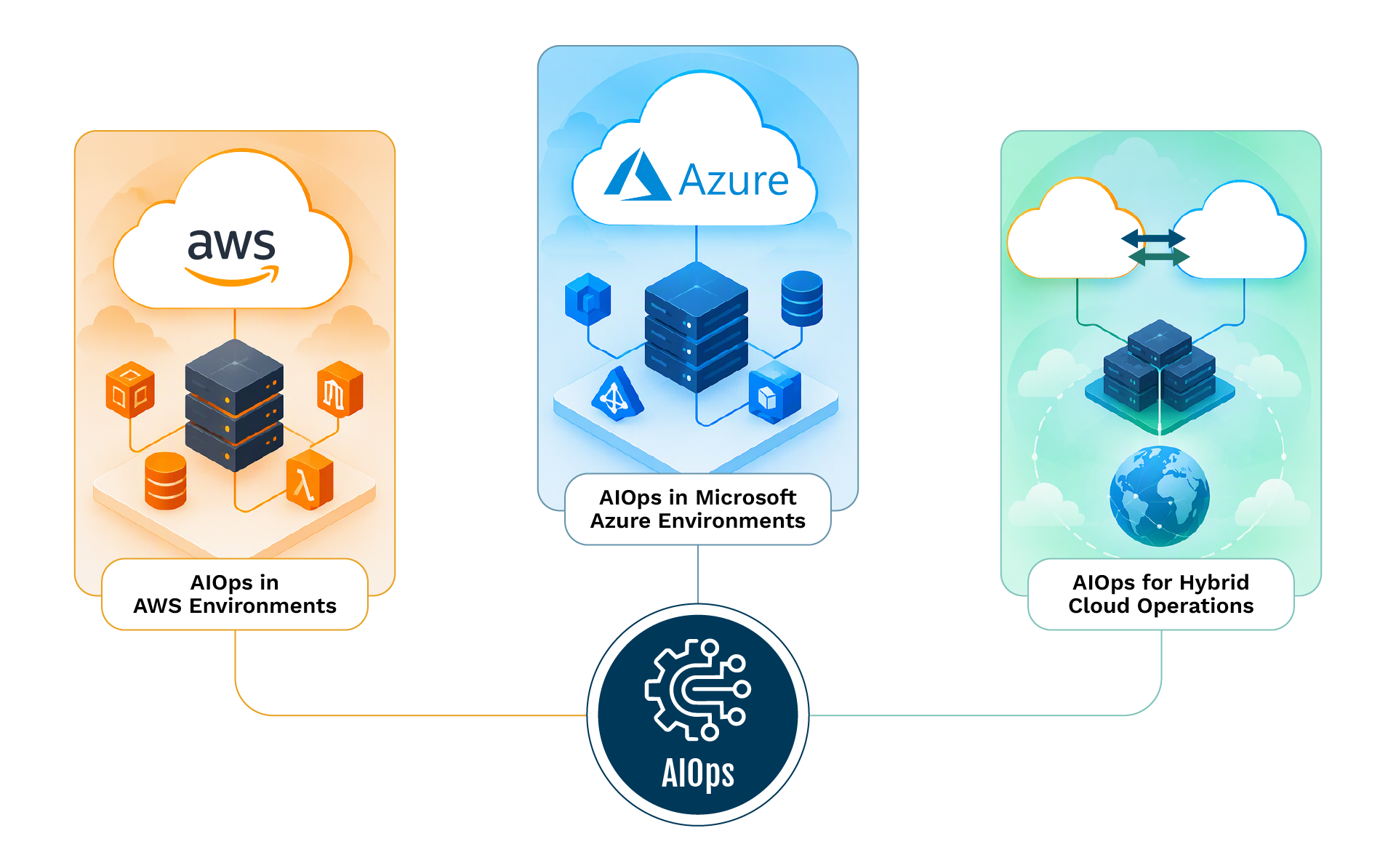
AIOps in AWS Environments
Organizations running workloads on AWS generate significant operational telemetry from services such as Amazon EC2, Amazon EKS, ECS, Lambda, RDS, CloudWatch, and CloudTrail.
AIOps enhances AWS operations by transforming this data into actionable intelligence.
Intelligent Anomaly Detection
Traditional monitoring relies heavily on predefined thresholds. AIOps takes a more advanced approach by learning normal operational behavior and detecting deviations automatically.
For example, machine learning models can identify:
- Unusual CPU utilization
- Memory consumption spikes
- Network traffic anomalies
- Storage performance degradation
- Application latency increases
By identifying abnormal patterns early, organizations can address issues before they impact the end users.
Predictive Operations
AIOps enables predictive monitoring by analyzing historical operational trends.
Organizations can proactively identify:
- Capacity constraints
- Resource exhaustion risks
- Infrastructure bottlenecks
- Performance degradation patterns
- Potential service failures
Rather than waiting for incidents to occur, teams can take preventive action to maintain service availability.
Automated Remediation
When integrated with cloud automation services, AIOps can trigger corrective actions automatically.
Common examples include:
- Scaling compute resources
- Restarting failed services
- Replacing unhealthy instances
- Correcting configuration drift
- Executing recovery workflows
Automated remediation reduces Mean Time to Resolution (MTTR) and improves operational resilience.
Cost Optimization
AIOps platforms continuously evaluate cloud resource utilization and spending behavior.
This enables organizations to identify:
- Idle resources
- Oversized workloads
- Unused storage
- Underutilized compute instances
Intelligent recommendations help reduce cloud costs while maintaining performance and availability.
AIOps in Microsoft Azure Environments
Azure has become a preferred platform for enterprise applications, analytics workloads, and business-critical systems. Services such as Azure Monitor, Application Insights, Azure Log Analytics, Azure Kubernetes Service (AKS), and Azure Virtual Machines produce extensive operational data.
AIOps helps organizations gain greater value from this telemetry.
Enhanced Observability
AIOps provides unified visibility across applications, infrastructure, databases, user interactions, and customer behavior to support an optimal digital customer experience.
By analyzing large volumes of telemetry data, organizations gain a deeper understanding of:
- Service health
- User experience
- Infrastructure performance
- Resource consumption
- Dependency relationships
This comprehensive observability improves operational decision-making and service reliability, and AIops solutions can also strengthen security operations by analyzing user behavior.
Faster Root Cause Identification
One of the biggest operational challenges is determining why an incident occurred.
AIOps platforms use automated root cause analysis to correlate logs, metrics, traces, and events across Azure services, helping it teams resolve issues faster.
Intelligent Capacity Planning
Machine learning models use predictive analytics to evaluate historical infrastructure consumption and business demand patterns to forecast future requirements.
This supports resource allocation decisions by using historical demand patterns to guide scaling before constraints emerge.
This allows organizations to:
- Improve capacity planning
- Avoid resource shortages
- Optimize infrastructure investments
- Reduce operational risk
Resource Efficiency
AIOps continuously assesses Azure environments and provides recommendations to optimize workload placement, storage utilization, storage systems, and infrastructure sizing, helping organizations achieve greater operational efficiency.
AIOps for Hybrid Cloud Operations
Many enterprises continue to operate hybrid cloud environments that combine public cloud platforms with private infrastructure and on-premises systems.
While hybrid strategies provide flexibility and compliance advantages, they also increase operational complexity.
Unified Operational Visibility
One of the most significant benefits of AIOps is the ability to consolidate operational intelligence across environments.
Organizations gain centralized visibility into:
- AWS workloads
- Azure services
- Private cloud resources
- On-premises infrastructure
- Edge devices
- Enterprise applications
This single-pane view eliminates operational blind spots and enables better decision-making.
Cross-platform Event Correlation
Hybrid cloud issues frequently span multiple systems.
For example, a slowdown in a customer-facing application may be caused by a database bottleneck residing in an on-premises data center, which is triggered by network latency affecting cloud connectivity.
AIOps correlates these events automatically and identifies the actual root cause, reducing troubleshooting effort and accelerating recovery.
Governance and Compliance
Organizations operating in regulated industries require continuous compliance monitoring.
AIOps supports governance initiatives through:
- Configuration monitoring
- Policy validation
- Audit readiness
- Security anomaly detection
- Compliance reporting
This enables organizations to maintain operational consistency across distributed environments.
The Convergence of AIOps and MLOps
As enterprises invest heavily in artificial intelligence, operational teams must manage not only traditional infrastructure but also AI and machine learning workloads. This is driving the convergence between AIOps and MLOps.
Organizations require visibility into:
- Model performance
- Training pipelines
- Data quality
- Inference environments
- Model drift
- AI governance
A unified approach enables enterprises to monitor and manage both cloud infrastructure and AI ecosystems through a common operational framework.
As AI adoption grows, organizations increasingly need integrated capabilities for model deployment, monitoring, lifecycle management, observability, and operational automation. eInfochips helps organizations establish these capabilities through end-to-end AI/ML, MLOps, and enterprise AI services.
Generative AI and the Future of AIOps
Generative AI is redefining how IT operations teams interact with operational data.
AI-powered operational copilots can assist engineers by:
- Summarizing incidents
- Recommending remediation actions
- Generating troubleshooting workflows
- Answering operational questions
- Automating support processes
- Learning from historical incidents
These intelligent assistants help reduce the operational burden while improving response quality and consistency.
As enterprises continue adopting AI-driven operations, Generative AI will become an important component of autonomous cloud management, enabling faster decision-making and enhanced operational efficiency.
Why eInfochips?
Organizations looking to modernize cloud operations require a partner that understands not only cloud infrastructure but also AI, automation, and operational intelligence. eInfochips delivers end-to-end AI and ML services spanning enterprise AI, MLOps, AIOps, Edge AI, Generative AI, data engineering, and cloud-native deployment. The company’s capabilities extend from AI model development and operationalization to observability, lifecycle management, and automation frameworks designed to help enterprises build intelligent and scalable ecosystems.
With proven experience in implementing MLOps platforms, AI-driven operational intelligence solutions, Generative AI-based SRE copilots, and large-scale AIOps deployments, eInfochips enables organizations to improve service reliability, accelerate issue resolution, optimize cloud resources, and build resilient operations across AWS, Azure, and hybrid cloud environments.
Conclusion
As organizations continue expanding across AWS, Azure, and hybrid cloud environments, IT operations are also becoming increasingly complex. Traditional monitoring and management approaches are no longer sufficient to manage the scale, speed, and interdependencies of modern cloud ecosystems.
AIOps provides a powerful solution by combining artificial intelligence, machine learning, observability, and automation to create proactive, data-driven operations. From anomaly detection and predictive maintenance to automated remediation and cloud cost optimization, AIOps empowers organizations to improve reliability, enhance operational efficiency, and maximize the value of their cloud investments.
The future of cloud operations lies in intelligent and autonomous systems capable of predicting, preventing, and resolving issues before they impact business outcomes. Organizations that embrace AIOps today will be better positioned to drive innovation, strengthen resilience, and gain a competitive advantage in an increasingly digital world.
Frequently Asked Questions
1. How does AIOps improve cloud operations across AWS and Azure?
AIOps uses artificial intelligence and machine learning to analyze operational data across AWS, Azure, and hybrid cloud environments. It enables intelligent anomaly detection, predictive monitoring, automated root cause analysis, and incident remediation, helping organizations improve service reliability and operational efficiency.
2. What is the difference between AIOps and traditional cloud monitoring?
Traditional cloud monitoring relies primarily on predefined thresholds and manual investigation to identify issues. AIOps goes further by analyzing historical and real-time data, detecting unusual patterns, predicting potential failures, correlating events, and recommending or automating corrective actions.
3. How does AIOps help optimize cloud infrastructure costs?
AIOps continuously analyzes cloud resource utilization and spending patterns to identify idle resources, oversized workloads, unused storage, and underutilized compute instances. These insights help organizations optimize resource allocation, reduce unnecessary cloud expenditure, and maintain application performance and availability.
4. Can AIOps automate incident detection and resolution in hybrid cloud environments?
Yes. AIOps provides centralized visibility across public clouds, private clouds, and on-premises infrastructure.