

A Practical, Human-Centered Guide to Designing Better Experiences
UX Research Techniques: A Practical, Human-centered Guide to Designing Better Experiences
1. An Overview of UX Research
Systematic investigation of users, their behaviours, needs, motivations, and obstacles through UX (User Experience) Research is a way to influence the design of products and services. Rather than relying on assumptions or ‘gut feelings’, UX Research employs systematic techniques to better understand how people interact with technology. The aim is to design products and services that are natural, effective, and valuable.
User experience research methods are essential tools for understanding users and improving product design.
A UX researcher plays a key role in planning and conducting studies to gather insights that inform design decisions and ensure best practices are followed.
UX Research enables teams to answer valuable questions about users, including:
- Who are the users?
- What problems do they want to solve?
- How do they act in real-world settings?
- What are the difficulties faced while using certain features?
- How do teams conduct user research to inform and improve design decisions?
Defining clear research goals at the start of any UX research project is crucial to ensure the research is focused and actionable.
Example:
A certain food delivery service had low repeat usage. Research indicated that users were confused by inaccurate time projections. This led to an upgrade in the tracking capabilities by the service for better usage.
User research methodologies provide a structured approach to gathering insights that drive effective design solutions.
Exploratory research is often used in the early stages of a project to uncover user needs, behaviors, and motivations, setting a strong foundation for subsequent design and research activities.
2. Reasons Why UX Research is the Backbone of Great Design
Research into the user experience (UX) is critical to the successful development of a digital product. Conducting extensive UX research prior to creating a digital product helps organizations to minimize uncertainty when designing digital products that meet user needs while helping to meet business objectives. UX research also enables teams to connect with their target audience, ensuring that products are designed to address the specific needs and preferences of the intended users.
Benefits of UX Research:
- Reduced chances of product failure
- Savings through reduced development costs as rework is eliminated
- Improved usability and accessibility of products for users
- Increased levels of satisfaction and retention of customers
- Data-driven decisions about products made possible for businesses
- Helps teams understand user motivations, behaviors, and pain points, leading to more effective solutions
Example:
A bank used Usability Testing to improve their “Know Your Customer” (KYC) process. This led to a 40% reduction in users abandoning the onboarding process before completion. By conducting UX research, the team was able to gain insights that drove better product decisions and improved the overall user experience.
3. Categories of UX Research Techniques
By gathering and examining users’ thoughts, emotions, motives, and reasoning behind their actions, the field of user experience research encompasses many different aspects of research (i.e., “Behavioural” vs. “Attitudinal”). While both types of research provide a wide variety of insights about the user experience, they each serve different purposes and can add to the overall findings through integration.
In addition to providing the data on how a product has performed, the following list of research methods also details some of the major research methods employed throughout the user-experience/research process.
- Qualitative Research: Focuses on understanding user emotions, motivations, and reasoning. Interviews and usability testing are examples of a qualitative research method, providing in-depth, non-quantitative insights. Qualitative data gathered from these methods is valuable for understanding user motivations, perceptions, and emotional responses.
Examples: Interviews, usability testing, and contextual inquiry. - Quantitative Research: Focuses on measurable data and patterns. Quantitative research relies on numerical data to identify patterns and trends in user behavior. The data collected through these methods is essential for making informed UX decisions.
Examples: Surveys, analytics, A/B testing. - Attitudinal Research: Captures what users say or feel.
Examples: Feedback forms, satisfaction surveys. - Behavioral Research: Observes what users actually do. Researchers collect data on user actions through observation and analytics to better understand real user interactions.
Examples: Click tracking, usability testing.
4. A Detailed Study of Core UX Research Techniques
4.1 User Interviews
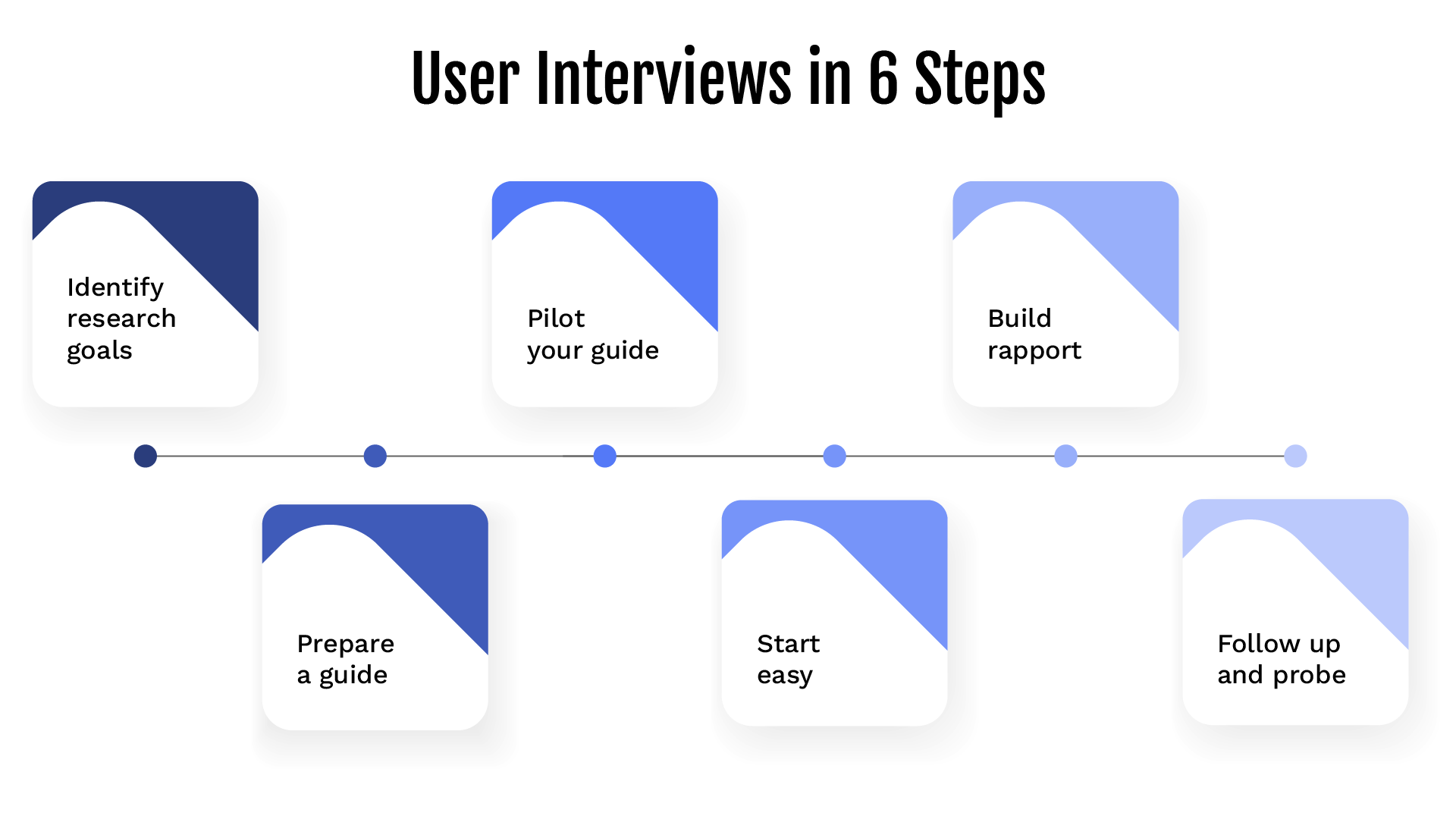
User interviews could be structured and/or semi-structured individual interviews which take place face-to-face with users of products, services, etc., to provide better insights into user preferences, motivation, and pain points. These insights form the basis for enhanced user experiences.
When to conduct:
- For early detection of product features
- To understand/new feature development
- To gain an understanding of pain point of your customers
Good User Interview Practices:
- Use open-ended questions
- Don’t lead your users in an interview setting
- Listen more than you speak to your users
An example of how to conduct user interviews: After conducting user interviews, an online education company learned their student body preferred shorter format lessons (videos) vs longer format lecture styles.
4.1.1 Focus Groups
Focus groups are a qualitative research method that involves moderated discussions with selected user groups. These sessions are typically conducted during the discovery phase to gather user perceptions, opinions, and attitudes about a product or concept. By leveraging group dynamics, focus groups allow researchers to observe how users interact, discuss, and influence each other’s viewpoints, providing diverse insights. User groups in focus groups help generate a wide range of ideas and uncover market needs, making them valuable for concept validation and understanding user attitudes early in product development.
4.2 Surveys and Questionnaires
An efficient way to gather information from a large number of users. Surveys are used to identify trends and to validate assumptions.
Salient points:
- Questions should be easy to understand and to the point
- A combination of closed-ended (multiple choice) and open-ended questions should be used
- Wording should be neutral with no bias
Example:
An example of what eCommerce sites learned by using surveys is that many sites lost potential sales because of high shipping fees, making it difficult for customers to complete their purchases.
4.3 Usability Testing

Usability Testing is a research method that monitors how users perform tasks while using an item (e.g., computer software) to look for potential pain points and the changes required in a product or service to overcome those issues. User testing is an umbrella term that covers various methods, including remote moderated usability testing and both qualitative and quantitative approaches, to evaluate a site’s design and how users find a specific page or interact with a web page. Eye tracking can be used during usability testing to understand how users visually process design elements and identify areas that attract or lose attention. Measuring user sentiment through post-test surveys helps capture users’ emotional responses and perceptions. Remote testing allows usability studies to be conducted with a wider and more diverse audience, increasing efficiency and reach.
Key metrics most frequently used:
- Task completion percentage
- Number of errors made
- Length of time on tasks
Example:
Many users experienced difficulty locating the filter in the Search feature of a mobile application; therefore, the design was updated to make it easier for users to find that filter.
4.4 Contextual Inquiry
Contextual Inquiry is a qualitative UX research method whereby the researchers observe users in their natural environment while performing their regular tasks. Different from controlled usability testing, in this approach, attention is drawn to understanding real workflows, tools, constraints, and influences from the surroundings that form user behavior.
The objective for this research is to gain an in-depth understanding of the true functioning of the end-user, as opposed to relying on their word for how they claim to function.
Conducting Contextual Inquiry Effectively
To gain reliable insights through Contextual Inquiry, it is essential to manage your participants properly:
Maintain a small research team/number of observers during study; too many people observing could affect the participants’ behaviour.
Clearly define the purpose and process to the participant prior to the study (i.e. explain to the participant what they will be doing as well as how long it is estimated to take, and that they are being evaluated on their performance).
Encourage participants to offer explanations without rushing through their explanations. Explain to the participant that you would like them to briefly provide verbal descriptions of what they are doing and the reasons for doing those things, while working at their normal speed.
Minimize the amount of disruption to their work environment; the researcher should observe the participant respectfully and not interfere with the participant’s workflow.
4.5 Card Sorting
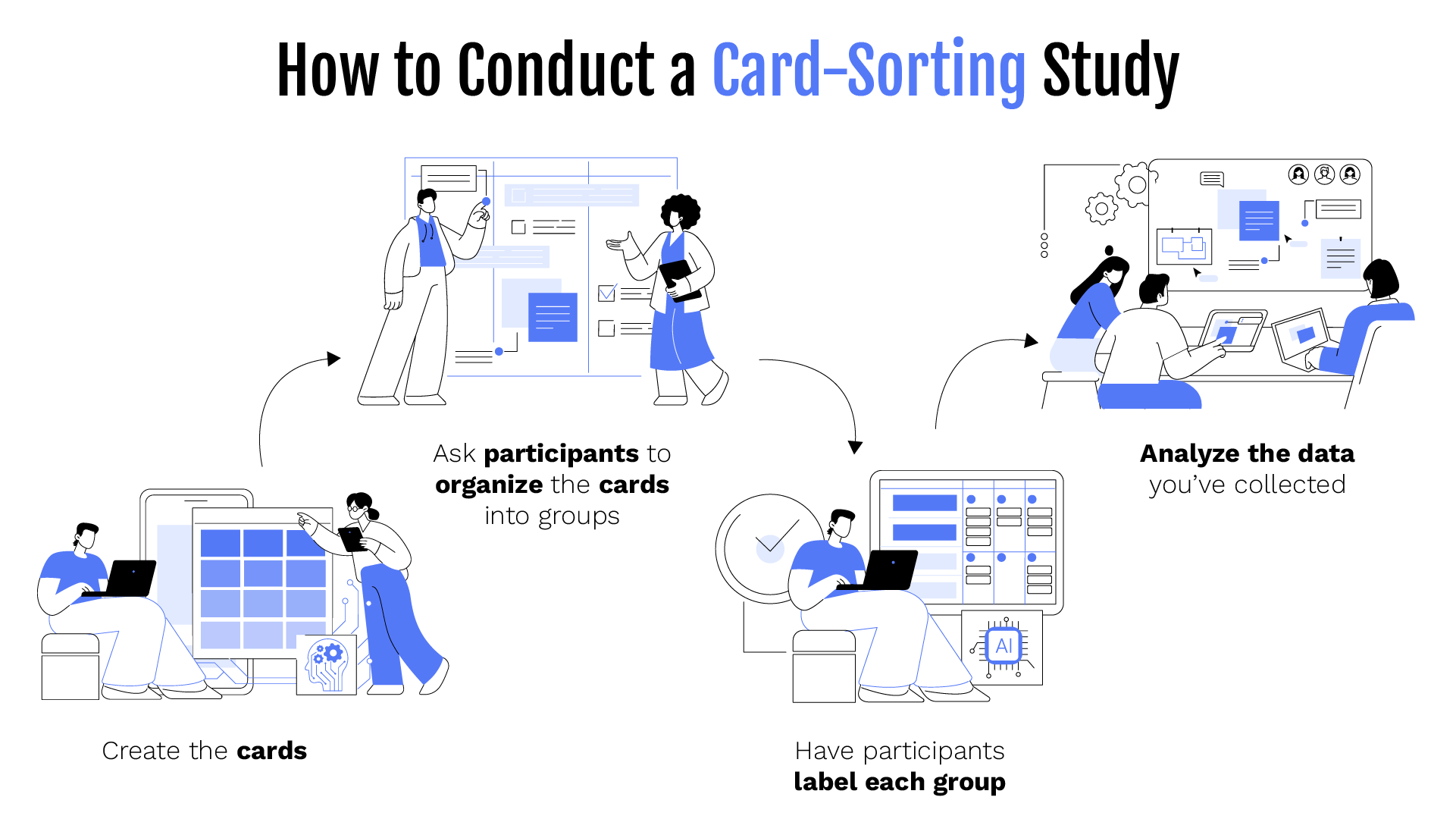
Card sorting helps improve information architecture by understanding how users categorize content.
Types:
– Open card sorting
– Closed card sorting
Example:
A news website reorganized its navigation after users grouped topics differently from what was expected.
4.6 Diary Studies
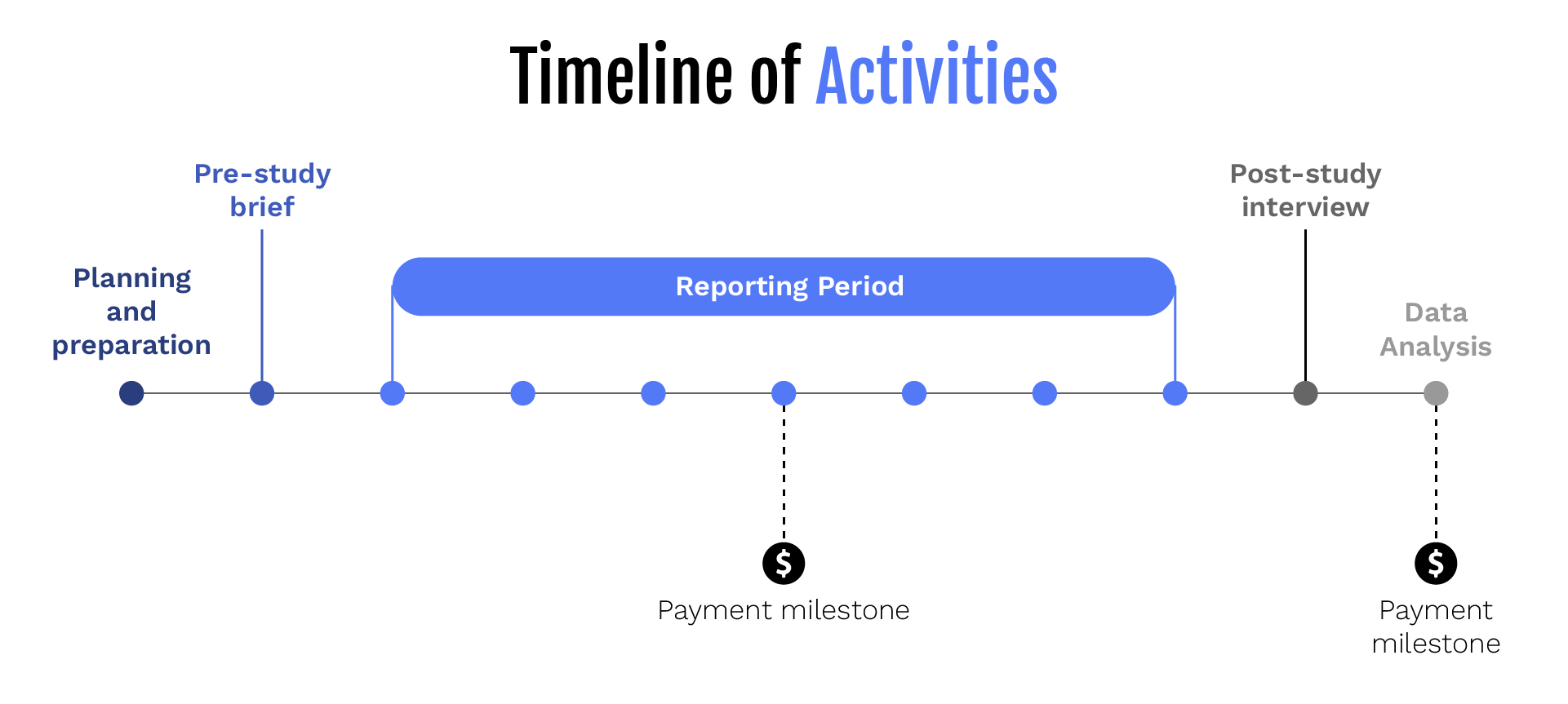
Diary studies ask users to record experiences over time, providing long-term behavioral insights. This method captures qualitative insights about user behaviors, motivations, and needs as they evolve.
Best For:
- Habit-forming products
- Long usage cycles
Example:
A fitness app used diary studies to understand motivation drop-offs.
4.7 A/B Testing

A/B testing compares two design versions to see which performs better based on metrics. Google Analytics is often used to track performance and collect numerical data, helping teams make data-driven decisions.
Example:
Changing a call-to-action button color increased sign-ups by 12%.
4.8 Concept Testing
Concept testing is used in the early stages of product research to validate ideas and gauge user interest, understanding, and feasibility before development. This qualitative and attitudinal method helps refine concepts and make informed design decisions by gathering feedback from target users.
4.9 Task Analysis
Task analysis involves studying how users perform specific tasks to understand their goals, workflows, and pain points. This method is essential for designing complex workflows and improving user experience by breaking down each step users take to achieve their objectives.
4.10 Mental Models
Understanding users’ mental models is crucial for designing intuitive interfaces. Mental models represent users’ expectations and perceptions about how a system should work, guiding the structure of information architecture and interaction design to align with user thinking.
4.11 Design Elements
Design elements such as buttons, layout, and interface structures play a significant role in capturing user attention and influencing behavior. Evaluating how users interact with these elements during usability testing helps identify which visual components support or hinder usability.
4.12 Most Frequently Used Methods and Selecting UX Methods
Some UX research techniques are most frequently used at different stages of a project, such as user interviews and focus groups during the discovery phase, and usability testing throughout the design process. Selecting the right UX methods depends on the research questions, project goals, and the type of insights needed to improve the user experience.
5. UX Research Process Flow
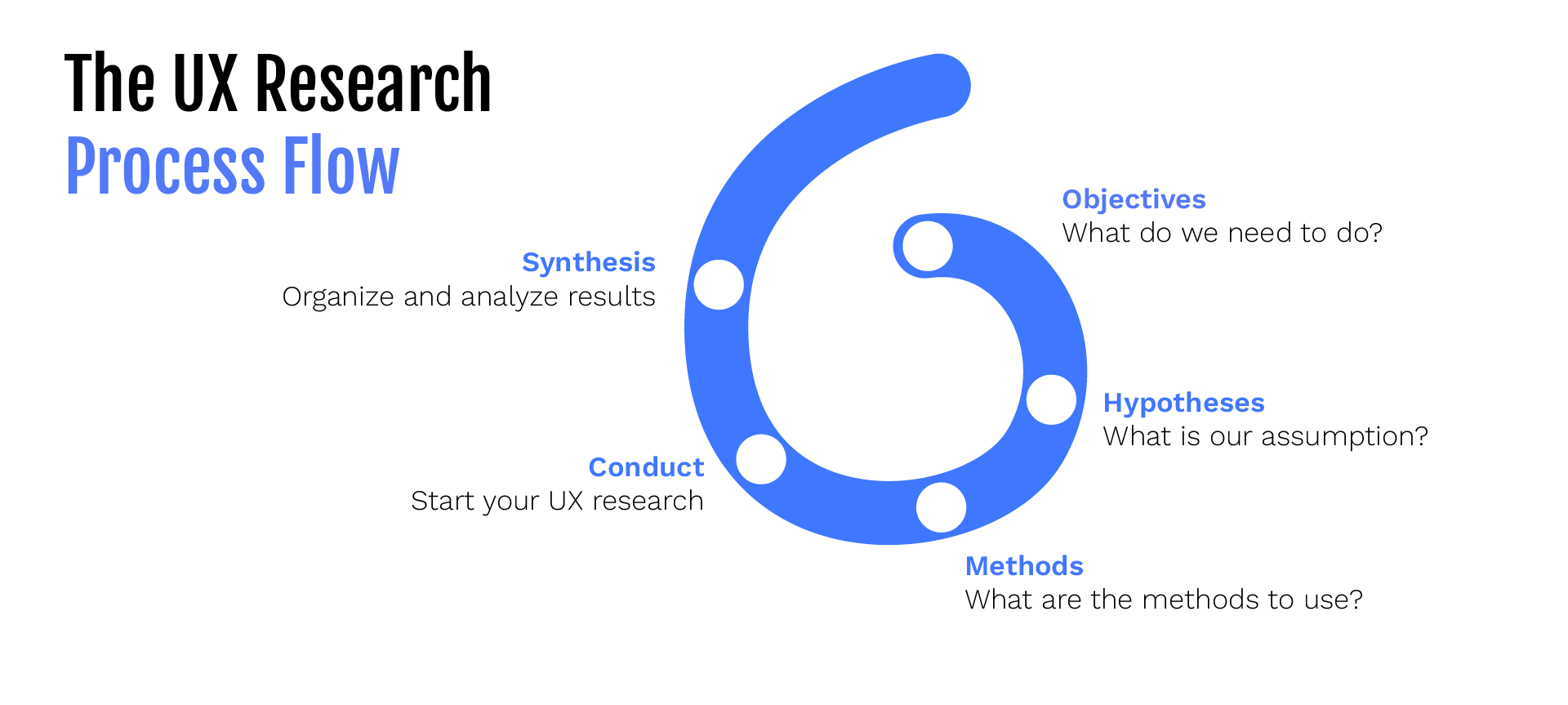
A typical UX research process includes the following steps:
1. Define the research problem
2. Select appropriate research methods
3. Recruit participants
4. Conduct research sessions
5. Analyze findings
6. Translate insights into design decisions
This flow ensures that the research remains focused, ethical, and actionable.
6. Real-world Examples and Mini-case Studies
Sample Case Studies and Application Examples
1. SaaS Dashboard Re-design
– Issue: Users felt overwhelmed by the current dashboard.
– Method: Usability tests and participants’ interviews.
– Result: A new, streamlined layout led to increased user engagement.
2. Onboarding Process for Mobile Apps
– Issue: High loss of users after starting onboarding.
– Method: A/B Testing was used.
– Result: Increased rates of completed campaigns.
3. Finding Content within e-Learning Platforms
– Issue: Hard to Find Content
– Method: Participants completed Card Sorting.
– Result: Improvement of Navigation Clarification.
7. Common Mistakes in UX Research
– Conducting research without clear objectives
– Asking biased or vague questions
– Ignoring negative feedback
– Failing to involve stakeholders
– Not acting on insights
8. Choosing the Right UX Research Technique
Consider:
– Product stage (idea, MVP, live product)
– Time and budget constraints
– Type of insight required
– Number of users available
Early stages benefit from interviews, while mature products benefit from analytics and A/B testing.
9. What Makes UX Research Outstanding and Fabulous
Quality UX research is not just about collecting data – through great research, we gain empathy, clarity, and confidence in our design decisions.
Key Factors of Quality UX Research:
– Storytelling with our research insights
– Collaboration across all teams
– Adopting a culture of continuous research
– Adopting ethical research practices
– Converting insights into measurable results
Outstanding research creates empathy, clarity, and confidence in design decisions.
10. Future of UX Research
The future of UX research continues to evolve as technologies progress, especially around the following trends:
– AI technology will assist us in analyzing our research results
– Remote and unmoderated testing will be more common
– Measuring emotions when evaluating user experiences
– Predicting user behavior based on our findings
11. Conclusion
Researching user experiences is central to human-focused design philosophies. A thorough and systematic understanding of a potential user’s point of view allows a team to develop products that are functional and have an emotional connection with their customers. Investments made in UX research will yield positive results over time.