

Key Considerations in EV Smart Charging Mobile/Web App Development
As of today, there are hundreds of EV charging mobile apps present on the app stores with millions of downloads and this is going to increase by multi-folds over the next few years. If you are looking to develop an EV charging app, you should know key features, tech stack, and most importantly vendor’s expertise around EV charging hardware & software systems.
This is the third blog in a series of ‘Digital transformation in EV charging value chain’ and focuses on the key factors to consider while developing a smart EV charging app.
Introduction
With EV sales shooting up, there is an increasing need for charging infrastructure development including charging station hardware, management software, mobile app, etc. For EV owners, usage of mobile charging apps has become inevitable as they need to know vital stats such as driving range, battery charging status and nearby charging stations, etc. before they move out.
Unlike any other mobile app, the EV charging apps are different as it involves multiple technological aspects such as charging features, port & charging type selection, integration with IoT & cloud backend systems, and an open platform for future innovations. It requires the developers to thoroughly understand and experience the working of EV charging hardware and software systems.
Before moving to the key features of the EV smart charging app, let’s understand the need for it.
Why Mobile & Web Apps are Crucial for EV Charging Ecosystems
Today, we are living in a connected world of electric vehicles, smart EV charging app is no longer just about plugging in; it’s about wholesome experiences, real-time decisions, and data-driven energy management. Mobile and web applications act as the digital backbone of this ecosystem.
Here’s why they matter:
- Real-Time Charging Availability
EV users rely on apps to find nearby charging stations, check availability, and get real-time updates. Without this, range anxiety increases, decision-making gets hindered, and charger downtime goes unnoticed.
2. Remote Monitoring & Control
Smart EV Charging Apps allow drivers to:
- Start or stop charging remotely
- Monitor charge status and energy usage
- Receive alerts for low battery or charging errors
For fleet owners, this level of control improves uptime and energy efficiency. And it improves EV fleet charging management.
3. User Behavior & Insights
EV Mobile apps collect valuable data on user preferences, charging habits, and app interactions. This enables:
- Predictive maintenance
- Personalized experiences
- Load optimization for utilities
4. OTA Updates & Firmware Management
Web dashboards empower EV charging app development companies to push over-the-air updates, manage device firmware, and configure charge points without onsite visits.
What are the Key Features of an EV charging app
More than just finding the nearest charging EV Charging station, it helps in checking the availability of charge points, reserving a time slot, scheduling a charging, knowing the charging status, and many more.
Let’s have a quick look at its usage scenarios:
- User management (log-in, passwords)
- Charger lists – add/update/delete/status
- Availability of nearby charging stations
- Trip planning based on charge capacity
- Charger on-boarding via QR code
- Slot booking at a public charging station
- Filters based on port type and location
- Scheduled charge, plug & charge
- Real-time battery charging status
- In-app & phone-based notifications
- Charging usage history & patterns
- Sharing private/residential charger
- Diagnostics, error reporting, app analytics
- Payments & billing records
Key Factors in developing an EV charging app
The market is full of software companies and developers offering white-labelled solutions. However, most of the time such apps are developed using generic templates and do not reflect the real value and uniqueness of your offerings.
In the below section we have enlisted some of the key aspects one should consider while developing an EV charging app:
Technical Complexity
EV charging app employs complex operations involving control of EVSE hardware and software components. For example – onboarding a charger, selection of port type, smartphone-based user authentication, alert generation and integration of diverse protocols & connectivity options, etc. It is important to understand the impact of each parameter in overall charging experience and designing an easy-to-use app.
Real-time Status
EV charging apps are of real-time nature, meaning the app must work seamlessly all the time and present the live status of battery charging, energy rates, available locations, etc. App developers must also consider limited bandwidth and wireless connectivity while developing and testing the app.
IoT/Cloud Backend
EV charging sessions generate a high volume of telemetry data and service requests. IoT and cloud backend infrastructure are needed to continuously monitor and ensure the high availability of charging services. The charging app should have tight integration with backend systems to ensure it generates alerts for critical information.
Target Users
Anyone who drives an EV is the intended user of the charging app irrespective of the user’s gender, age, or location. Besides functional aspects, it should offer ease of use like any other app, have intuitive UI/UX, simple navigation, and support regional languages.
eCommerce Integration
To provide seamless charging and payments experience, the EV charging app should provide chatbot assistance, CRM integration and payment gateways/digital wallets, etc. Rewards points, memberships, and discounts are other important aspects while developing the app to attract and retain frequent users.
Save this essential feature list for developing the best EV Charging app.
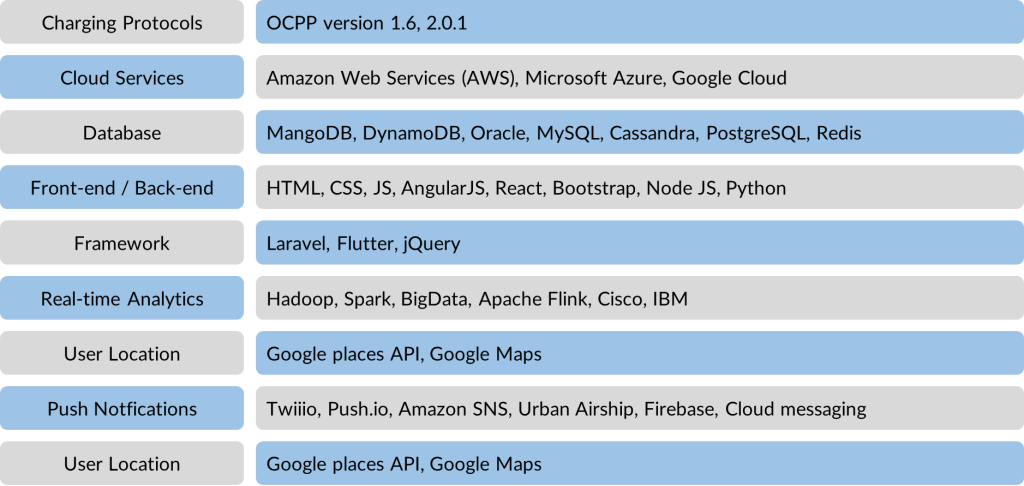
Technology Stack to Build an EV Charging App
Conclusion
EV charging apps have enabled automakers and e-Mobility service providers to connect and understand how customers use EVs and associated charging services.EV charging apps generate a huge amount of qualitative data (i.e., locations, payment methods, reviews, etc.) and quantitative data (charging time, usage patterns, battery state, etc.). This data-driven approach presents a unique opportunity for them to constantly evolve services and innovate offerings.
About eInfochips
eInfochips is at the forefront of the e-Mobility/EVSE industry and provides digital transformation services across the EV charging value chain. It has successfully executed award-winning projects including turn-key EV charging hardware, smart charging apps, and a charging management platform.
We have helped multiple companies in the e-Mobility industry to develop smart charging apps and web management portal. Following is an example of our solutions developed for an EV charging leader based in North America.
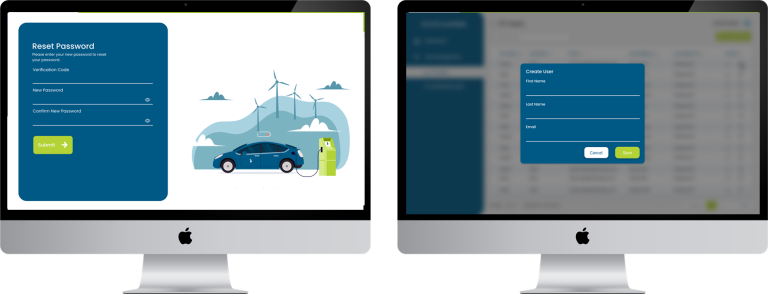
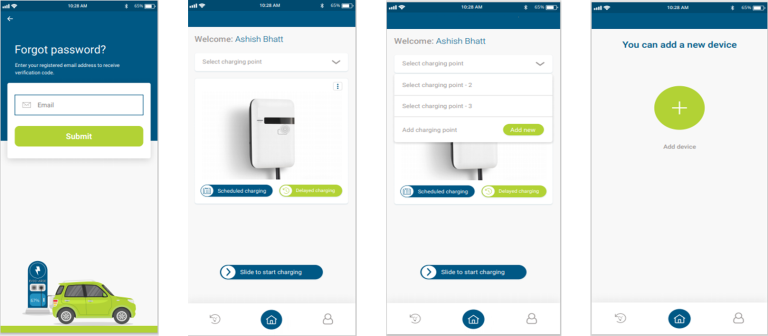
eInfochips offers full-stack EV Charging app development services across the enterprise application stack from user applications (mobile, web applications for workflows and analytics with UX/UI design) to data management (streaming data acquisition, pre-processing, modelling, and enterprise data integration).
This includes assessment, design consulting, implementation, and testing services for user applications and requisite information architecture. To know more, contact our experts today.