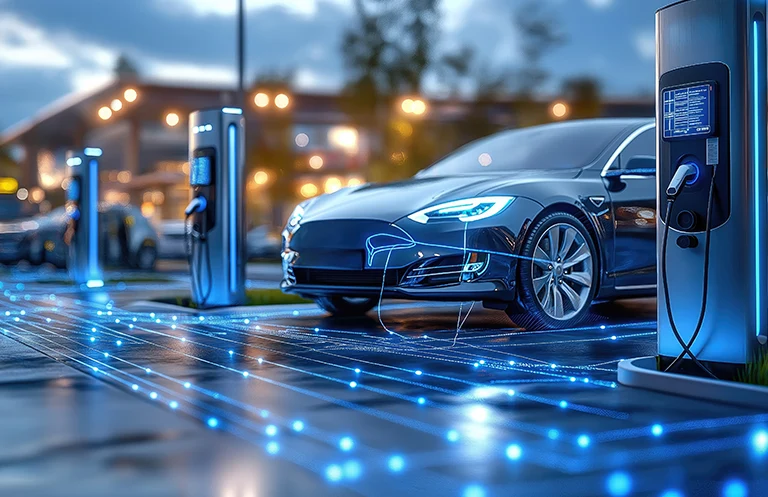

The Electric Vehicle (EV) revolution is accelerating, but it raises a critical question: how can we prevent our electrical grids from becoming overloaded as we power more EVs? You should not just generate more power; you should also use the existing power better. Two Load Management solutions that can help with this are Local Load Management (LLM) and Dynamic Load Management (DLM).
Energy management and energy management systems are crucial for optimizing EV load management, as they enable real-time monitoring, predictive analytics, and automation to ensure efficient, reliable, and sustainable operation of EV charging infrastructure.
Homeowners, fleet managers, and commercial property managers should learn about these choices to charge EVs securely, quickly, and cost-effectively. This is especially relevant for the EV charging business and the expansion of EV infrastructure, where efficient load management supports reliable growth and operational efficiency. This blog talks about what LLM and DLM are, how they can help, how to use them in a legal way in Europe, and problems they could cause.
The Basics: What does it mean to manage a changing local load? The primary goal of load management is to ensure that the amount of electricity needed is the same as the amount of electricity available. When one or more EVs are connected, it maintains total electricity use within the building’s or area’s maximum capacity. Effective load management ensures power availability for charging stations and allows multiple vehicles to be charged simultaneously without exceeding capacity, supporting both grid stability and user needs.
Local Load Management (LLM) is a mechanism to ensure that a set of EV chargers consistently receives an equal share of power. Charging stations obtain a specific quantity of power and from that reserved capacity, the power is usually distributed among all the chargers connected. LLM is especially useful in settings with multiple vehicles and limited electricity infrastructure, as it helps balance the available power among all users.
- For Example, if there is a reserve capacity of 40 amps and there are four EVs connected, then the LLM system makes sure that each charger can only consume 10 amps at a time. This limit stays constant no matter what is happening in the building. This is a simple and useful way to keep a charging slot from growing too full.
Dynamic Load Management, or DLM, is a newer and better way to do things. A DLM system can work without having any extra space set aside. Instead, it maintains track of how much power the property uses. It keeps track of how much power is available and sends it to the connected EV chargers when required. Advanced technologies such as AI and IoT are increasingly used in modern load management systems to optimize energy distribution and improve efficiency.
- Think of your building as having a main power supply with a capacity of 100 amps. The DLM system continuously monitors the building’s power usage. If the building only requires 30 amps, the EV chargers can use the remaining 70 amps. DLM first tries to reduce the load capacity of the connected chargers, and if no load is available then it turns off the charging, when an external load such as an oven is turned on, and it consumes 50 amps, to keep the current load below 100 amps. It varies often, so you must find a balance.
The “Why”: The Cost, the Benefits for the Grid, and How Well it Works?
When you employ LLM and DLM, it is not only about stopping tripped breakers. It helps the firm save costs.
Do Not Spend a Lot of Money to Improve Your Infrastructure: The best aspect is that you can add more chargers to the electrical system you already have. Upgrading the main electrical panel and building power supply can be very costly. DLM maximizes the existing capacity, reducing or delaying the need for expensive upgrades. Load management also helps reduce installation costs by supporting multiple charging stations on a single circuit and optimizing electrical usage.
Lower Energy Costs and Tariffs: In many European nations, the cost of electricity changes as per the power usage during peak hours. People call this “demand charges.” These rates are based on the clients’ maximum usage of electricity during the month. DLM smooths out these peaks by balancing the EV charging time when there is high demand. This can help you cut down on your electric bill effectively by reducing energy costs. DLM also helps manage peak demand periods, further reducing operational expenses and supporting cost-effective charging infrastructure.
- Get Your Property Ready for the Future: There will be more electric cars on the road, therefore they need to be charged more often. People are more likely to rent, work, or shop at a site with a good load management system. It has grown to be an important part of the world. Implementing advanced load management ensures maximum benefits for site owners and operators by optimizing efficiency and generating additional revenue.
- Speed Up Charging and Make It Better for the User: A DLM system makes certain that the connected cars charge as rapidly as possible within the available power. You may even give some people or cars more power than others. For example, a delivery truck that needs to turn around fast can be more important than an employee’s car that would be parked all day. Effective load management also improves customer satisfaction by ensuring reliable, timely charging and meeting user expectations for service reliability and cost efficiency.
Integrating renewable energy sources with DLM not only supports sustainability but also helps in reducing reliance on traditional energy sources, promoting a cleaner and more efficient charging infrastructure.
Charging Infrastructure
Charging infrastructure forms the backbone of the electric vehicle (EV) revolution, providing the essential network that enables drivers to recharge their vehicles efficiently and conveniently. As EV adoption accelerates, the need for robust, scalable, and intelligent charging infrastructure becomes increasingly important—not just for user satisfaction, but also for the stability and sustainability of our energy systems.
A key aspect of modern charging infrastructure is the implementation of dynamic load management and advanced load balancing. These technologies ensure that the available electrical power is distributed optimally across multiple charging stations, even as energy demand fluctuates throughout the day. By dynamically adjusting charging power based on real-time consumption and available grid power, operators can maximize the use of existing electrical infrastructure without the need for costly upgrades.
Integrating renewable energy sources, such as solar or wind, into charging infrastructure further enhances its sustainability and cost-effectiveness. By leveraging renewable energy, charging stations can reduce reliance on the traditional power grid, lower energy costs, and contribute to a greener energy mix. Smart charging systems can prioritize the use of renewable energy when available, aligning charging sessions with periods of peak energy production and minimizing the carbon footprint of EV charging.
Effective load management within charging infrastructure also plays a crucial role in reducing peak demand and associated energy costs. By smoothing out demand spikes and shifting charging to off-peak hours, operators can take advantage of lower tariffs and participate in demand response programs. This not only helps to control operational costs but also supports the broader power grid by preventing overloads and reducing the risk of power surges.
Ultimately, a well-designed charging infrastructure—supported by dynamic load management, load balancing, and renewable energy integration—ensures a reliable power supply for EV users and enables sustainable growth of the EV charging network. As the number of electric vehicles and charging stations continues to rise, investing in smart, future-proof infrastructure is essential for maximizing benefits, minimizing costs, and supporting the transition to a cleaner, more efficient transportation ecosystem.
How it Works: A Step-by-Step Guide to Putting it into Action
The Main Process:
- Connecting and Shaking Hands: The charger is plugged into the car. The charger and the car interact to determine how much power the charging cable and the car can handle. This is a crucial safety safeguard, according to IEC 61851 and other standards.
- System Detection: The load management system recognizes that the charger is running when it detects that the charging relay has opened.
- Getting Data: The system receives data from two basic sources:
- An outside meter on the main electrical line of the property to check the total load that is not coming from an electric vehicle.
- The EV chargers to see how much electricity each EV is using.
Monitoring energy consumption during each charging session is essential for effective load management, as it allows the system to optimize power distribution and prevent overloads.
- Calculation and Action: This is where LLM and DLM differ.
How to Use LLM:
The LLM system uses a set value that doesn’t change: A place just for electric cars.
- Check How Much Power the Electric Cars are Using: The system knows how much power each connected charger is using.
- Check Against Limit: This helps examine if the current EV load is greater than the reserved capacity for EVs.
- Share Power: When a new car plugs in, the system divides the reserved capacity for EVs across all the chargers that are already in use.
Static load management is used to distribute power evenly across multiple charge points, especially in ev chargers based systems, by using pre-set configurations.
For instance, the reserved capacity is 30 amps.
- When one EV connects: It can handle up to 30 amps (or its own maximum limit, whichever is lower).
- If two automobiles are connected, the system might give each one 15 amps.
- It gives 10 amps to each of the three cars that connect. This approach is particularly suitable for scenarios with predictable energy consumption and a fixed number of multiple charge points.
This allocation is final and does not account for the building’s current load capacity.
DLM Implementation Flow:
The DLM system does math every few seconds and constantly remains active.
- Figure Out How Much Space is Available: This is how you find the available capacity: total site capacity – total non-EV load – safety buffer (the safety buffer is a small amount that is set aside, usually 10 to 15%, to make sure that sudden, small increases in consumption don’t cause overloads.)
- Distribute Power Dynamically: The system tells the active charging stations about available power.
Let’s say, the site can handle 100 amps and the safety buffer is 10 amps.Situation A: The building needs 20 amps of power that isn’t for an electric car.
The available capacity is 70 amps, which is 100 – 20 – 10.
A car that is being charged can get up to 70 amps.
If two cars are charging at the same time, they can split 70 amps into two groups of 35 amps each.
Each of the four cars that are charging could get 17.5 amps.Situation B: Someone turns on a big machine, and the load that isn’t an electric car goes up to 50 amps.
The available capacity is 40 amps, which is 100 – 50 – 10.
The gadget immediately sends a message to the chargers, telling them to use only 40 amps of power. Now, each of the four cars from the last example could only use 10 amps.A smart DLM system does more than just split the electricity evenly. It can use complex algorithms to determine how to distribute power efficiently. It might not simply split the power evenly at 6.66 amps per car, since that value is both inefficient and below the 6-amp minimum charging threshold. Instead, it could allocate 8 amps to one car and 6 amps each to the other two, totaling 20 amps, to ensure all cars charge properly.
Challenges in Implementation
There are a few points that we need to take care of while implementing:
These challenges are especially relevant for large-scale ev charging networks, where interoperability and efficient energy consumption management are critical for reliable operation.
- System Independent: There shouldn’t be any problems with different brands of chargers, meters, and control systems working together. In this case, the Open Charge Point Protocol (OCPP) and other open standards are quite important. Using hardware that works with OCPP is important for creating a system that can grow and change. Supporting multiple manufacturers is essential for seamless integration and interoperability across the entire ev charging network.
- The Meters’ Accuracy and Efficiency: DLM can only use the data it obtains. We need energy meters that can regularly, quickly, and precisely monitor and record energy use. The meter could not work well or might be slow, which might make things take longer. This might mean that the maximum capacity isn’t being used to its full potential or that the overload isn’t fixed quickly enough. Make sure that the meters, controls, and communication links are set up correctly.
- Following the rules: Different parts of Europe may have different rules or grid codes that regulate how to control loads.
Software Development for Local and Dynamic Load Management in EV Charging by eInfochips:
eInfochips has implemented the Local Load Management and Dynamic Load Management Algorithm for type-2 EV chargers that support single phase and three phase chargers. We have designed a local charger hosted webpage for configuration of LLM/DLM parameters like grid capacity, reserve capacity, adding client chargers and energy meter. The system enables operators to monitor and control power availability in real-time, ensuring efficient energy distribution and reliable charging operations.
We have configured one charger as a gateway charger and the rest of the chargers in the group as client chargers. The gateway charger communicates with an external energy meter connected to the mains supply through Modbus TCP Protocol that reads the total current consumption. Algorithms are developed for distributing available capacity between chargers that run on the gateway charger, which distributes the calculated current to all chargers. The algorithm considers the maximum charger capacity, available capacity, and the phase types of the charger and the car.
Conclusion
As more people buy electric cars, the question is not whether a site can charge them, but how they can share power in a smart way that does not put too much stress on the power grid. Local Load Management (LLM) and Dynamic Load Management (DLM) help you manage the capacity by controlling it with software. LLM helps in distributing the capacity from the available reserved capacity and DLM distributes the capacity in real-time as per the non-EV load connected.
Using technologies like LLM and DLM, we can build a powerful EV charging ecosystem that works seamlessly with the existing power grid. This helps reduce capital costs by delaying upgrades, lowers operating costs through smart peak-hour management and tariff-based charging, and improves the driver’s experience with fair and transparent power allocation. When set up correctly, these systems follow per-phase limits, consider the capabilities of the vehicle and cable, and enforce safety buffers while quickly adapting to changes in building load.
Works cited
-
Load Management for Electric Vehicle Charging – Wikipedia, accessed October 12,2025, https://en.wikipedia.org/wiki/Load_management#Electric_vehicle_charging
-
ZVEH, “E-Mobility: Load Management for Charging Electric Vehicles,” OECS E-Motion Press Article, May 2023, accessed October 12,2025, Dynamic Load Management Instead of Expanding Grid Connections
-
M. A. Dabbaghjamanesh et al., “Load management techniques in electric vehicle-integrated smart grids: A comprehensive review,” IET Smart Grid, vol. 5, no. 4, pp. 394–408, 2022, accessed October 12, 2025, https://ietresearch.onlinelibrary.wiley.com/doi/full/10.1049/stg2.70002
-
Elgamal et al., “Dynamic Load Management for Electric Vehicle Charging: An Experimental Study,” 2023 IEEE International Conference, accessed October 12, 2025, https://ieeexplore.ieee.org/document/11101434