
Electric Vehicle (EV) charging infrastructure relies on a set of communication standards to ensure interoperability between electric vehicles, charging stations (EVSE – Electric Vehicle Supply Equipment), and backend systems (like payment or grid management). These standards govern how information is exchanged for authentication, charging control, payment, and energy management. EV charging standards are critical for enabling interoperability, compliance, and network expansion, supporting the evolving needs of the ev industry and the broader ev infrastructure market. Cost considerations are also a key factor in planning and deploying EV charging infrastructure.
EV charging infrastructure relies on multi-layered communication between four main entities: EV vehicle, EVSE, Backend – Charge Point Operator (CPO) system, and energy grid systems.
- Vehicle to Charger (EV ↔ EVSE): The key function of this communication is to identify/authenticate user, charging profile selection, dynamic power adjustment, safety, and Vehicle-to-Grid (V2G) support. The communication interface, as defined in protocols like ISO 15118, enables digital communication between the EV and EVSE, supporting features such as Plug & Charge, automatic authentication, and seamless two-way power flow. This interface also supports bidirectional charging, which benefits grid resilience and renewable energy integration. Inductive charging is an emerging wireless charging method, while conductive charging systems, compliant with IEC 61851, remain the standard for most public and private installations. Fast charging protocols like CHAdeMO deliver power directly to the EV’s battery for quicker charging times, and rapid charging standards specify technical requirements for ultra-high-power charging sessions.
- Charger ↔ Backend (EVSE ↔ CPO): Chargers are connected to a management backend operated by the CPO. This communication is required for remote start/stop of charging, status and fault reporting, firmware updates, energy metering, load balancing, and scheduling. The charge point management system enables communication with energy management systems using protocols like OSCP, supporting real-time grid capacity predictions and capacity-based smart charging. Charging network operators play a vital role in deploying, managing, and ensuring interoperability of charging infrastructure through protocols like OCPP.
- Backend ↔ Roaming Networks and Mobility Service Providers: This feature allows EV drivers to use chargers from multiple operators (interoperability). Charge points are managed and interconnected through standards like OCPI to facilitate EV roaming and scalable, automated charging services. The adoption of open protocols enables interoperability between different networks and service providers, while the open clearing house protocol facilitates seamless data exchange and interoperability across roaming platforms and backend networks. The clearing house system is a central component that enables seamless e-roaming and billing processes. Standardized payment systems are essential for secure and efficient transactions within expanding charging networks.
- Backend ↔ Grid / Energy System: Enables integration with the electric grid and energy management systems. This helps in effective load management, demand response, and grid balancing. The charge point management system’s compatibility with various hardware and open standards facilitates efficient EV charging management and supports the needs of growing ev ownership.
In this blog, we will focus on the first layer of communication between the EV vehicle and EV chargers and discuss in detail the design and development considerations to comply with the latest standards and protocols. The evolution of these protocols is shaping the future of the ev industry, with advancements supporting greater interoperability, user experience, and scalability. The north american ev market, for example, is seeing widespread adoption of the North American Charging Standard (NACS) by major automakers, influencing infrastructure development. Regulatory frameworks, including guidance from the federal highway administration, are also playing a significant role in shaping EV charging infrastructure standards.
There are two modes of communication between the EV and the EVSE. Access control is essential for facilitating secure and efficient communication within the EV charging ecosystem, ensuring that only authorized users and systems interact with the network.
Analog Communication (CP-PWM) and Communication Protocols
In this mode, communication occurs through simple electrical signals on the Control Pilot (CP) and Proximity Pilot (PP) lines in the charging cable. The EVSE sends a Pulse Width Modulated (PWM) signal to the EV. The EV responds by changing the load on the CP line to indicate its status.
For example, when the charger gun is connected to the EV, it changes the voltage level to nine volts from 12 volt. Similarly, when the EVSE tells its power capacity to the EV with the PWM signal on the control pilot line. So, the entire communication is done with the PWM and voltage level on the control pilot line. Proximity line is used to indicate that the EV is connected to the EVSE, so that the EV cannot move during the charging cycle.
Used in: Most AC chargers and some DC fast chargers (as the initial handshake).
Information Exchanged
- Connection status (plug connected, ready to charge)
- Maximum current limit (tells the EV how much current it can draw)
- Fault detection / safety checks
- Charging enable/disable signals
Digital (High-Level / Data) Communication
It is typically used in DC fast charging and smart AC charging systems. After the basics, the EV and EVSE establish digital communication over the same power cable using Power Line Communication (PLC) — specifically HomePlug Green PHY. In this case, control pilot line is used for high level communication along with the voltage level change. This allows data packets to be exchanged between EV and EVSE controllers.
Information Exchanged
- Vehicle authentication (e.g., Plug & Charge using certificates)
- Charging profiles (energy demand, timing, tariffs)
- Smart charging control (dynamic load management)
- Metering and billing data
- Vehicle-to-Grid (V2G) energy flow commands
The following table provides a quick summary of different protocols and its characteristics:
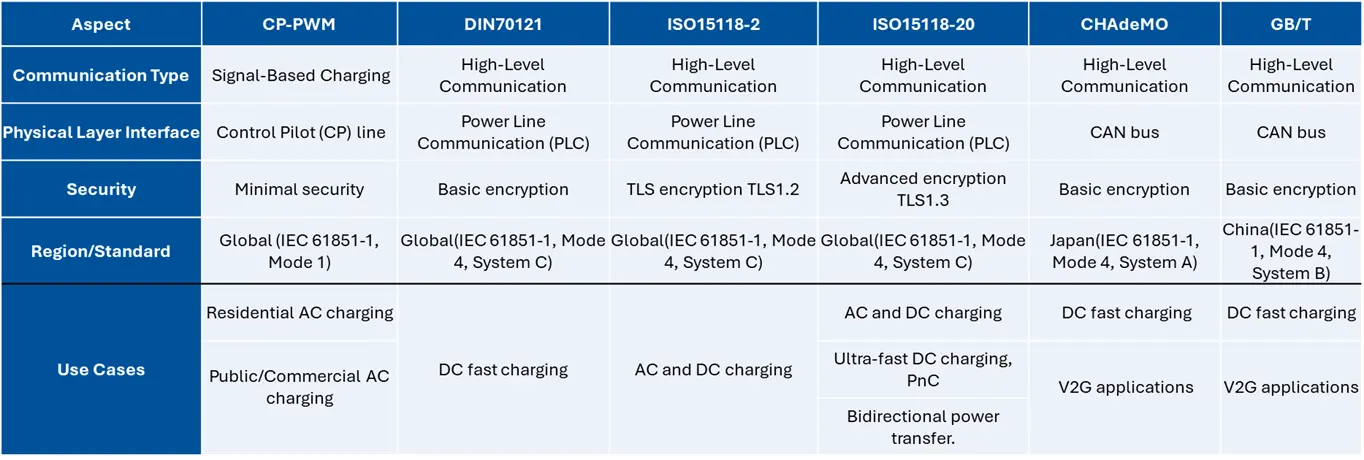
CP-PWM is a signal-based charging protocol and uses control pilot as the physical layer for its communication. It requires minimal security as it is a signal-based charging protocol, is used globally, and it is based on the IEC 61851-1 mode 1. CP-PWM is used for AC chargers, public, or commercial AC charging.
DIN 70121 was the initial version of ISO 15118 for DC charging, created quickly because the industry needed it right away. It is based on high-level or digital communication via control pilot line and communication is based on power line. It is widely used globally and is based on standard IEC 61851-1 mode 4, type C.
ISO 15118-2 is based on high-level digital communication. The physical layer uses the control pilot line, with power line communication added on top of it. The security is TLS 1.2 and is based on standard IEC 61851-1 mode 4, system C. This is used for both AC and DC charging.
ISO 15118-20 leverages digital communication and has control pilot line with power line communication. It implements advanced encryption TLS 1.3 and is based on IEC 61851-1 mode 4 and system C. ISO 15118-20 is used for AC and DC charging with extended functionality of plug and charge, fast charging, and bi-directional power transfer.
CHAdeMO implements digital communication via CAN bus. It is used for DC fast charging and V2G application in Japan. It offers basic encryption technique compliant to IEC 61851-1, Mode 4, System A.
GB/T offers high-level digital communication via CAN bus. It is used in China and offers basic encryption compliant with IEC 61851-1 mode 4 and system B. It is used for DC fast charging and V2G application.
Data Exchange and Security
As the EV charging industry continues to expand, secure and reliable data exchange has become a cornerstone of modern EV charging infrastructure. Effective communication between electric vehicles, charging stations, and the power grid is essential for delivering seamless charging services, managing energy loads, and supporting the growing network of electric vehicle charging stations.
A key enabler of this interoperability is the Open Charge Point Protocol (OCPP), which has become the de facto standard for data exchange between charging stations and central management systems. OCPP allows charging infrastructure from different manufacturers to communicate with a central management system, enabling network operators and charge point operators to remotely monitor, control, and maintain their EV charging stations. This open protocol is critical for the scalability and flexibility of EV charging networks, supporting both AC charging and DC fast charging solutions.
The latest version, OCPP 2.0.1, introduces significant enhancements tailored to the evolving needs of the EV charging industry. With improved device management, OCPP 2.0.1 enables more granular control over charging stations, allowing for real-time status updates, remote diagnostics, and efficient firmware updates. Transaction handling is also more robust, supporting advanced billing, user authentication, and detailed charge detail records, which are essential for both public and private charging infrastructure.
Security is a top priority in OCPP 2.0.1, with features such as end-to-end encryption, secure authentication, and digital signatures to protect sensitive data exchanged between EV chargers and the central management system. These security measures help safeguard the charging network against cyber threats, ensuring that both the charging process and user data remain protected. Secure data exchange is also vital for integrating charging stations with the power grid, enabling smart charging, load balancing, and demand response capabilities that support the stability of the electrical power supply.
By adopting open and secure communication protocols like OCPP 2.0.1, the EV charging infrastructure market can ensure interoperability, reduce costs, and accelerate EV adoption. As government funding and initiatives like the National Electric Vehicle Infrastructure (NEVI) program drive the deployment of new charging stations, robust data exchange and security standards will remain essential for the continued growth and reliability of the entire electric vehicle market.
Safety Features and Cost Considerations
- Electrical Hazards: EVSE system handles very high voltage and current that can pose very high risk, such as electric shocks, short circuit, and especially fires. Safety features like ground fault protection, surge protection are very important to mitigate this kind of risk.
- User Safety: To win user trust, it is very important that the EVSE design handles the user safety features like insulated connectors, emergency system, fault handling system, and user interfaces to reduce the likelihood of accidents.
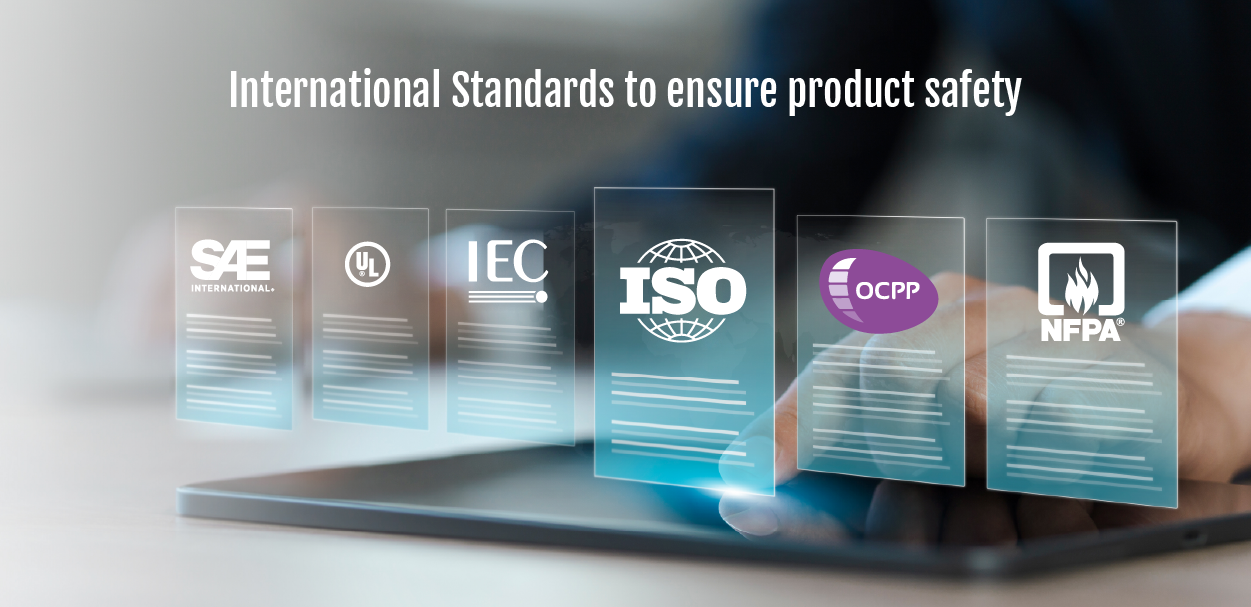
- Equipment Reliability: EVSE components need to be robust to avoid damage due to overheating, overloading, or environmental factors. This enhances the lifespan and performance of the equipment. To ensure this, there are certain compliance standards that help create such kind of safety critical system. So, these are the product safety guidelines that should be followed in any EVSE design to make it robust.

- Environmental protection: There should be a robust design to protect the EVSE system from water ingress, dust, extreme temperatures, and to ensure safe operations in diverse conditions.
- Cybersecurity: The system must not be compromised by hackers, as this could lead to malfunctions and create serious safety risks.
Firmware in Safety Design
- Real-time monitoring and diagnostics: The firmware continuously monitors the system for anomalies such as overcurrent, overvoltage, or overheating. The firmware shuts down immediately on detecting any faults to prevent electric shocks. It monitors the temperature of the charging gun to avoid thermal runaway. Real-time monitoring ensures that the potential hazards are identified and mitigated before they are escalated.
- Advanced software algorithms are used to detect the faults in the system, such as short circuit, communication errors, or hardware malfunctions. Once a fault is detected, the software isolates the affected components to prevent further damage. If a communication failure occurs between the EV and the EVSE, the software can terminate the charging session safely. Detecting the insulation resistance issues and isolating the EVSC from power supply is the best way to identify the issue. A fault detection mechanism helps prevent cascading failures and ensures the safety of both the user and the equipment.
- Compliance with safety standards: The software ensures EVSE’s compliance with the international safety standards like UL 1998. These standards define the safety requirements for critical systems like the EV charging system. The firmware supports this by implementing self-tests for all peripherals and interfaces it uses, such as the clock, memory, flash, interrupts, CPU registers, and other digital interfaces. It is also important to analyze and implement the software DFM, which includes self-tests of all interfaces that can cause safety hazards.
- Fail-safe mechanism: The software incorporates a fail-safe mechanism to handle the unexpected scenarios. This mechanism ensures that the system transitions to a safe state in case of a failure. In the event of software crash, a watch log timer can reset the system to restore normal operation. If the EVSC detects a power surge, a software can trigger an emergency shutdown. The fail-safe mechanism protects the user and the equipment from harm during the unforeseen events.
- User safety features: The software provides user-centric safety features such as alerts, notification, and guided instructions, alerting users via LED or HMI interface on any safety concerns, and providing step-by-step instructions for safe operations. These features enhance user experience while ensuring safety.
eInfochips provides end-to-end EV charging solutions, including the design and manufacturing of the charging hardware, development of smart charging mobile and web applications, and building cloud-based management platforms. Its services cover the entire EV charging value chain, from user-facing applications to backend infrastructure for managing charging networks and fleets. Please refer the link for more information.