

Abstract
This is the second part of a two-part series on the architecture of Remote Device Management (RDM) at IoT scale. Part 1 established the foundation of infrastructure: protocol normalization, ingestion scalability, device identity, real-time command execution, and data tiering. This article builds on that foundation by addressing the operational intelligence and enterprise integration layer, the architectural capabilities that transform a functional IoT platform into a scalable, governable, and observable business system.
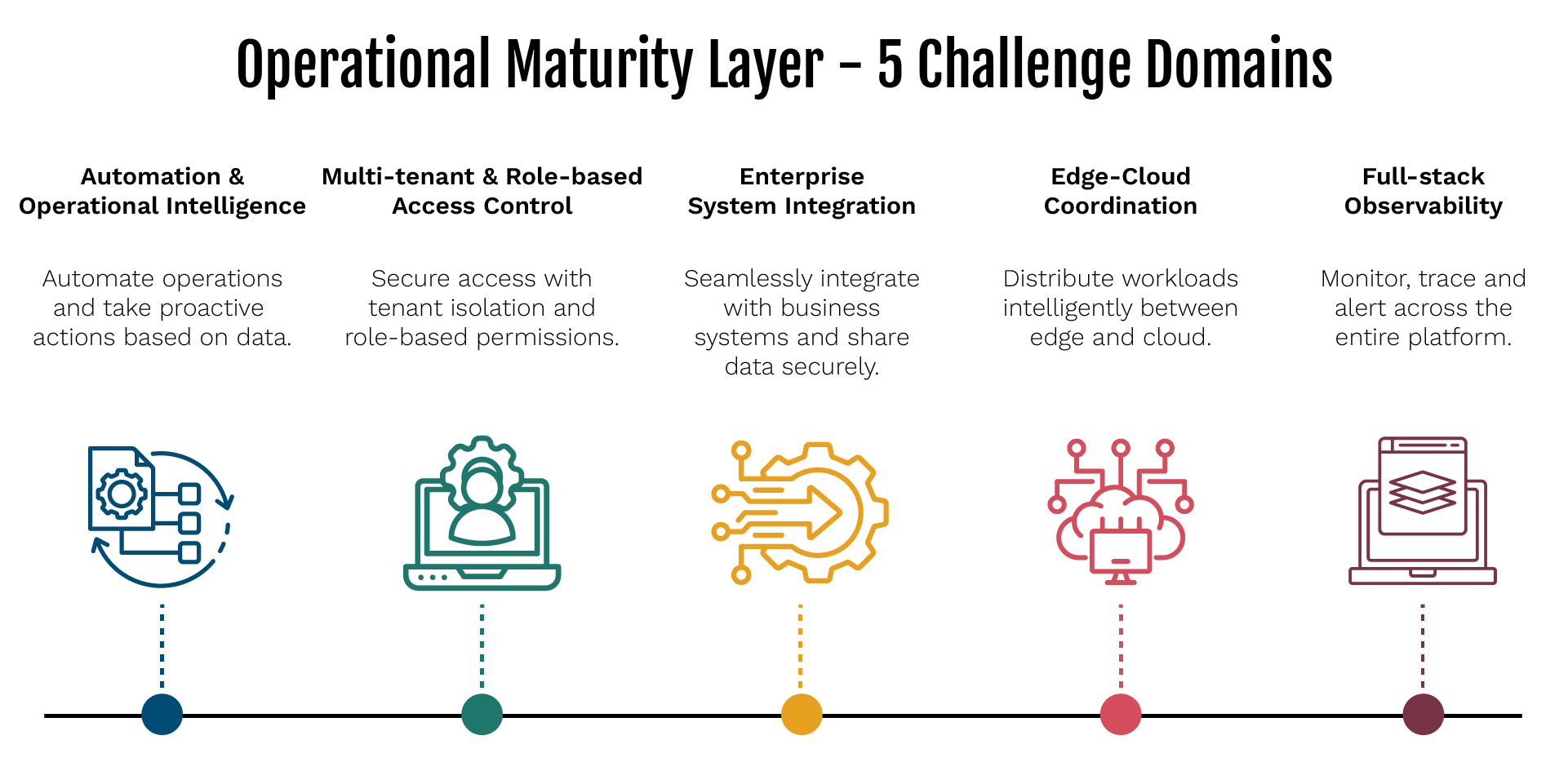
The five challenge domains covered here, automation, access control, enterprise integration, Edge-Cloud coordination, and observability, represent the operational maturity layer of large-scale RDM. Each depends on the infrastructure foundation established in Part 1, and each, in turn, enables higher-order business capabilities: proactive fleet health management, regulatory compliance, enterprise data flow, resilient Edge operations, and rapid incident response.

An Overview
In the first part of this two-part series on IoT Device Management architectures, we highlighted five key challenges:
- How to deal with varying message formats from different types of IoT devices
- How to handle large volumes of data from large numbers of devices
- How to introduce consistency and uniquely identify IoT devices
- How to reliably send and execute commands on edge devices
- How to economically store large amounts of time-series data
However, laying a solid foundation for data exchange and management of IoT devices is only half the battle. Scalable remote device management is the ability to control large IoT fleets through automated, centralized management that remains governable and observable as the system grows. For IoT architects, engineers, and enterprise teams building or operating large-scale RDM platforms, the harder problem is the software that automates data-driven decisions, enforces role-based access control, integrates with existing business applications, coordinates workloads across Edge and Cloud resources, and monitors system performance across a distributed network. As device counts increase, manual administration becomes too slow, expensive, and error-prone to support security, compliance, reliability, and rapid issue resolution. These are the operational intelligence and enterprise integration challenges addressed in this article.
Challenge 6 Automation and Operational Intelligence
The challenges of scaling remote device management
Scaling remote device management depends on strong systems and automation rather than manual intervention. As your device count grows, remote device management becomes exponentially more complex.
This is where many organizations run into trouble. What works for 10 devices often breaks down at 100 or 1,000. Suddenly, IT teams must coordinate updates across multiple environments, handle inconsistent connectivity, and maintain visibility into sprawling deployments. As device fleets grow, they also require careful resource planning. Manual processes become not just inefficient, but infeasible, while automation improves operational efficiency and reduces operational expenditures by decreasing on-site support needs.
In many cases, network reliability becomes a limiting factor. Devices in the field may operate across unstable Wi-Fi, cellular, or hybrid networks, making synchronized control difficult. At the same time, each endpoint increases the attack surface, which raises the stakes for security, compliance, and access control.
Architectural Impact
Without automation, operational costs scale linearly with the fleet size. Field technician dispatches for faults that could be handled through remote remediation and remote troubleshooting represent a significant and avoidable expense, and real-time diagnostics reduce downtime by letting IT teams fix software issues when physical access is limited. A reactive-only posture increases device downtime and, in medical or industrial contexts, creates safety and compliance exposure.
Solution: Rule Engines and Predictive Operational Intelligence
Automating RDM operations means moving from manual intervention by a data scientist to a sequence of policy engines each handling a different class of tasks. Deterministic rule-based engines are optimal for handling known faults and thresholds are ideal for monitoring operational SLAs for data scientists. For early anomaly detection prior to data load, Machine Learning based models can be used to generate warnings.
- Implement an Event-Condition-Action (ECA) framework that evaluates telemetry events against configurable rule sets and triggers automated workflows: restart, firmware updates, firmware rollback to the last known device configuration after a failed update, ticket creation, or escalation
- Deploy policy-driven fleet management workflows for staged rollouts: canary deployments to a device cohort, automated health checks, phased rollout through progressive cohorts to catch anomalies early, progressive fleet expansion, and automatic rollback on failure threshold breach
- Integrate ML inference pipelines that score device health metrics in real time, flagging devices with elevated failure probability for proactive maintenance before failure occurs
- Implement configuration drift detection, comparing deployed device state against the intended configuration baseline and auto-remediating detected deviations
- Maintain an automation audit log that records every automated action, the triggering condition, the rule that was fired, and the outcome.
This is essential for regulatory compliance and debugging.
Challenge 7 Multi-tenant and Role-based Access Control
Problem Statement
Security in Enterprise IoT Networks requires multiple levels of access for multiple stakeholders i.e., platform administrators, fleet operators, field technicians, third-party service providers, auditors, etc. Every problem has a unique set of stakeholders and a set of devices / things they need to access, along with sensitive device data and sensitive data that must be protected. In a multi-tenant environment (SaaS IoT platforms, shared data center infrastructure, etc.), it is particularly important to enforce tenant isolation at both the data and control planes. This means, for example, that information or access to devices and things owned by Tenant A should never be accessible to Tenant B, since poor isolation can expose data to unauthorized parties beyond tenant boundaries.
Architectural Impact
Absence of granular access control creates both security risks and compliance failures, underscoring the need for robust security measures that prevent over-privileged access. Over-privileged service accounts become high-value attack targets. Insufficient tenant isolation in multi-tenant architectures can expose sensitive device data across organizational boundaries, a critical failure in regulated industries, so stronger isolation and access constraints help mitigate security risks. In healthcare and industrial deployments, access control gaps are not merely security incidents; they are regulatory violations.
Solution: Layered RBAC/ABAC Access Architecture
- For production IoT systems, a production-ready access control architecture could include a combination of Role-Based Access Control (RBAC) to provide coarse-grained access control and Attribute-Based Access Control (ABAC) to provide fine-grained, context-aware decisioning for specific subsets of devices or geographic locations. RBAC asks what a role can perform. ABAC asks under what conditions that role can perform it.
- Define role hierarchies (platform admin > tenant admin > fleet operator > field technician > read-only auditor) with explicit permission sets for device read, command dispatch, firmware management, and configuration modification
- Implement ABAC policies that evaluate device attributes (region, device class, risk level, fleet tag) and device credentials alongside user attributes (role, tenant membership, active shift) to make access decisions
- Enforce tenant isolation at the data layer using row-level security in databases and tenant-scoped Kafka topics, never rely solely on application-layer filtering
- Apply just-in-time (JIT) privileged access for sensitive operations (factory reset, certificate revocation) requiring multi-party approval workflows
- Issue unique cryptographic identities during manufacturing or first boot so only authorized devices become authorized devices before enrollment
Challenge 8 Integration with Enterprise Systems
Problem Statement
A remote device management platform does not work in isolation. Data from the device management platform needs to be incorporated into an asset management system, in both real and historical forms. Events from the platform need to be surfaced with the billing systems. Insight derived from the device’s telemetry needs to be incorporated into the CRM or ERP systems, because an IoT ecosystem only creates value when connected device data flows into business systems. We see too many cases of IoT platforms generating significant amounts of data that never make it to places where it can generate .
Architectural Impact
Point-to-point integrations between the RDM platform and each enterprise system create a brittle dependency mesh across multiple locations. All schema changes, API version updates, and platform migrations affect more than just one integration point, while decoupled messaging relies on lightweight protocols and event-driven message queues to avoid brittle integrations. The cost of maintaining all of these integrations grows superlinear with the number of individual software systems that are integrated to solve a larger computing problem. This means that the cost of integrating all of the systems on an IoT enabled workflow exceeds the available engineering capacity to maintain the integrations, at some point.
Solution: API-First Microservices Integration Architecture
- Enterprise integration for IoT platforms is best addressed through a combination of standardized APIs, event streaming, and integration middleware that decouples the RDM platform from its consumers and producers. The platform should act as an event producer and API provider, not an integration hub.
- Expose all RDM platform capabilities through versioned REST and/or GraphQL APIs, with OpenAPI specifications governing the integration contract and breaking changes managed through deprecation windows
- Publish device lifecycle events (provisioned, activated, firmware updated, decommissioned) to an integration event bus (Apache Kafka, AWS EventBridge) that downstream enterprise systems consume independently; for provisioned states, use zero-touch enrollment as the standardized registration path, and zero-touch provisioning can complete device setup right out of the box through remote configuration
- Use integration middleware (MuleSoft, Azure Integration Services, Apache Camel) to handle protocol translation, data transformation, and orchestration without embedding business logic in the core RDM platform
- Implement webhook delivery for systems that cannot consume streaming events natively, with retry logic, HMAC signing for authenticity, and delivery audit logs
- Apply the strangler fig pattern when migrating existing point-to-point integrations to the event-driven model, to ensure incremental replacement without a full cut-over
The RDM platform should be an event producer and API provider, not an integration hub. Downstream systems have the responsibility of consuming and acting on events in their own bounded contexts.
Challenge 9 Edge-to-Cloud Coordination
Problem Statement
Not all IoT workflows are best run in the Cloud. Many local control loops will not tolerate the latency associated with a Cloud based architecture. In some cases the costs and network bandwidth required to send all raw sensor telemetry across the ‘nats’ or to the Cloud for processing exceeds reasonable budgets. Nevertheless, Cloud-based centralized services are often needed to support fleet-wide analytics, cross-device policies, firmware servicing, and long term data storage. Scaling large device fleets also requires careful planning of bandwidth and compute resources.
Architectural Impact
Cloud-first systems suffer from latency, bandwidth, and resilience problems. Edge-first systems lack the remote monitoring needed to keep distributed devices visible and coordinated for fleet management.
Solution: Hierarchical Hybrid Edge-Cloud Architecture
- Automating RDM operations means moving from manual intervention by a data scientist to a sequence of policy engines each handling a different class of tasks. Deterministic rule-based engines are optimal for handling known faults and thresholds are ideal for monitoring operational SLAs for data scientists. For early anomaly detection prior to data load, Machine Learning based models can be used to generate warnings. For production IoT systems, a production-ready access control architecture could include a combination of Role-Based Access Control (RBAC) to provide coarse-grained access control and Attribute-Based Access Control (ABAC) to provide fine-grained, context aware decisioning for specific subsets of devices or geographic locations. RBAC asks what a role can perform. ABAC asks under what conditions that role can perform it.
- Deploy Edge gateway agents that perform local telemetry filtering and aggregation, forwarding only anomalies, summaries, or threshold-breached values to the Cloud thereby dramatically reducing egress bandwidth and latency
- Implement local rule evaluation on Edge gateways for safety-critical responses (emergency shutdown, fault isolation) that must be executed regardless of Cloud connectivity
- Use a store-and-forward pattern on Edge nodes to buffer telemetry during Cloud disconnection, replaying it in order upon reconnection with appropriate timestamps
- Maintain a synchronization protocol between Edge device twins and Cloud device twins, using a desired-versus-reported state model to spot configuration drift and resolving conflicts with configurable merge strategies (Cloud-wins, Edge-wins, or last-write-wins with version vectors)
- Implement over-the-air update orchestration for device deployment from Cloud to Edge gateway to leaf devices in a hierarchical cascade, enabling firmware management without direct Cloud-to-leaf-device connectivity
Challenge 10 Observability and System Reliability
Problem Statement
Modern distributed IoT management platforms consist of dozens of interacting microservices, message queues, stream processors, databases, and Edge nodes. Failures at this scale do not happen often, but when they do, time is of the essence. Understanding what went wrong, including current device status, as quickly as possible is critical to keep the downtime as short as possible. Without sufficient observability, excessive debugging will be performed by brute force trial and error, leading to even more downtime and more likely to cause secondary failures that affect device performance.
Architectural Impact
Reduced incident response time is beneficial for proactive capacity management, early detection of potential issues before they fail, accurate reporting of SLAs to customers, and observability based on telemetry data. In regulated environments, even without an attack occurring, the lack of system-level audit trails can put organizations at risk of non-compliance, while real-time dashboards provide visibility into device health and compliance and aggregated telemetry helps surface anomalies before broader outages.
Solution: Full-Stack Observability Framework
- There are three key data streams used for observability in distributed systems: logs, metrics, and traces with alerting and SLO-based monitoring on top of them. It is cheaper to build monitoring tools into the initial architecture than it is to add monitoring to an already running production environment, especially because observability supports ongoing system management as the platform grows. Centralized structured logging: All services emit JSON formatted logs with the same set of fields (service name, device id, correlation id, log level, timestamp), and those logs from connected devices are sent to a log management and search service (Elasticsearch/OpenSearch, Splunk, Datadog Logs, etc.).
- Distributed Tracing: Equip all services with OpenTelemetry SDK, propagating trace context across service boundaries, message queues, and Edge-to-Cloud hops to reconstruct end-to-end request flows
- Metrics and SLO Monitoring: Expose Prometheus-compatible metrics from all services (ingestion rate, processing lag, command delivery latency, error rates), visualize in Grafana, and define SLOs with error budgets for proactive reliability management
- Proactive Alerting: Define alert rules based on SLO burn rate, not just threshold breaches, to catch reliability degradation before SLA violations occur
- Runbook Automation: Link alerts to automated remediation runbooks (restart unhealthy pods, scale consumer groups, clear stuck queues) to reduce MTTR without requiring human intervention for known failure modes
Observability is not a monitoring dashboard, it is the property of a system that allows engineers to understand its internal state from external outputs. It must be designed in, not bolted on.
Part 2 Architecture Summary
The table below summarizes the five operational and intelligence-layer challenges covered in this article, mapped to their design patterns and primary technology stacks that collectively support scalable device management.
| Challenge Domain | Design Pattern | Key Technologies |
| Operational Intelligence | ECA Rule Engines with ML Prediction Pipelines | Apache Flink CEP, ML Inference, OTA Orchestration |
| Access Control | Layered RBAC/ABAC with Tenant Isolation | OIDC/SAML, OPA, Row-Level Security |
| Enterprise Integration | API-First with Event Streaming | REST, GraphQL, EventBridge, MuleSoft |
| Edge-Cloud Coordination | Hierarchical Hybrid with Shadow Sync | Edge Gateways, Store-and-Forward, OTA Cascade |
| Observability | Full-Stack Logs + Metrics + Traces + SLOs | OpenTelemetry, Prometheus, Grafana, ELK |
Complete Series Reference
The full ten-challenge architecture map across both parts of this series, for consolidated reference.
| Challenge Domain | Design Pattern | Key Technologies |
| Protocol Fragmentation | Protocol Abstraction Layer | MQTT, Kafka, Avro, Schema Registry |
| Ingestion Scalability | Distributed Stream Processing | Kafka, Flink, Kinesis, Spark Streaming |
| Device Identity | Zero-Trust PKI Architecture | X.509 PKI, OCSP, TPM, mTLS |
| Real-Time Control | Event-Driven Bidirectional Command Architecture | MQTT QoS 2, Rule Engines, Shadow State |
| Data Management | Hot-Warm-Cold Tiered Storage | InfluxDB, Parquet/S3, Glacier, Avro |
| Operational Intelligence | ECA Engines with ML Prediction | Flink CEP, ML Inference, OTA Orchestration |
| Access Control | Layered RBAC/ABAC with Tenant Isolation | OIDC/SAML, OPA, Row-Level Security |
| Enterprise Integration | API-First with Event Streaming | REST, GraphQL, EventBridge, MuleSoft |
| Edge-Cloud Coordination | Hierarchical Hybrid with Shadow Sync | Edge Gateways, Store-and-Forward, OTA Cascade |
| Observability | Full-Stack Logs + Metrics + Traces + SLOs | OpenTelemetry, Prometheus, Grafana, ELK |
Series Conclusion
Taken together, the ten challenges addressed across this two-part series constitute a comprehensive reference architecture for scalable remote device management. Part 1 established the infrastructure layer, the foundational systems without which no higher-order capability can function reliably.
Part 2 addressed the operational intelligence and enterprise integration layer, the capabilities that transform reliable infrastructure into a governable, observable, and business-integrated platform.
The design patterns presented here share a common architectural philosophy: decoupled components with well-defined interfaces, independent scalability at each layer, security enforced at the infrastructure level rather than the application level, and observability instrumented from day one rather than retrofitted under pressure. These are not aspirational principles they are engineering requirements at the scale that modern IoT deployments demand.
Looking forward, the trajectory of RDM architecture is clear: intelligence will move progressively toward the Edge, AI-driven orchestration will displace manual policy authoring, and autonomous device ecosystems that are capable of self-healing, self-provisioning, and self-optimizing within defined safety boundaries, will become the operational norm. Architectural teams that build these principles into their platforms today, including mature lifecycle design with secure decommissioning through certificate revocation and wiping sensitive data, will be positioned to absorb that evolution without disruptive re-platforming.
Frequently Asked Questions
1. What are the most important architectural patterns for scalable IoT device management?
Scalable IoT device management requires a combination of architectural patterns rather than a single technology. Key patterns include protocol abstraction, distributed stream processing, zero-trust device identity, event-driven command execution, tiered data storage, automation through rule engines, layered RBAC/ABAC security, API-first integration, Edge-Cloud coordination, and full-stack observability. Together, these patterns help organizations manage large device fleets securely, reduce operational costs, improve reliability, and support future growth without requiring major platform redesigns.
2. Why is Edge-Cloud coordination important in remote device management?
Edge-Cloud coordination allows organizations to balance performance, reliability, and cost. Time-sensitive operations such as safety responses, local analytics, or fault isolation can run at the Edge, while centralized functions such as fleet management, long-term storage, and advanced analytics remain in the Cloud. This architecture reduces network bandwidth usage, minimizes latency, and enables devices to continue operating during connectivity disruptions. As IoT deployments scale, effective Edge-Cloud coordination becomes essential for resilient and efficient device management.
3. How does observability improve the reliability of large-scale IoT deployments?
Observability provides visibility into the health and behavior of distributed IoT systems through logs, metrics, traces, and automated alerts. It helps engineering teams quickly identify root causes of failures, monitor service level objectives (SLOs), and detect performance degradation before users are affected. In large-scale remote device management environments, observability reduces mean time to resolution (MTTR), improves uptime, supports compliance requirements, and enables proactive maintenance. Building observability into the architecture from the beginning is more effective than adding monitoring tools later.
4. What is the difference between RBAC and ABAC in IoT access control?
Role-Based Access Control (RBAC) grants permissions based on predefined user roles such as administrator, operator, or technician. Attribute-Based Access Control (ABAC) adds context-aware decision-making by evaluating attributes such as device type, location, risk level, tenant membership, or time of access. In scalable IoT environments, RBAC simplifies permission management while ABAC provides finer control for sensitive operations. Using both together helps strengthen security, support compliance requirements, and enforce tenant isolation across large device fleets.