
Vehicle‑to‑everything (V2X) spans V2V, V2I, V2P, V2N, V2G and V2D. It enables low‑latency awareness and cooperative maneuvers by exchanging kinematics, infrastructure data (SPaT/MAP/TIM), vulnerable road-user alerts, and network intelligence. While most V2X communication use cases focus on safety and traffic efficiency, V2G focuses on energy management and sustainability.
Two radio stacks are used: IEEE 802.11p/ITS‑G5 (aka DSRC) and C‑V2X (LTE sidelink PC5). The real‑world performance depends on congestion control, accurate GPS positioning, and a robust security management, while 5GAA proposes the use of 5G networks for the same.
Types of V2X Communication
- V2V (Vehicle-to-Vehicle) – collision avoidance, cooperative driving. V2X systems can use dedicated short-range communication (DSRC) technology for low-latency, short-distance exchanges between vehicles, supporting safety-critical applications.
- V2I (Vehicle-to-Infrastructure) – traffic signals, road signs, toll booths. Dedicated short range communication (DSRC) is also used for efficient, real-time communication between vehicles and infrastructure.
- V2P (Vehicle-to-Pedestrian) – alerts for pedestrians and cyclists
- V2N (Vehicle-to-Network) – cloud services, OTA, real-time traffic updates. Communication infrastructure, such as cellular networks and roadside systems, plays a crucial role in enabling V2N and V2I functionalities for extended coverage and reliable connectivity.
- V2D (Vehicle-to-Device) – integration with beacons, smartphones, wearables, and other devices such as sensors and IoT components within the mobility ecosystem to enhance safety and efficiency.
- V2G (Vehicle-to-Grid) – enables electric vehicles (EVs) to not only draw power from the grid but also send electricity back to it. This bi-directional energy flow transforms EVs into mobile energy storage units, supporting grid stability and energy efficiency.
ADAS and V2X
V2X Communication and ADAS (Advanced Driver Assistance Systems) both aim to improve safety and efficiency, but they work in vastly different ways. Vehicle-to-Everything (V2X) including V2V, V2I, and V2P gives road users a 360° awareness bubble that works in non line-of-sight conditions and in poor visibility, complementing onboard sensors and ADAS. ADAS is self-contained and is a working technology today, while V2X is a network effect technology implying its value/performance only grows as more vehicles and infrastructure adopt it.
ADAS uses onboard sensors (cameras, radar, and LiDAR) to perceive the environment around the vehicle, but V2X uses wireless communication. ADAS is limited by sensor range (typically 100–250 m) and line of sight and cannot see around corners or through obstacles, however V2X works on co-cooperativeness. V2X has low hardware cost compared to ADAS; it needs first-up investment in terms of spectrum allocation, infrastructure, RSU deployments, etc.
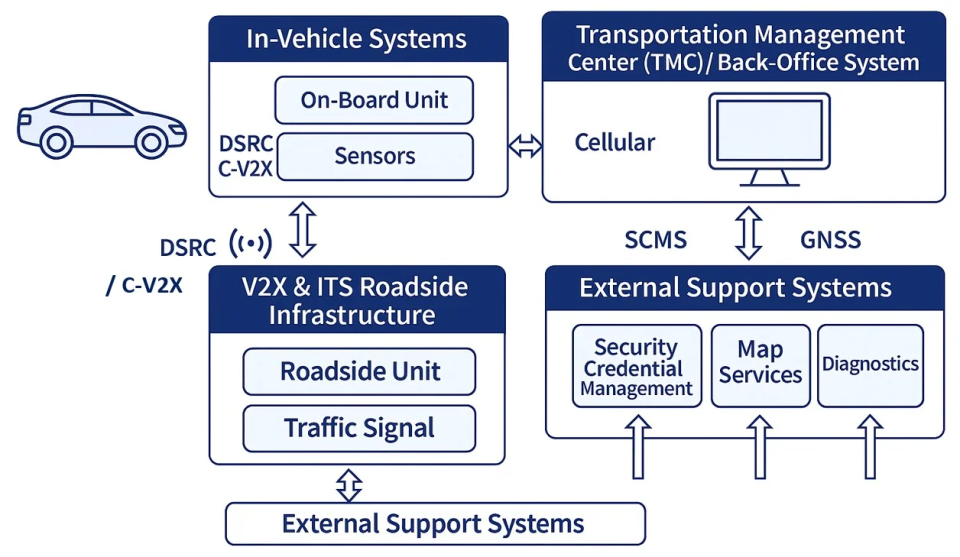
A V2X System Block Diagram
- In-vehicle Systems: In-vehicle systems consist of on-board Units (OBUs), sensors, and interfaces that gather and transmit vehicle data effectively. The real-time data provided by these systems support timely decision-making and operational control.
- Roadside Infrastructure: Roadside units (RSUs) and traffic signals provide real-time updates and enable communication between vehicles and infrastructure.
- Transportation Management Centers: TMCs analyze traffic data centrally and assist in decision-making to improve traffic flow and safety. The data provided by TMCs ensures that operators have comprehensive insights for effective operational control.
- Security Credential Management: SCMS ensures secure, authenticated communication to maintain data integrity and trust across the system.
V2X Basics
- System Components
- On-board unit (OBU) – a device in the vehicle with DSRC/PC5 radio
- Road-side unit (RSU) – a virtual device in the Cloud or physically present at intersection connected to a signal controller
- Radios
- IEEE 802.11p / ITS‑G5 (DSRC): 20 MHz channels at 5.9 GHz
- C‑V2X (LTE sidelink PC5)
- C-V2X Uu link can be used for backhauling connectivity to network server/cell base station for OTA
- V2X Messages
- SAE J2735 for USA: A Basic Safety Message (BSM) includes speed, heading, acceleration and vehicle state, Signal Phase and Timing (SPAT) and a MAP includes the intersection geometry, signal state and timing information, Traveler Information Message (TIM) for weather warnings, work zones, road closures, and detours. BSMs also include vehicle location information, which enhances situational awareness for all road users.
- ETSI for Europe: CAM, vehicle, and infrastructure messages (periodic) and DENM, event messages like weather, traffic jam, and roadworks warnings
- Encoding: ASN.1 UPER
- V2P protects Vulnerable Road Users (VRUs) by exchanging presence and motion via smartphones/wearables or dedicated beacons. Mobile devices such as smartphones play a key role in enabling V2P communication. Privacy‑preserving design and accurate positioning are critical. It can also assist especially abled pedestrians to get voice/vibration inputs to independently navigate the intersection.
System Constraints/Requirements
- Latency: < 100 ms
- Interoperability
- KPIs: Packet delivery ratio (PDR) vs distance, RSSI, Channel Busy Ratio, jitter
- Range: 1 km
- Antenna and RF: Roof‑mount, MIMO
- Time source: GNSS‑derived UTC.
- Lane‑level accuracy: Differential GNSS/RTK, dead reckoning
- Secure lifecycle: secure boot, OTA, SBOM, data encryption, certificate rotation, and hardware HSM/TPM, Threat analysis and risk assessment (TARA), coordinated vulnerability disclosure, incident response. Protection of sensitive data from hacking, tampering, and data malfunctions is essential to ensure data security and system reliability.
- Geo-fencing algorithm
Applications
- Safety critical (Day-1 use cases): Forward Collision Warning (FCW), Emergency Electronic Brake Lights (EEBL) for any hard braking event in the applicable geo-fence, emergency braking, blind spot assist, Lane Change Warning (LCW), signal prioritization and pre-emption for emergency vehicles, alerts drivers or triggers automatic braking when pedestrians or cyclists are detected. V2X systems provide early warnings and hazard detection to help prevent accidents by enabling vehicles and infrastructure to communicate potential dangers in real time. V2X-enabled services can also facilitate faster roadside assistance during emergencies or breakdowns.
- Informative: Road works, hazards, weather via TIM/DENM. V2X can monitor and alert speeding violations, improving safety and compliance for drivers and fleets.
- Traffic flow: Green light optimization, queue/jam warning, cooperative lane change, and merge. V2X applications can also guide drivers to available parking lot spaces through smart parking solutions, reducing congestion, and improving urban mobility.
- Fleet management: V2X data empowers fleet managers to optimize routes, improve safety, monitor driver behavior (including speeding), and control operational costs. Mobile devices enable real-time monitoring, regulatory compliance, and automated workflows for vehicle inspection and reporting.
- Infrastructure: V2X relies on an IoT ecosystem that includes road sensors, traffic lights, and CCTV cameras, all working together to enhance transportation efficiency and traffic management.
V2X Security
As V2X scales, trust is everything. Systems must authenticate messages from unknown devices and still protect privacy. The U.S. DOT’s Security Credential Management System (SCMS) model and Europe’s C-ITS trust framework converge on public-key infrastructure (PKI), short-lived pseudonym certificates, and misbehavior management as the security backbone. Certificate rotation and short lifetime limit misuse. From a lifecycle perspective, OTA updates, secure boots, and tamper-evidence should be standardized. For the EU, the CRA and RED compliance can help ensure this. Security must be a core feature – budgeting, validating, and auditing. It should be part of typical development workflows.
Validations
- Message integrity: structure against ETSI and SAE-2735 standards (confirm mandatory and optional fields are present and within allowed ranges)
- Functional Validation:
- interoperability
- field trials: urban/highway/rural routes, signal‑challenged areas like dense buildings, forests
- range testing
- periodicity and latency tests
- Security: digital signatures and certificates (PKI-based security), ASN.1 UPER encoding
Challenges and Considerations
- Standardization: global vs regional specifications
- Adoption: Vehicle should be built with OBUs as well as retrofit capabilities
- Technology mandate: CV2X or DSRC
- Infrastructure readiness: Smart roads, edge nodes, safety beacons.
- Regulatory: Spectrum allocation, safety certifications
- Interoperability: New vs legacy vehicles, DSRC vs C-V2X and among stacks from different vendors
SoCs Platforms Used for V2X OBUs/RSUs
- NXP i.MX 6 / i.MX 8 Series
- ARM Cortex-A cores, automotive-grade
- Supports DSRC (IEEE 802.11p) and C-V2X via external radio module integration
- Qualcomm Snapdragon Automotive Platforms
- Integrated C-V2X modem
- Often used in dual-mode OBUs (DSRC + C-V2X)
- Autotalks CRATON2 / PLUTON2
- Dedicated V2X chipsets supporting DSRC and C-V2X
V2X Benefits and Impact
- Safety: 360-degree awareness helps reduce accidents.
- Efficiency: Communicating with infrastructure allows for dynamic routing and traffic flow optimization.
- Sustainability: Integration with EV infrastructure (V2G) smart grids allows for energy efficiency.
The Future Outlook
- 5G and Beyond: Enables low-latency and using available network infrastructure allowing high range benefits and lowering infrastructure setup cost.
- AI and Edge Computing: Allows intelligence in decision-making, predictive analytics, and adaptive routing.
- V2X can play a key role in shaping autonomous mobility and MaaS (Mobility as a Service)
- Current deployment is majorly in China, followed by US and Europe. There is no mandate yet for V2X to be mandatory features in cars like seatbelts or ABS, also uncertainty around technology whether CV2X or DSRC is a major roadblock in growth of this technology.
- For EV space, V2G can play a critical role in smart grids and make them sustainable. Combined with V2X technologies, it will add value to smarter cities, efficient transportation, and help attain a reduced dependence on fossil fuels.